
Copyright 2026 © Leading Tools Industrial Co., Ltd.
All Rights Reserved. Website Design by Awakening Design
CATALOG TYPE
Product Categories
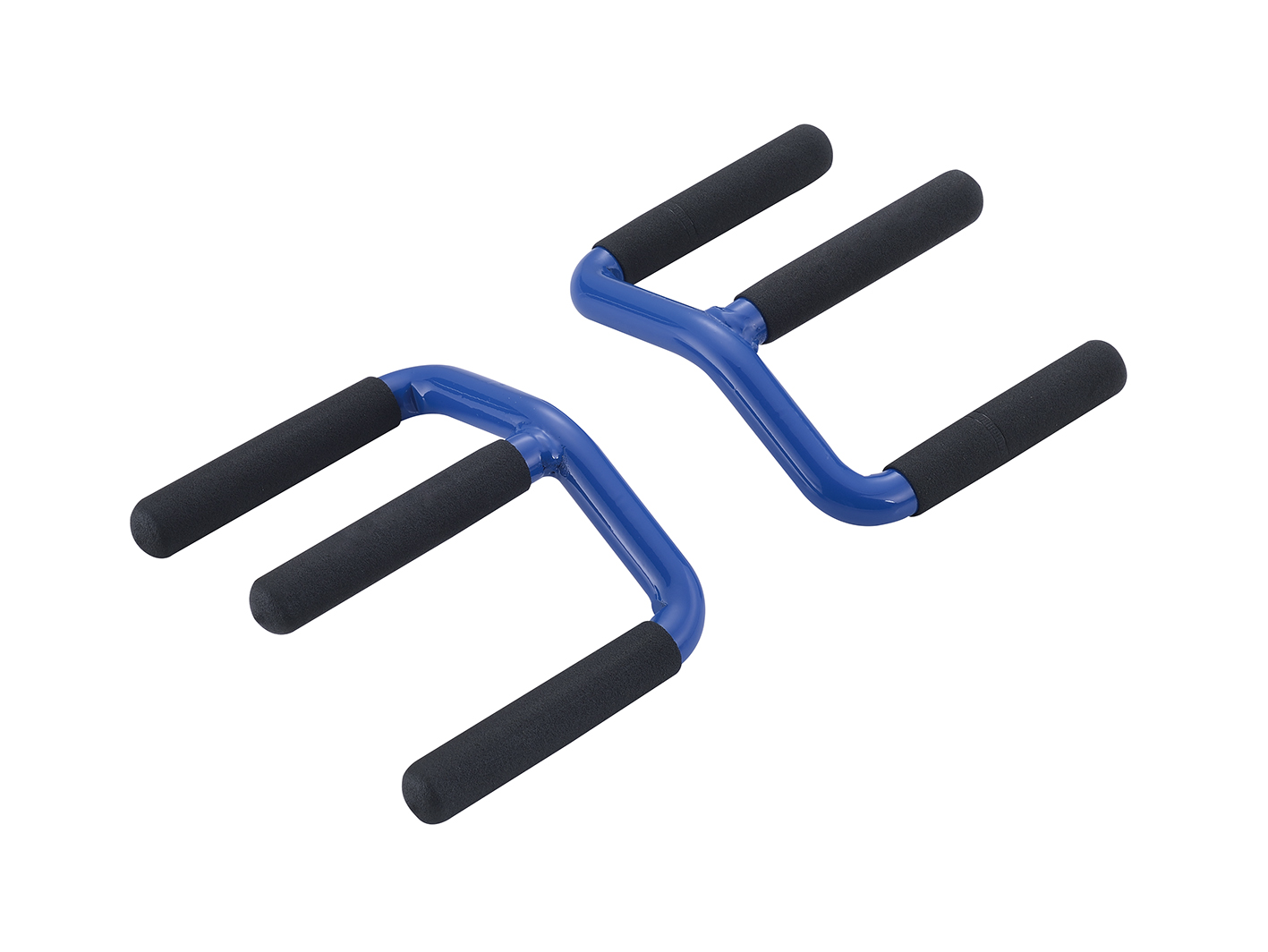
Board Carrier
Product Description
| Item | Detail |
|---|---|
| Product name | Board Carrier |
| Art. Nr | 301175-9, 301175-15 |
| Size | 9mm (301175-9), 15mm (301175-15) |
| Product line | "Builder Tools" range |
| Frame | Blue-finished bent tube frame |
| Contact bars | Three black sleeved bars per unit |
| Selling unit | 1 pc per art number; a two-person carry needs two, so order by quantity |
| Related products in the range | Pro Floor Pull Bar (350003), DIY Floor Pull Bar (350002) |
The Board Carrier is a manual carrying handle for large sheet material: plasterboard and drywall, OSB, plywood, cement board and similar panels. The operator hooks the handle onto the edge of the panel, takes the panel's weight through the handle instead of through a bare-hand pinch grip on the panel edge, and walks the panel from the stack to the point of installation.
The Board Carrier is a site-safety tool. A full-size plasterboard sheet is heavy and awkward to hold. Manual handling aids such as carrying handles reduce plasterboard handling injuries, and where boards have to be carried by hand, this should be a two-person operation.
A note on the two art numbers. The two sizes are 9mm (301175-9) and 15mm (301175-15). For which size suits the boards you carry, contact sales.
It moves the load off the back and onto the legs. The injury that this tool class exists to prevent is the lower-back strain caused by bending at the waist to get fingers under a panel edge and then hugging the panel to the body.
With a carrier, the panel edge is picked up at handle height, the operator can straighten with the knees, and the panel travels beside the body rather than clamped against the chest. Carrying handles are a manual handling aid for plasterboard work.
It makes the two-person carry practical, which is the recommended method. Hand-carried boards should be a two-person operation. Two carriers, one per operator, are the hardware that method needs: one operator at each end of the panel, each taking a defined share of the weight at a defined point. Each art number is one carrier, so order two for a two-person carry.
Simple enough to issue one per operative. There is nothing to adjust, so a contractor can put two in every van rather than one clamp in the store, and the tool that is in the van is the tool that gets used.
Few parts to fail while loaded. A one-piece bent bar has no fasteners to loosen, no spring to lose tension, and no cam to slip on a dusty panel face. Clamp-type carriers depend on a mechanism staying clean and correctly adjusted to the panel thickness; this one does not. The cost of that simplicity is that the operator has to keep hand pressure on the tool for the whole carry.
Sleeving protects both hand and board face. Plasterboard paper faces and pre-finished panel faces mark easily, and bare-metal-on-paper contact over a long carry is how corner and face damage happens before the sheet is even fixed. The sleeves on the contact bars help prevent this.
It keeps the panel edge-on, so the operator can see where they are going. Carried on two handles at the panel's lower edge, the sheet travels vertically beside the operator rather than flat across the front of the body. On a partition job with stacked material and other trades on the floor, sightline is a real safety factor, and it is the single most common reason panels get walked into door frames and window reveals.
It is not a plasterboard-only tool. The same carrier handles OSB and plywood sheathing, cement board and fiber cement panel.
| Situation | Use the Board Carrier? | Why |
|---|---|---|
| Moving plasterboard from the stack to the wall line, same floor, short run | Yes, this is the core case | Panel travels edge-on beside the operator, load taken through the legs |
| Full 1200 x 2400 mm / 4x8 ft sheet, one operator | Use two carriers, two operators | Hand-carried boards should be a two-person operation |
| Heavier grades such as fire-rated or acoustic board | Yes, two-person | These boards are heavier than standard board |
| Long repeated runs across a clear, level slab | No, use a wheeled trolley | Wheels are better for distance and volume |
| Up stairs, onto scaffold, through a doorway sequence | Yes, no trolley alternative | Carriers work where wheels do not |
| Lifting board to a ceiling and holding it there | No, use a panel hoist | Transport tool, not a positioning tool |
| OSB, plywood or cement board sheathing | Yes | The same type of tool is used for OSB as for plasterboard |
| Any panel the operator cannot control at walking pace | No, reduce the load or add a person | If the panel cannot be controlled, the carry is not safe |
| Step | Action | Point to watch |
|---|---|---|
| 1 | Plan the route before touching the panel: check the floor for offcuts and cables, check door widths, agree the set-down point | The most common injury on this task happens when a carry has to be aborted mid-route |
| 2 | Stand at the side of the panel, not square behind the face | If the sheet topples, it should fall away from you, not onto you |
| 3 | Tilt the top of the sheet toward you until the lower edge is clear of the stack | Break the sheet's contact with the stack before taking any weight |
| 4 | Hook the carrier onto the lower edge of the panel so the edge sits between the bars; check it is fully seated before loading it | A part-seated handle will slip off under load |
| 5 | With a second carrier, the second operator hooks on at the opposite end, symmetrically | Both operators the same distance from the panel centre |
| 6 | Bend at the knees, keep the back straight, and lift with the legs on an agreed count | Leg lift, not back lift, the reason the tool exists |
| 7 | Walk at a controlled pace with the panel angled slightly away from the body for sightline; call out stops, turns and steps | Both operators must be able to see and hear each other |
| 8 | Set down by bending the knees again, rest the panel edge on the floor or a batten, then unhook | Never unhook while the panel is still taking your weight |
Treat the two-person carry as the standard, not the exception. Where boards are hand-carried it should be a two-person operation, and with one carrier each, the two operators work with matched hardware at matched positions. The practical rules: both operators the same distance from the panel centre; one person nominated to call the count; no turns without a verbal warning; and no attempt to change grip mid-carry: set the panel down instead.
A single operator can move smaller and thinner panels with one carrier. The limits are real, though: the carrier's arm length may be too short for comfortable clearance, so the sheet fouls the leg on a long carry. A single-operator carry should be short, on a clear floor, with the panel edge-on and the far end under control. If the panel has to be dragged or rested repeatedly, the carry is too long for one person.
This is the case a trolley cannot cover and where the carrier is the only realistic tool. Work slowly and treat the panel as a sail: on scaffold or any exposed elevation, wind on a full sheet will move it and the operators.
On stairs, agree who leads and call every step; agree stopping points at each half-landing; and never carry a panel where the leading operator cannot see the treads. For repeated floor-to-floor movement, staging a stack on each level and carrying short from there is faster and safer than repeat trips.
The same carrier is used for structural sheathing. Two differences matter. First, OSB and plywood sheets have a squarer, harder edge than plasterboard, so seat the handle more deliberately and check it before the lift. Second, cement board and fiber cement are brittle at the edge: carry them with both handles closer to the panel centre than you would on plasterboard, and never let the panel flex under its own weight while suspended between two handles.
Three sentences cover the whole tool: hook it fully onto the lower edge; lift with your legs on a count with your partner; if you cannot see where your feet are going, put it down. Everything else is route planning.
Q1: What do I get with one article number, and what do 9 mm and 15 mm mean?
A: One article number is one carrier (1 pc); a two-person carry needs two, so order by quantity. The two sizes are 9 mm and 15 mm; for what the size refers to and which size suits the boards you carry, please contact Leading Tools sales.
Q2: Can one person carry a full sheet with one carrier?
A: Hand-carried boards should be a two-person operation, and acoustic and fire-rated sheets are heavier still. Physically possible is not the same as advisable, so use two carriers and two operators for full sheets.
Q3: Will it mark the board, and can I use it on OSB or cement board?
A: The contact bars are sleeved, and the real damage risk comes from the panel edge, so seat the handle fully, do not drag the lower edge along the floor, and keep the sheet from flexing during the carry. This tool class is used for plasterboard and OSB alike; seat the handle more carefully on hard-edged sheathing, and keep the handles closer to the centre on brittle cement board.
Q4: The board keeps slipping off, or the sheet keeps hitting my leg. What can I do?
A: Slipping is almost always a handle that is not fully seated on the panel edge, or two operators standing at different distances from the panel centre so the panel is twisted instead of lifted; set down, reseat both handles, match positions and lift on a count. The sheet hitting your leg is a known limit of one-person carries, and the fix is a two-person carry with two carriers, or a trolley for longer runs.
Q5: Should I use this, a clamp-type carrier or a trolley?
A: A clamp-type carrier holds the panel without continuous hand pressure and adjusts to a thickness range, but it has a mechanism to keep clean and adjust; the fixed-prong carrier has nothing to adjust. Use a trolley for long repeated runs on clear level floors, and carriers for stairs, scaffold, tight routes and the last few metres.
| Property | Detail |
|---|---|
| Construction | One-piece bent tube frame |
| Frame material | Blue-finished bent tube |
| Finish | Blue |
| Moving parts | None, no clamp, spring, cam, pivot or fastener |
| Property | Detail |
|---|---|
| Number of bars | Three per unit |
| Bar covering | Black sleeve on each bar |
| Function of the bars | Three sleeved bars; hook the panel edge between the bars |
| Sleeve material | Contact sales |
| ART. Nr | Size |
|---|---|
| 301175-9 | 9mm |
| 301175-15 | 15mm |
| ART. Nr | Size |
|---|---|
| 301175-9 | 9mm |
| 301175-15 | 15mm |
For which of the two sizes suits the boards you carry, contact Leading Tools sales.
| Tool | Mechanism | Where it wins | Where it loses |
|---|---|---|---|
| Board Carrier (this product) | Fixed frame, hand-held; no clamping mechanism | Nothing to adjust or service; two carriers support the recommended two-person carry | Operator maintains grip pressure throughout the carry; no self-locking |
| Spring-clamp carrier | Spring clamp, adjustable to panel thickness | Handles a wide thickness range from one tool | More parts to keep clean and set than a fixed-prong carrier |
| Lever-locking clamp | Lever cam; grip increases with panel weight | One-hand carry without continuous squeeze; heaviest panels | Mechanism must stay clean; thickness-specific models |
| Wheeled panel trolley | Wheels; panel travels vertically | Long runs and high volume, the better method for distance | Needs a clear, level route; useless on stairs and scaffold |
| Panel hoist / board lifter | Geared lift | Ceiling fixing and overhead work | Positioning tool, not a transport tool |
In short: it is the transport tool for the last few metres, on floors that a trolley cannot cross, simple enough that every operative can have one. For long repeated runs across a clear slab, a trolley is the better answer.
Each art number is one carrier (1 pc). The recommended carrying method is a two-person carry, which needs two carriers, so order by quantity: two for each crew that carries full sheets.
All art numbers in the Leading Tools Board Carrier range:
| ART. Nr | Size | Frame material | Grip / contact bars |
|---|---|---|---|
| 301175-9 | 9mm | Blue-finished bent tube, one piece | Three black sleeved bars per unit |
| 301175-15 | 15mm | Blue-finished bent tube, one piece | Three black sleeved bars per unit |
Two art numbers total. The Size column gives the nominal size for each art number.

In compliance with EU personal data protection laws, we are committed to protecting and providing you with control over your personal data. By clicking "Accept All", you allow us to place cookies to enhance your experience on this site, help us analyze site performance and usage, and enable us to deliver relevant marketing content. You can manage your cookie settings below. By clicking "Agree" you agree to the current settings. For more information, please visit the Privacy Statement.
This website uses cookies
In compliance with EU personal data protection laws, we are committed to protecting your personal data and providing you with control over it. By clicking "Agree", you allow us to place cookies to improve your experience on this site, help us analyze site performance and usage, and allow us to deliver relevant marketing content.
By clicking "Only necessary" you allow us to place only necessary cookies. The website cannot function without these cookies and you cannot switch them off on your system. These cookies are typically set only in response to an action you perform (i.e. a service request), such as setting privacy preferences, logging in, or filling in a form. You can set your browser to block or prompt you for these cookies, but this may prevent some site features from working.