
Copyright 2026 © Leading Tools Industrial Co., Ltd.
All Rights Reserved. Website Design by Awakening Design
CATALOG TYPE
Product Categories
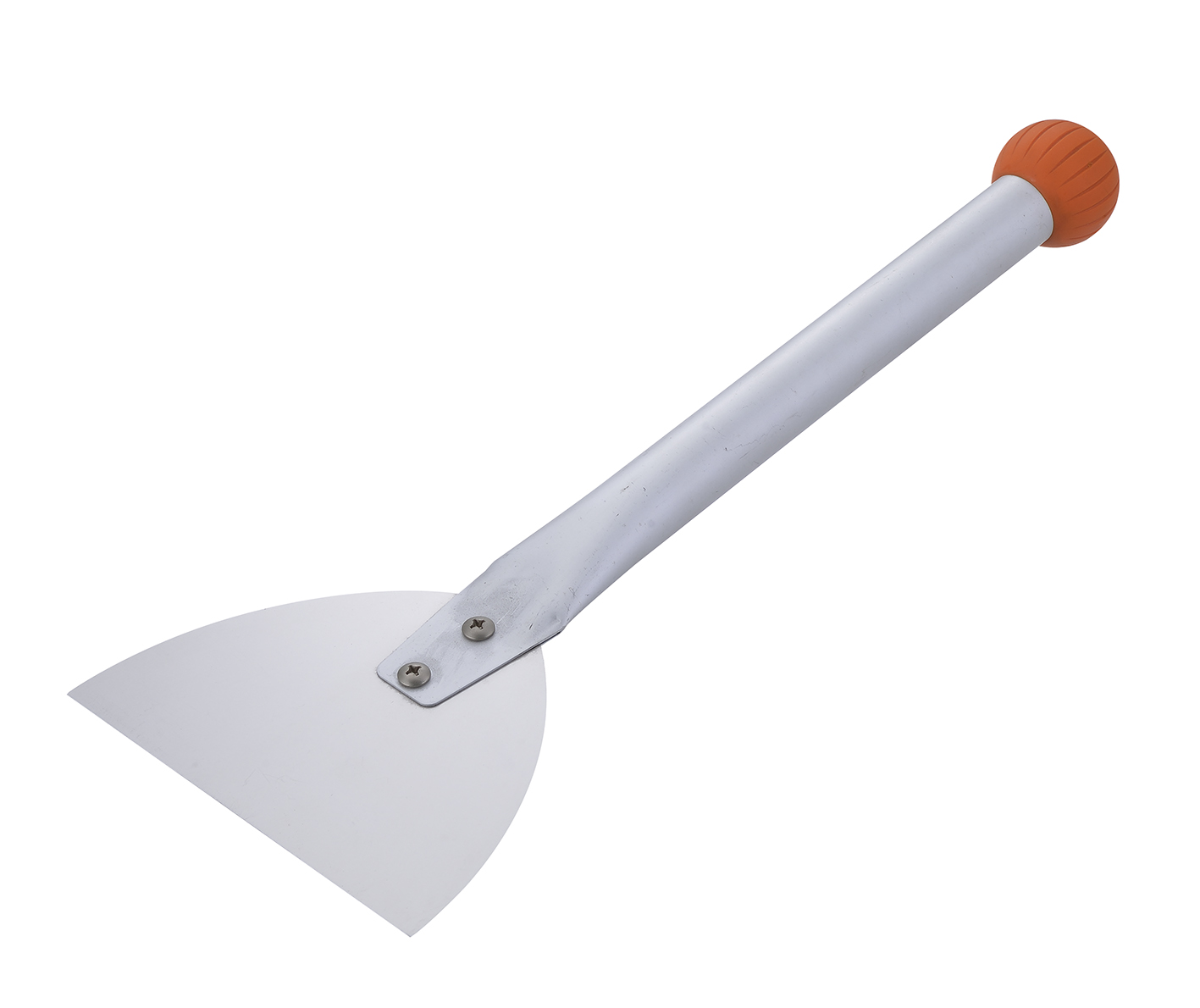
Broad Knife
Product Description
Broad Knife
| Item | Detail |
|---|---|
| Product name | Broad Knife |
| Article number | 300495, the only article number in this product line |
| Size | 180 mm (approx. 7 in, at 1 in = 25.4 mm) |
| Blade material | Stainless Steel |
| Handle | Aluminum Handle |
| Product family | Scraper, the same family also carries the 314124 Carbon Steel Scraper (100 mm) |
| Tool category | Long-handled broad knife / wipedown knife: a wide, fan-shaped blade on a straight tube handle, used for spreading and wiping down compound and for scraping |
Where it sits in the Leading Tools range. Leading Tools places 300495 in the Scraper family, alongside the 314124 Carbon Steel Scraper, and not in the taping-knife family. That placement is a useful signal for buyers: this is a spreading-and-scraping tool with a handle you push with, not a finishing knife you feather with.
| Situation | Use 300495? | Why |
|---|---|---|
| Wiping down ceiling joints after an automatic taping tool | Yes | The handle supplies the working height |
| Spreading skim plaster in small areas | Yes | Broad flat blade suits spreading |
| Finishing plasterboard tape joints | Yes | Broad flat blade suits plasterboard tape-joint finishing |
| Light scraping of adhesive and old coatings on floors and walls | Yes, light work | Leading Tools lists 300495 in the Scraper family |
| Filling screw holes and small patches | No, use 316808 (8 in) or 310812–310816 | Those are the smaller Leading Tools taping knives |
| Final feathering across a finished joint | No, use 316812 / 316814 (12 in, 14 in) | Feathering is the wide taping knife's job |
| Prying, levering, chopping | No | Not a demolition tool |
| Step | Action | Note |
|---|---|---|
| 1 | Load the blade from a hawk or straight from the bucket with a smaller knife | Standard plastering practice |
| 2 | Set the blade at approximately 30–45° to the surface | Typical angle for spreading and smoothing |
| 3 | Apply firm, even pressure and hold the angle steady through the stroke | Uneven pressure or a changing angle produces uneven material distribution and surface scratches |
| 4 | Move in slow, steady, constant-speed strokes | Speed control is what makes the material bond evenly |
| 5 | Overlap strokes slightly; do not overlap heavily | Heavy overlap builds ridges |
| 6 | Skim off surplus as you go rather than at the end | |
| 7 | For the finishing pass, change down to a narrower knife or up to a 316812 / 316814 (12–14 in) taping knife as the coat requires | The trade progresses narrow → wide across coats |
| 8 | Clean the blade before the compound cures on it | Cleaning discipline is what separates a stainless blade that stays flat from one that does not |
A long-handle broad knife can be used for this job. After an automatic taping tool has laid tape and compound into a ceiling joint, the wipedown knife follows it to press the tape down and wipe the surplus off the joint. The tube handle supplies the height so the operator is not on stilts or a bench for every seam. Work along the joint in the direction the taper ran, hold the 30–45° angle, and keep the pressure constant so the compound behind the tape is not pulled out.
This blade form spreads and levels filler and plaster. Load the blade, set it at 30–45°, and lay the coat in slow, steady, overlapping strokes at constant pressure. The 180 mm edge covers more per stroke than the 120–160 mm knives used for patching and first coats, but it is not the feathering tool; plan on a 316812 / 316814 (12–14 in) knife for the final blend if the specification calls for one.
For finishing taped plasterboard joints the working method is the same as for spreading: 30–45°, constant pressure, steady speed, no snatching. Because the blade is stainless, the risk of rust staining the compound between coats is low, which matters on a joint that will be seen under paint; still rinse and dry the blade rather than leaving it soaking.
The 300495 can be used for light scraping of adhesive and coating residue on floors and walls. Note that this is scraping, not spreading. Work at a steeper angle than the spreading angle, push from the handle rather than pulling with the wrist, and take overlapping passes across the area. Leading Tools' own placement of 300495 in the Scraper family supports this use.
Q1. Is 300495 a taping knife or a scraper?
Neither exactly, it is a broad knife, filed under Scraper by Leading Tools. It is sold for two overlapping jobs: spreading and wiping down compound and plaster, and scraping adhesive and coatings off floors and walls. If you need a knife purely for taping and feathering, the Leading Tools taping knives (310812–310822, 316808–316814, 316608–316614) are the right tools.
Q2. Is the blade stiff or flexible?
Blade thickness and stiffness are not listed in the catalog. Please contact us if stiffness is critical to your application.
Q3. Why stainless steel, and how do I keep it clean?
Stainless has high corrosion resistance and cleans easily, which makes it the lower-risk choice for a tool that will meet plaster and compound and then go into a bag.
It still needs rinsing before the mix cures, because the failure to avoid is hardened material on the blade face. High corrosion resistance and low upkeep; chlorinated water, coastal air or prolonged soaking can still cause rust spots, so rinse with clean water and dry after use.
Q4. What angle should I hold it at?
Approximately 30–45° to the surface for spreading and smoothing, moving slowly and evenly and holding the pressure constant. Uneven pressure or a shifting angle gives uneven material distribution and surface scratches.
Q5. Can I use it as a pry bar or lever?
No. It is a spreading and scraping tool, and levering puts loads on the handle joint and the blade that neither is built for. For dry, aggressive removal, the 314124 carbon steel scraper in the same range is the intended tool.
| Attribute | Detail |
|---|---|
| Blade width | 180 mm (approx. 7 in) |
| Blade material | Stainless Steel |
| Blade profile | Fan-shaped: full-width straight working edge, tapering rearward to a narrow tang |
| Working edge | Straight, square-cut, full 180 mm width |
| Edge grind | Single-sided bevel |
Why stainless matters here. The materials this knife is designed to move are wet and alkaline: all-purpose joint compound is a water-based paste, and gypsum plaster is calcium sulfate. Stainless is preferred over carbon steel here because it has high corrosion resistance and cleans up easily, while carbon steel must be wiped dry and thinly oiled after use to avoid rusting.
| Attribute | Detail |
|---|---|
| Handle material | Aluminum |
| Handle form | Straight round tube, smooth (not contoured, not a molded grip) |
| Handle end | Ball knob cap closing the tube end |
| Handle-to-blade attachment | Fixed with two screws through a flattened tube end to the blade tang |
| Hanging hole | None on 300495 |
| Blade width | Class | Typical use |
|---|---|---|
| 120–160 mm | Taping knife (310812–310816) | Patching compound, screw holes, first coats over tape |
| 180 mm (approx. 7 in) — 300495 | Broad knife (this product) | Broad-area spreading, wipedown, ceiling work, light scraping |
| 203–356 mm (8–14 in) | Taping knife (316808–316814, 316608–316614) | Bedding, leveling and final feathering across a finished joint |
180 mm is wide enough to be a meaningful step up from a 120–160 mm taping knife, and narrow enough to stay controllable in one hand at the end of a tube handle.
Blade thickness and stiffness are not listed in the catalog. Please contact us if they are critical to your application.
| Stainless — 300495 | Carbon / blue carbon steel | |
|---|---|---|
| Corrosion | High corrosion resistance; chlorinated water, coastal air or prolonged soaking can still cause rust spots | Rusts unless wiped dry and thinly oiled after use |
| Cleaning burden | Low, rinse and dry | Higher, clean immediately, then protect |
| Flexibility | Contact us | See the taping knife series |
| Typical use | Ceiling joint wipedown, tape-joint finishing, wet-mix spreading | Hand feathering with a flexible blade (see the taping knife series) |
The drywall-knife convention is progressive: start narrow, finish wide. A narrower knife (316808 at 8 in, or 310812–310816) handles patching compound and screw holes; the final feathering passes are made with a 316812 / 316814 (12–14 in) knife so the joint edge blends away. At 180 mm, 300495 sits between those two roles: too wide for screw-hole work, too narrow to be the dedicated feathering knife, which is exactly why it is sold as a spreading and wipedown tool rather than as either.
Leading Tools lists one article number for Broad Knife.
| Art. Nr | Size | Blade material | Handle | Blade profile | End cap | Hanging hole |
|---|---|---|---|---|---|---|
| 300495 | 180 mm (approx. 7 in) | Stainless Steel | Aluminum tube | Fan-shaped, straight full-width edge | Ball knob | None |
Same-range cross reference: the other article number in the Scraper line:
| Art. Nr | Product name | Size | Blade material | Handle | Hanging hole |
|---|---|---|---|---|---|
| 314124 | Scraper | 100 mm | Carbon Steel | Wooden | Yes |
Stainless is the easier of the two blade materials to live with: it has high corrosion resistance and cleans up easily, which is why it suits users who cannot clean tools immediately. Blue carbon steel must be wiped dry and thinly oiled after use or it rusts.
It is not zero maintenance: cured compound left on the blade will still build up and affect how flat the blade runs. High corrosion resistance and low upkeep; chlorinated water, coastal air or prolonged soaking can still cause rust spots, so rinse with clean water and dry after use.
| Situation | Recommendation |
|---|---|
| Workshop / van rack | Lay flat with nothing on the blade |
| Tool bag | Fit an edge guard or wrap the edge; the blade shares the bag with everything else |
| Vehicle overnight | Dry the tool first; stainless has high corrosion resistance, but long exposure to damp can still cause rust spots |
| Long term | Clean, dry, store flat |

In compliance with EU personal data protection laws, we are committed to protecting and providing you with control over your personal data. By clicking "Accept All", you allow us to place cookies to enhance your experience on this site, help us analyze site performance and usage, and enable us to deliver relevant marketing content. You can manage your cookie settings below. By clicking "Agree" you agree to the current settings. For more information, please visit the Privacy Statement.
This website uses cookies
In compliance with EU personal data protection laws, we are committed to protecting your personal data and providing you with control over it. By clicking "Agree", you allow us to place cookies to improve your experience on this site, help us analyze site performance and usage, and allow us to deliver relevant marketing content.
By clicking "Only necessary" you allow us to place only necessary cookies. The website cannot function without these cookies and you cannot switch them off on your system. These cookies are typically set only in response to an action you perform (i.e. a service request), such as setting privacy preferences, logging in, or filling in a form. You can set your browser to block or prompt you for these cookies, but this may prevent some site features from working.