
Copyright 2026 © Leading Tools Industrial Co., Ltd.
All Rights Reserved. Website Design by Awakening Design
CATALOG TYPE
Product Categories
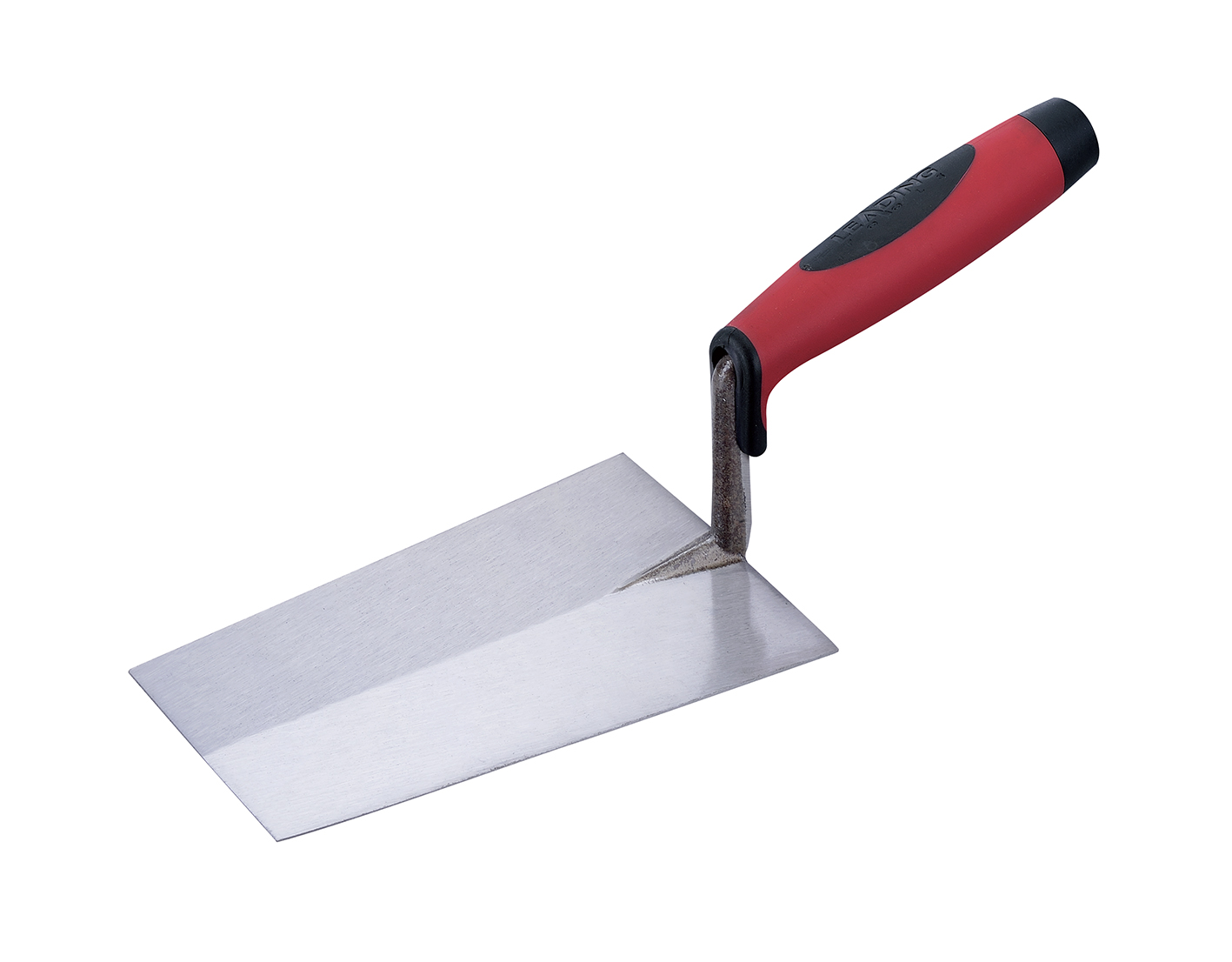
Bucket Trowel — Forged
Product Description
| Item | Detail |
|---|---|
| Product name | Bucket Trowel — Forged in One-piece High Carbon Steel |
| Art. Nr | 204721F, 205721F |
| Sizes | 204721F = 180 mm; 205721F = 200 mm (metric only) |
| Construction | Forged in one piece, high carbon steel |
| Blade shape | Flat trapezoidal blade: narrower at the toe, wider at the heel, straight edges |
| Shank | Forged in one piece with the blade |
| Handle | Two-tone soft grip (BF21) with end cap |
| Series | Brick Trowel series |
| Sibling families in the range | Bucket Trowel CO2 Welding Carbon Steel (202621–208621, 140–260 mm); Bucket Trowel Spot Welding Stainless Steel (202821–208821, 140–260 mm) |
A bucket trowel is a wide-bladed, short-handled masonry trowel used to lift mortar, render or tile adhesive out of a bucket or mixing tub, to scrape the bucket walls clean, and to deposit that material onto a hawk, a board or the work face.
It is a material-handling tool, not a bricklaying tool: the brick trowel has a pointed toe and is used to pick up a measured amount of mortar and bed a brick precisely, while the bucket trowel has a wide, blunt blade and is used to move material in bulk and to empty a container without waste. Professional masons commonly carry both and switch between them.
Art. Nr 204721F and 205721F are the forged members of the Leading Tools bucket trowel range. "Forged in One-piece High Carbon Steel" is Leading Tools' own designation for this family and is the single point that separates it from the two welded families alongside it: the blade and the shank are formed from one piece of steel rather than joined afterwards. Buyers arrive with two questions: "180 mm or 200 mm?" and "forged, CO2-welded carbon, or spot-welded stainless?"both are answered in the Selection Guide below.
One-piece forged construction. Every bucket trowel does the same job; in 204721F / 205721F the blade and shank are formed from one piece of steel rather than attached afterwards, which suits buyers who specify construction method and use the tool every day.
Less waste per bucket. The reason bucket trowels exist is that a wide blade drags the bucket wall clean, so mortar or adhesive is not left to set inside the container. On a site mixing bagged pre-blended mortar, that is a recurring material saving, not a comfort feature.
A straight-edged, trapezoidal blade. The 204721F / 205721F blade is a flat plate with straight edges and a blunt toe, so it can follow the wall of a bucket, tub or mixing tray while scraping.
Consistent mix, because the tub gets emptied. Scraping the sides down as work proceeds also keeps the mix uniform: material stuck on the wall of the tub is material that has not been mixed and is drying at a different rate.
Correct division of labor on a bricklaying gang. Using a bucket trowel to load and spread and a brick trowel to place gives each tool the job its blade shape is designed for; professionals routinely work with both rather than forcing one to do everything.
Two sizes. 180 mm and 200 mm are 20 mm apart; choose by the container opening and the amount of material per pass.
| Situation | Use this tool? | Why |
|---|---|---|
| Lifting mortar, render or tile adhesive out of a bucket or mixing tub | Yes, primary use | The wide blunt blade is designed for exactly this |
| Scraping the walls of a bucket or tub clean | Yes, primary use | Recovers material that would otherwise set inside the container and keeps the mix uniform |
| Loading a hawk or a mortar board | Yes | Moves material in bulk from container to working platform |
| Buttering brick and spreading mortar | Yes | Listed as a secondary use for bucket trowels |
| Getting thinset out of the pail before combing it with a notched trowel | Yes | Standard tile-setting sequence for this tool |
| Back-buttering tile | Yes | ; |
| Lifting a set tile to check adhesive coverage | Yes | ; |
| Bedding and aligning individual bricks | No, use a brick trowel | The blunt blade cannot place a measured lump precisely |
| Striking and finishing joints | No, use a brick jointer | Different tool class |
| Chiselling, prying or scraping hardened material | No | Not a chisel; impact damage and chipping are avoidable failure modes |
| Step | Action | Point to watch |
|---|---|---|
| 1 | Grip the handle with the blade face angled into the material and the shank keeping your hand above the bucket rim | Wear alkali-resistant gloves before you start, see Handling wet mortar safely below |
| 2 | Push the blade down the inside wall of the bucket so the straight edge stays in contact with the wall | Contact with the wall is what recovers the material rather than leaving it to set |
| 3 | Draw the blade up and toward you, letting material gather on the blade face | On a square tub, work the corners with the toe of the trapezoidal blade |
| 4 | Lift clear and transfer to the hawk, board or work face | Keep the blade close to level; this is a flat blade, not a scoop, so it holds material by surface area and not in a cavity |
| 5 | Turn the blade and let the material slide off, or push it off with the edge | A wet blade releases material more cleanly than a dry, cement-etched one |
| 6 | Repeat, scraping the container down as the batch is used | Emptying as you go keeps the remaining mix uniform |
| 7 | Rinse the blade before the material starts to set | See Care & Maintenance below: this is the maintenance step that determines the life of a carbon steel blade |
This is the job the tool is named for. Mortar or adhesive left on the wall of a bucket does two things: it is wasted material, and it dries at a different rate from the rest of the batch, so the mix stops being uniform. Dragging the blade down the wall as the batch is used addresses both.
Blade shape matters here. The 204721F / 205721F blade is trapezoidal with straight edges and a blunt toe, so it can follow the walls of square tubs, mixing trays and mortar boards.
Material comes out of the container on the bucket trowel and goes onto a hawk or board; from there the plasterer or mason works with the trowel appropriate to the finish. The bucket trowel can also spread and level material directly and can butter brick. It cannot place a measured lump of mortar under a brick with the accuracy of a pointed brick trowel, which is why a bricklaying gang keeps both tools on the board and switches between them.
Modern tile work is a natural fit for the bucket trowel: the adhesive is mixed in a pail, has a limited pot life, and must be got out of the pail and onto the substrate quickly before it skins. The bucket trowel handles the transfer; a notched trowel does the combing. For this work, note that the stainless spot-welded family (204821 / 205821) is the corrosion-appropriate choice if the tool lives in a wet cutting environment.
Wet mortar, render and concrete are strongly alkaline, pH about 12 to 13, and prolonged skin contact causes progressive alkaline chemical burns that worsen the longer the contact continues; cement hydration is also exothermic, so wet material trapped inside a glove or boot raises the risk further.
Wear nitrile or butyl gloves with genuine alkali resistance rather than cotton or leather, and change them if material gets inside. This applies to every masonry tool, not only to this one, but it is the single highest-consequence item on this page.
| Operation | Primary tool | Secondary tool |
|---|---|---|
| Emptying and scraping the mixing container | Bucket trowel | — |
| Loading a hawk or board | Bucket trowel | Brick trowel (slower, smaller load) |
| Spreading a mortar bed | Bucket trowel or brick trowel | Either, depending on the trade |
| Picking up a measured mortar lump | Brick trowel | — |
| Bedding and aligning a brick | Brick trowel | — |
| Back-buttering and small mixes | Margin trowel | Bucket trowel |
| Jointing and pointing | Brick jointer | — |
Q1. What is a bucket trowel actually for, and can I use it instead of a brick trowel?
It lifts mortar, render or tile adhesive out of a bucket or mixing tub, scrapes the container clean so material is not wasted, and deposits the material on a hawk, board or work face; it is also used for buttering brick and spreading.
It does not replace a brick trowel, which has a pointed toe for picking up a measured amount of mortar and bedding a brick accurately. Professionals carry both.
Q2. Which size should I buy?
The two sizes differ only in blade size: 204721F is 180 mm and 205721F is 200 mm, with the same construction, material and handle. Choose 180 mm for narrow-mouth buckets, tile adhesive work and all-day one-handed use, and 200 mm for wide tubs, mortar boards and larger batches.
Q3. How is the forged version different from the welded and stainless ones?
They differ in how the blade and shank are joined and in the steel: forged in one piece from high carbon steel (204721F / 205721F), CO2-welded carbon steel (202621–208621), and spot-welded stainless steel (202821–208821).
The forged tool is made in one piece and suits daily professional use; the welded families suit general masonry work and offer a wider size range (140–260 mm). Choose the spot-welded stainless (204821 / 205821) if the tool lives in wet conditions or the crew will not maintain a carbon blade.
Q4. There is rust on the blade after one weekend. Is that a defect?
No, that is carbon steel behaving normally when it is put away damp. Remove the rust with a nylon brush or a plastic abrasive pad, dry the blade, oil it and store it dry. If this keeps happening in your working environment, the spot-welded stainless family (204821 / 205821) is the right choice instead.
Q5. Is there anything I should watch out for when using it?
Wet cement-based material is strongly alkaline and can cause burns on prolonged skin contact, so wear nitrile or butyl gloves, not cotton or leather. If the blade moves at the shank, stop using the tool, because a one-piece forged tool should have no movement there; movement at the handle only means the handle has loosened on the tang (the end of the steel that runs into the handle).
| Property | Detail |
|---|---|
| Material | High carbon steel, designated "Forged in One-piece High Carbon Steel" |
| Blade outline | Flat trapezoidal: narrower at the toe, wider at the heel, straight side edges |
| Blade profile | Flat plate. The blade is not a dished or scooped section |
| Blade length | 204721F = 180 mm; 205721F = 200 mm |
| Toe | Blunt, straight-cut: no point |
| Surface finish | Bright ground finish |
| Property | Detail |
|---|---|
| Shank type | Integral forged shank |
| Shank construction | Forged in one piece with the blade, no welded junction |
| Shank purpose | Lifts the handle above the blade plane so the hand clears the bucket rim and the deposited material |
| Handle | Two-tone soft grip (BF21), end cap |
Leading Tools draws the distinction itself, offering three bucket trowel families and naming each one by construction method: "Forged in One-piece High Carbon Steel", "CO2 Welding Carbon Steel", and "Spot Welding Stainless Steel". The functional difference is where the blade ends and the shank begins.
| Attribute | Specification |
|---|---|
| Art. Nr | 204721F (180 mm), 205721F (200 mm) |
| Series | Brick Trowel series |
| Product family | Bucket Trowel |
| Manufacturing process | Forged in one piece |
| Material | High carbon steel |
| Blade form | Flat trapezoidal, blunt toe, straight edges |
| Shank | Integral with blade |
| Handle | Two-tone soft grip (BF21) |
| Size designation | Nominal sizes in mm only. Converted at 1 in = 25.4 mm: 180 mm ≈ 7.1 in, 200 mm ≈ 7.9 in |
| Sibling constructions | CO2 welded carbon steel 202621–208621; spot welded stainless steel 202821–208821 |
| Art. Nr | Size | Approx. | Choose when |
|---|---|---|---|
| 204721F | 180 mm | ≈ 7.1 in | Narrow-mouth buckets and smaller batches; tile adhesive and thinset work; the operator wants one-handed control and lower fatigue over a long day |
| 205721F | 200 mm | ≈ 7.9 in | Wide mixing tubs, mortar boards and larger batches; fewer passes to empty a container; loading a hawk in bulk |
A smaller blade is more manoeuvrable inside a narrow container while a larger blade lifts more per pass.
| Construction | Art. Nr range | Sizes | Best for | Trade-off |
|---|---|---|---|---|
| Forged in one piece, high carbon steel | 204721F, 205721F | 180, 200 mm | Daily professional use; buyers who specify construction method | Only two sizes; carbon steel needs drying and oiling |
| CO2 welding carbon steel | 202621–208621 | 140–260 mm | The widest size choice (seven sizes, 140–260 mm) | Shank is welded to the blade |
| Spot welding stainless steel | 202821–208821 | 140–260 mm | Wet conditions, tile adhesive and additive-modified mortars, buyers who will not maintain carbon steel | Shank is welded to the blade |
Recommendation. Specify the forged 204721F / 205721F where the tool is used every day and the customer specifies the construction. Specify the CO2 welded carbon range where the customer needs a size the forged family does not offer: 140, 160, 220, 240 or 260 mm. Specify the spot welded stainless range where corrosion is the dominant concern: wet-cutting tile work, additive-modified mortars, or crews who will not clean and oil a carbon blade.
| Size | CO2 welding carbon steel | Spot welding stainless steel |
|---|---|---|
| 140 mm | 202621 | 202821 |
| 160 mm | 203621 | 203821 |
| 180 mm | 204621 | 204821 |
| 200 mm | 205621 | 205821 |
| 220 mm | 206621 | 206821 |
| 240 mm | 207621 | 207821 |
| 260 mm | 208621 | 208821 |
These two families have their own product pages; the table is here only so a buyer comparing constructions can see the whole range at once.
All three bucket trowel families share one handle: a two-tone soft grip (BF21) with an end cap. Other handles can be fitted on request: contact Leading Tools sales.
| Bucket trowel (this product) | Brick trowel | Margin trowel | |
|---|---|---|---|
| Blade shape | Wide, blunt, flat, trapezoidal here | Pointed toe, tapered | Narrow rectangle, square end |
| Primary job | Lifting and scraping material out of a bucket or tub; depositing it on a hawk or board | Picking up a measured amount of mortar and bedding a brick precisely | Small-quantity mixing, back-buttering, cleaning up in tight spots |
| Precision placement | Low | High | Medium |
| Volume per pass | High | Moderate | Low |
A bucket trowel is not a substitute for a brick trowel: on a bricklaying gang both are on the board.
Complete art number and size reference for the Bucket Trowel Forged family.
| Art. Nr | Size | Approx. (1 in = 25.4 mm) | Material | Construction | Handle |
|---|---|---|---|---|---|
| 204721F | 180 mm | ≈ 7.1 in | High carbon steel | Forged in one piece | Two-tone soft grip |
| 205721F | 200 mm | ≈ 7.9 in | High carbon steel | Forged in one piece | Two-tone soft grip |
Notes on this table:
Clean before the material sets. Rinse the blade under running water while the mortar or adhesive is still plastic and scrub the face and the shank throat with a stiff nylon brush. Cured mortar has to be soaked off, and every cycle of soaking and scrubbing removes a little of the blade's finish. The routine below is general carbon-steel tool practice.
Dry and oil, because this is carbon steel. The carbon steel blade costs less, and it must be wiped dry and given a thin coat of tool oil after use, or it will rust. Dry the blade completely and wipe on a thin film of a light rust-preventive oil after every wash. Wipe off the excess: a thin even film is enough, and pooled oil collects dust.
Pay attention to the shank throat. The point where the shank meets the blade and the point where the shank enters the handle are where water and material sit after cleaning. Brush them out and dry them specifically.
Store dry, not in a sealed bag. A closed tool bag holds moisture against the blade. For storage of more than a few days, wrap the blade in a lightly oiled cloth or waxed paper.
Do not use a steel wire brush or wire wheel on the blade face. Remove dried mortar with a plastic scraper or a stiff nylon brush after a soak; a wire brush or wire wheel scratches the blade face (stainless steel that picks up iron particles will also rust).
Inspect the shank and the handle before each shift. On a forged one-piece tool there should be no movement at all between blade and shank; any visible crack in the shank is a reason to take the tool out of service rather than to keep using it. Check the soft grip for cuts, tearing or hardening: a damaged grip cannot be repaired.
On the handle. Wash a soft-grip handle with mild soap and water if cement dust has made it tacky, and keep it out of prolonged direct sunlight in storage. A wooden handle, if fitted on request, needs occasional sanding of raised grain and an annual oil or wax, and any cracked handle must be replaced.
Personal protection is part of maintenance. Cleaning a trowel means handling wet cement residue; the same nitrile or butyl glove requirement applies at the wash-out point as on the wall.

In compliance with EU personal data protection laws, we are committed to protecting and providing you with control over your personal data. By clicking "Accept All", you allow us to place cookies to enhance your experience on this site, help us analyze site performance and usage, and enable us to deliver relevant marketing content. You can manage your cookie settings below. By clicking "Agree" you agree to the current settings. For more information, please visit the Privacy Statement.
This website uses cookies
In compliance with EU personal data protection laws, we are committed to protecting your personal data and providing you with control over it. By clicking "Agree", you allow us to place cookies to improve your experience on this site, help us analyze site performance and usage, and allow us to deliver relevant marketing content.
By clicking "Only necessary" you allow us to place only necessary cookies. The website cannot function without these cookies and you cannot switch them off on your system. These cookies are typically set only in response to an action you perform (i.e. a service request), such as setting privacy preferences, logging in, or filling in a form. You can set your browser to block or prompt you for these cookies, but this may prevent some site features from working.