
Copyright 2026 © Leading Tools Industrial Co., Ltd.
All Rights Reserved. Website Design by Awakening Design
CATALOG TYPE
Product Categories
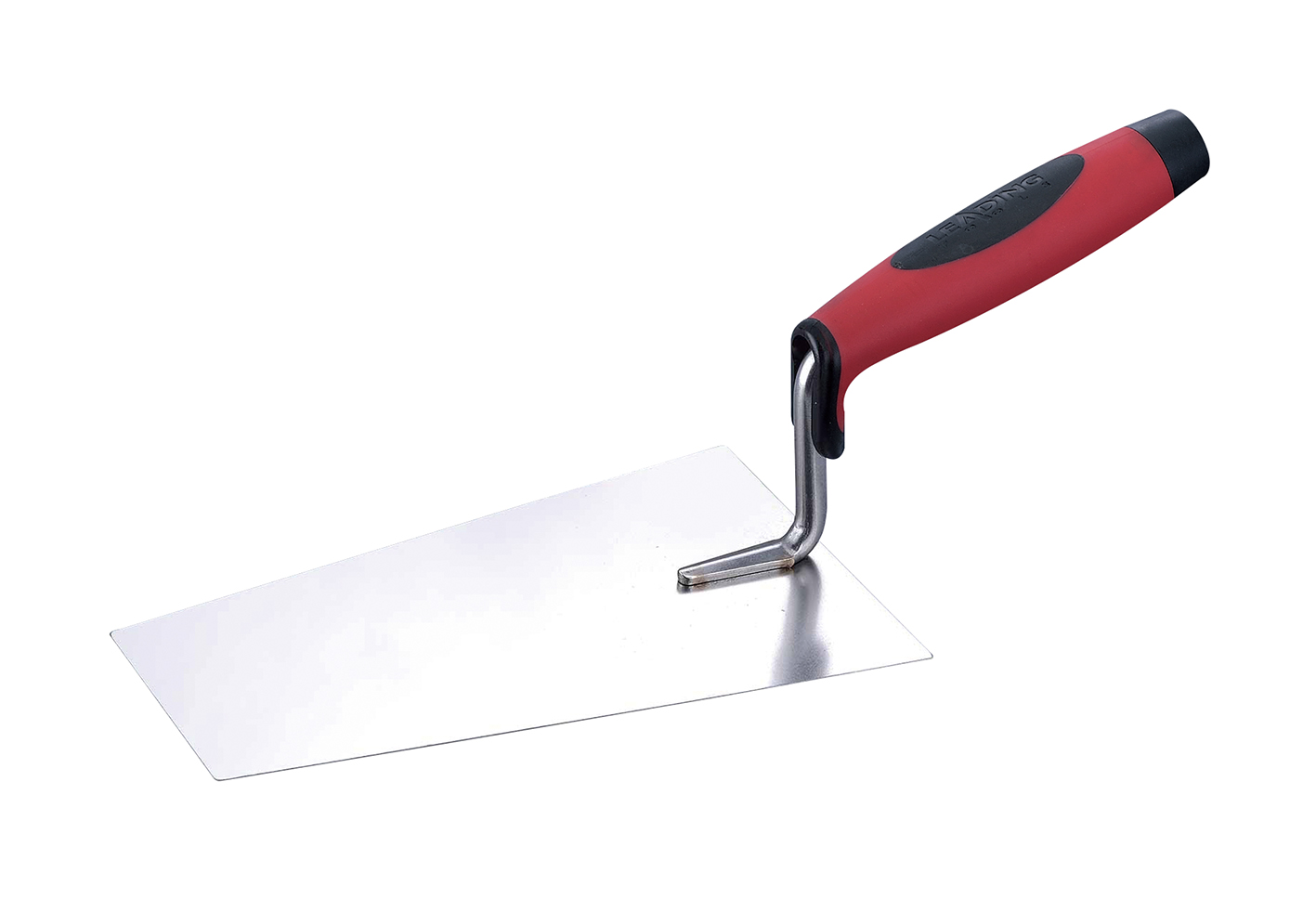
Bucket Trowel — Spot Welded Stainless Steel
Product Description
Product name: Bucket Trowel
Construction line: Spot Welding Stainless Steel
Art. Nr (seven sizes): 202821 (140mm), 203821 (160mm), 204821 (180mm), 205821 (200mm), 206821 (220mm), 207821 (240mm), 208821 (260mm).
These seven art numbers are one product family in one blade pattern and one construction, differing only in blade size. They are offered as one range, "Bucket Trowel / Spot Welding Stainless Steel", the third of the three constructions in which this blade is built. Sizes are specified in millimeters only; any inch figure on this page is a conversion at 1" = 25.4mm.
Leading Tools builds one and the same Bucket Trowel blade in three different ways, and offers all three alongside each other as a single product group.
| Construction | Product line name | Art. Nr | Sizes offered |
|---|---|---|---|
| Forged | Bucket Trowel — Forged in One-piece High Carbon Steel | 204721F, 205721F | 180mm, 200mm only |
| CO2 welded | Bucket Trowel — CO2 Welding Carbon Steel | 202621, 203621, 204621, 205621, 206621, 207621, 208621 | 140mm–260mm |
| Spot welded stainless (this product) | Bucket Trowel — Spot Welding Stainless Steel | 202821–208821 | 140mm–260mm |
The buyer can hold the blade shape constant and choose a construction and a blade material. The Selection Guide below works through that choice in full.
Ordering note. Always specify the full art number, not the size alone: at 180mm, 204721F is forged, 204621 is CO2 welded carbon steel and 204821 is spot welded stainless steel.
A bucket trowel is a wide-bladed tool used for scooping mortar out of a bucket, and it is also serviceable for buttering bricks and smoothing mortar.
The distinguishing feature against the other trowel a mason keeps in the same bucket, the gauging trowel, is that the bucket trowel is a full-size, cut-flat blade for digging large amounts of material out of a mixing bucket, whereas the gauging trowel has a round nose and a V-shaped back and exists for small mixes and detail work. The two are not interchangeable.
The construction line for this product is "Spot Welding Stainless Steel". The blade and the shank are made as separate stainless components and joined by spot welding at discrete points.
The blade is flat: a trapezoid that is widest at the heel, where the shank lands, and narrows toward a straight, square-cut toe. There is no bowl, dish or channel across the blade width. This is the bucket trowel geometry: a cut-flat blade, as opposed to the round-nosed gauging trowel.
This matters because the flat trapezoidal face is what makes the tool a spreader rather than a scoop-shaped carrier. Mortar is lifted on the face and held there by consistency and by the low angle of the blade, not by a cavity. Two direct consequences:
The blade is stainless steel. Stainless is the corrosion-resistant option in the masonry trowel material range, chosen for its resistance to corrosion. In this product family that choice is the whole point of the line: the very same blade is also offered in carbon steel (CO2 welded) and high-carbon steel (forged), and stainless is the third option for buyers whose problem is rust rather than raw strength.
The shank is spot welded to the blade and lifts the handle clear of the blade face, so the knuckles do not drag when the blade is worked flat. That lift is a functional feature, not a styling one.
Every art number in this family is fitted with the BF21 soft grip, with an end cap, used across the Leading Tools brick trowel range.
Other handles can be fitted on request: contact Leading Tools sales.
The ladder has seven sizes at a uniform 20mm interval. All seven sizes use one construction and one material.
The single clearest advantage of this line is that it puts the Bucket Trowel geometry into stainless steel. A bucket trowel spends its working life in contact with wet, alkaline mortar, that is its job description, and in carbon steel that means the tool must be washed and dried at every break or it will flash-rust.
Stainless has high corrosion resistance and low maintenance; chlorinated water, coastal air or prolonged soaking can still cause rust spots, so rinse with clean water and dry after use. Lower maintenance is the reason to choose stainless.
The stainless build is the one to specify where the end user cannot guarantee same-day cleaning: site tool pools, hire fleets, coastal and high-humidity work, and jobs where mortar sits in the tool through a rain delay.
Because Leading Tools offers the identical blade in forged high-carbon, CO2-welded carbon and spot-welded stainless, a buyer can hold the tool geometry constant and move only on construction and material. The mason who likes the way the 200mm bucket trowel handles does not have to change tool shape to change material: 205721F, 205621 and 205821 are the same size in three builds.
The stainless line and the CO2 line each run the full seven sizes; the forged line runs only 180mm and 200mm. If the requirement is a size outside 180–200mm, the forged option does not exist and the real choice is between carbon steel and stainless.
On a site where tools cannot be washed and dried the same day, the stainless version reduces the maintenance and replacement caused by rust.
Every art number in this family carries the BF21 soft grip.
| Operation | Bucket trowel | Better tool if not |
|---|---|---|
| Scooping mortar out of a bucket or mixer | Primary use, this is what the tool is defined by | ; |
| Scraping residue off the bottom and walls of a mixing bucket | Yes, the straight, cut-flat toe is the working edge | ; |
| Buttering bricks | Yes, listed as a secondary use of the bucket trowel | A brick trowel gives finer control |
| Smoothing and spreading mortar over an area | Yes | A float or finishing trowel for the final surface |
| Loading and spreading tile adhesive, checking coverage | Yes, a standard use for bucket trowels in tile setting | A notched trowel for combing to depth |
| Small measured mixes and detail work | No | Gauging trowel, round nose, V-back |
| Placing and aligning individual bricks | No | Brick trowel (London, Philadelphia, Wide London patterns) |
| Pointing and joint finishing | No | Brick jointer |
In practice a mason carries both: the bucket trowel for bulk loading and bed preparation, the brick trowel for the precision work of laying each unit.
| Step | Action | Why |
|---|---|---|
| 1 | Inspect the tool before use: check for visible damage to blade, shank and handle | Safety instruction |
| 2 | Put on safety glasses, alkali-resistant gloves (nitrile or butyl) and safety footwear | Safety instruction |
| 3 | Grip the handle with the fingers wrapped and the thumb along the top of the handle, so the wrist stays in line with the forearm | Reduces wrist deviation over a long session |
| 4 | Enter the mortar with the blade at a shallow angle to the surface of the mix, not vertically | A shallow entry loads the face; a vertical entry just cuts the mix |
| 5 | Draw the blade toward you and lift, keeping the face near horizontal | The load is held by the flat face and the mortar's own consistency: there is no cavity to retain it |
| 6 | Carry with the face level and the blade low; support the blade near the shank with the free hand on the larger sizes | A 220–260mm blade fully loaded is a significant off-axis load on one wrist |
| 7 | Deposit by tilting the face and letting the mortar run off in a controlled line | Tipping too fast drops the whole load in one place |
| 8 | Spread with the face at a low angle in a sweeping pass, then lay the face flat to strike off and level | The flat blade is the strike-off tool; this is what the trapezoid geometry is for |
| 9 | Scrape the bucket down with the straight toe before the mix stiffens | The cut-flat edge reaches the bucket wall and base |
| 10 | Use only on mortar or comparable materials, not as a pry bar, chisel or hammer | Intended for mortar or similar materials only |
This is the tool's core cycle. Work with the bucket close to the working line so the loaded carry is short. Enter at a shallow angle, draw and lift, carry level, deposit in a line rather than a heap, then spread and strike off with the face. On the 220mm, 240mm and 260mm sizes, use the free hand under the blade during the carry: the load these blades pick up is the reason the large sizes exist and also the reason they fatigue an unsupported wrist.
The stainless blade proves its worth at the end of this cycle rather than during it: the tool can sit in the bucket between loads with far less risk of flash rust.
A bucket trowel is used for scooping, spreading and cleaning off mortar with precision, including work with tile adhesive. The bucket trowel loads adhesive out of the tub and lays it on the substrate or the back of the tile; the notched trowel then combs it to depth.
The 140mm and 160mm sizes exist for reveals, small openings, chases and patch repairs where a full-size blade cannot be angled in. The trapezoid taper is what makes the smaller sizes usable in these spots. For this work the tool is typically used one-handed, which also puts a ceiling on how much mortar should be loaded per pass.
The bucket trowel works best with a mortar that is workable but holds its shape on a flat blade. Very wet mixes run off the face during the carry, because there is no cavity to retain them, this tool is less tolerant of soupy mortar than a dished scoop would be. Very stiff or flash-setting mixes are hard to load cleanly and should be re-tempered or worked faster. Neither limitation is specific to the stainless build.
Q1. What is the difference between 204821, 204621 and 204721F?
All three are the 180mm Bucket Trowel and share the same blade shape. 204821 is spot-welded stainless steel, 204621 is CO2-welded carbon steel, and 204721F is forged in one piece from high carbon steel. The two welded lines are two-piece builds joined at the blade and shank, while the forged line is made in one piece; choose the forged line if you prefer a one-piece blade and 180mm or 200mm is acceptable.
Q2. Which size should a first order carry?
180mm and 200mm, the two sizes offered in all three constructions. Add 140mm for repair and confined work, and 220–260mm for large batches once the base sizes are moving.
Q3. Can it replace a brick trowel or a gauging trowel, and can I use it for tile adhesive?
It replaces neither. The bucket trowel is a bulk loading and spreading tool, the brick trowel places and beds individual units, and the gauging trowel, with its round nose and V-shaped back, handles small measured mixes and detail work. For tile adhesive it works for loading and spreading, but a notched trowel is still needed to comb the adhesive to depth.
Q4. Rust spots have appeared on a stainless blade. Is it defective?
Usually not. The most common causes are iron contamination from a steel wire brush or steel wool, and mortar residue left to cure and trap moisture against the surface.
Remove the spots with a nylon abrasive pad, clean thoroughly, dry, and switch to nylon or stainless bristles for cleaning. Persistent pitting after correct cleaning is worth reporting with photographs.
Q5. The handle wobbles, or the blade moves against the shank. What now?
Stop using the tool. On a two-piece welded build, movement at the blade-shank joint means the weld or the handle-to-shank attachment has loosened. Spot-welded joints are not field-repairable, so replace the tool. Mortar buildup where the handle meets the shank is itself a known cause of handle loosening, so include that area in daily cleaning.
| Attribute | Specification |
|---|---|
| Blade material | Stainless steel |
| Blade shape | Flat trapezoid: widest at the heel, narrowing to a straight, cut-flat toe |
| Blade cross-section | Flat across the width; no dish, bowl or channel |
| Blade length ("Size") | 140 / 160 / 180 / 200 / 220 / 240 / 260 mm |
| Surface treatment | Not polished |
| Attribute | Specification |
|---|---|
| Handle type | Soft grip, BF21 |
| Handle accessory | End cap |
| Other handles | Available on request, contact Leading Tools sales |
| Shank | Spot welded to the blade heel |
| Shank material | Stainless steel |
| Blade-to-shank joint | Spot welding |
| Feature | Forged (204721F, 205721F) | CO2 Welded (202621–208621) | Spot Welded SS (202821–208821) |
|---|---|---|---|
| Product line name | Forged in One-piece High Carbon Steel | CO2 Welding Carbon Steel | Spot Welding Stainless Steel |
| Blade material | Carbon steel, polished | Carbon steel | Stainless steel |
| Blade-shank joint | None, one piece | CO2 welded joint | Spot welds |
| Corrosion resistance | Low, carbon steel | Low, carbon steel | High, stainless (rinse and dry after use) |
| Blade shape | Same bucket trowel trapezoid | Same bucket trowel trapezoid | Same bucket trowel trapezoid |
| Sizes | 180mm, 200mm | 140–260mm | 140–260mm |
| Handle | Soft grip, BF21 | Soft grip, BF21 | Soft grip, BF21 |
| Construction | Art. Nr range | Choose it when | Accept this trade-off |
|---|---|---|---|
| Spot Welding Stainless Steel (this line) | 202821–208821 | The tool will stay wet, or cannot be cleaned and dried promptly; humid, coastal or exposed sites; hire fleets and shared site tool pools; buyers who want one material across all seven sizes | Rinse with clean water and dry after use |
| CO2 Welding Carbon Steel | 202621–208621 | The end user washes and dries tools daily; indoor or short-duration work; all seven sizes needed | Carbon steel will rust if neglected |
| Forged in One-piece High Carbon Steel | 204721F, 205721F | A one-piece blade and shank is preferred and 180mm or 200mm is an acceptable size | Only two sizes exist; carbon steel needs rust prevention |
The decision in one line: if the size you need is not 180mm or 200mm, the forged option is off the table and the question becomes carbon versus stainless. If the size is 180mm or 200mm, the question is whether a one-piece blade or rust resistance matters more on that particular site.
Each art number carries one size figure, in millimeters. The inch figures below are conversions at 1" = 25.4mm.
| Art. Nr | Size | Conversion | Where it fits |
|---|---|---|---|
| 202821 | 140mm | 5.51" | Smallest in the range. Tight work, small batches, patch and repair, one-handed use |
| 203821 | 160mm | 6.30" | Small batches and confined work with a little more capacity per pass |
| 204821 | 180mm | 7.09" | The size at which forged, CO2 and stainless builds all exist |
| 205821 | 200mm | 7.87" | The general-purpose professional size; still available in all three constructions |
| 206821 | 220mm | 8.66" | Larger batches |
| 207821 | 240mm | 9.45" | High volume per pass |
| 208821 | 260mm | 10.24" | Largest in the range |
For reference, general-purpose brick trowel blades run roughly 9"–12"; the 220–260mm sizes (8.7"–10.2") sit near the lower end of that band.
Sizing rule of thumb. Larger is not automatically better. A larger blade moves more mortar per pass but loads the wrist harder and is less controllable near edges and in confined openings. If the tool will be used all day, size down; if it will be used in bursts to move volume, size up.
The BF21 soft grip is the standard handle for this line. Other handles can be fitted on request: contact Leading Tools sales.
If the requirement is small measured mixes or detail work rather than bulk material handling, the correct tool is a gauging trowel: round nose, V-shaped back, and not a bucket trowel. The two are distinct products with distinct blade geometries and are not substitutes.
All seven art numbers in the Bucket Trowel Spot Welding Stainless Steel line.
| Art. Nr | Size (mm) | Conversion (1"=25.4mm) | Blade material | Blade shape | Shank / joint | Handle |
|---|---|---|---|---|---|---|
| 202821 | 140mm | 5.51" | Stainless steel | Flat trapezoid, straight cut-flat toe | Shank, spot welded | Soft grip, BF21 |
| 203821 | 160mm | 6.30" | Stainless steel | Flat trapezoid, straight cut-flat toe | Shank, spot welded | Soft grip, BF21 |
| 204821 | 180mm | 7.09" | Stainless steel | Flat trapezoid, straight cut-flat toe | Shank, spot welded | Soft grip, BF21 |
| 205821 | 200mm | 7.87" | Stainless steel | Flat trapezoid, straight cut-flat toe | Shank, spot welded | Soft grip, BF21 |
| 206821 | 220mm | 8.66" | Stainless steel | Flat trapezoid, straight cut-flat toe | Shank, spot welded | Soft grip, BF21 |
| 207821 | 240mm | 9.45" | Stainless steel | Flat trapezoid, straight cut-flat toe | Shank, spot welded | Soft grip, BF21 |
| 208821 | 260mm | 10.24" | Stainless steel | Flat trapezoid, straight cut-flat toe | Shank, spot welded | Soft grip, BF21 |
| Size | Forged high-carbon | CO2 welded carbon | Spot welded stainless |
|---|---|---|---|
| 140mm | — | 202621 | 202821 |
| 160mm | — | 203621 | 203821 |
| 180mm | 204721F | 204621 | 204821 |
| 200mm | 205721F | 205621 | 205821 |
| 220mm | — | 206621 | 206821 |
| 240mm | — | 207621 | 207821 |
| 260mm | — | 208621 | 208821 |
Clean the tool thoroughly after use and dry it to prevent rust. Stainless narrows the consequences of skipping this, but it does not remove the requirement. There is a second reason as well: mortar allowed to build up on a trowel loosens the handle over time and scratches the surface being worked.
Daily routine:
Store dry. For extended storage, a light wipe of protective oil: camellia oil, a light mineral oil or a dedicated stainless protector, is a reasonable precaution even on stainless, particularly around the spot welds and the shank joint where water collects. Do not store the tool wet in a closed toolbox.
Because this is a two-piece build, the blade-shank joint is the component to inspect. Before use, check for visible damage; specifically, check for any movement between blade and shank, any visible crack radiating from a weld point, and any lifting of the shank at its welded edges. Light discoloration around the weld points is cosmetic and does not affect use; if in doubt, contact Leading Tools sales.
Any detectable movement at the joint means the tool should be taken out of service and replaced; a spot-welded joint is not field-repairable.
The blade is flat and it needs to stay flat, because the flat face is what strikes off and levels. Check it against a straight edge if the tool starts leaving ridges. Minor edge dents at the toe can be dressed with a fine file; a blade that has taken a permanent bend across its width should be replaced rather than hammered back.
The standard handle is the BF21 soft grip.
Recommended practice is to wear safety glasses, alkali-resistant gloves (nitrile or butyl) and safety footwear, and to use the tool only for mortar or comparable materials.

In compliance with EU personal data protection laws, we are committed to protecting and providing you with control over your personal data. By clicking "Accept All", you allow us to place cookies to enhance your experience on this site, help us analyze site performance and usage, and enable us to deliver relevant marketing content. You can manage your cookie settings below. By clicking "Agree" you agree to the current settings. For more information, please visit the Privacy Statement.
This website uses cookies
In compliance with EU personal data protection laws, we are committed to protecting your personal data and providing you with control over it. By clicking "Agree", you allow us to place cookies to improve your experience on this site, help us analyze site performance and usage, and allow us to deliver relevant marketing content.
By clicking "Only necessary" you allow us to place only necessary cookies. The website cannot function without these cookies and you cannot switch them off on your system. These cookies are typically set only in response to an action you perform (i.e. a service request), such as setting privacy preferences, logging in, or filling in a form. You can set your browser to block or prompt you for these cookies, but this may prevent some site features from working.