
Copyright 2026 © Leading Tools Industrial Co., Ltd.
All Rights Reserved. Website Design by Awakening Design
CATALOG TYPE
Product Categories
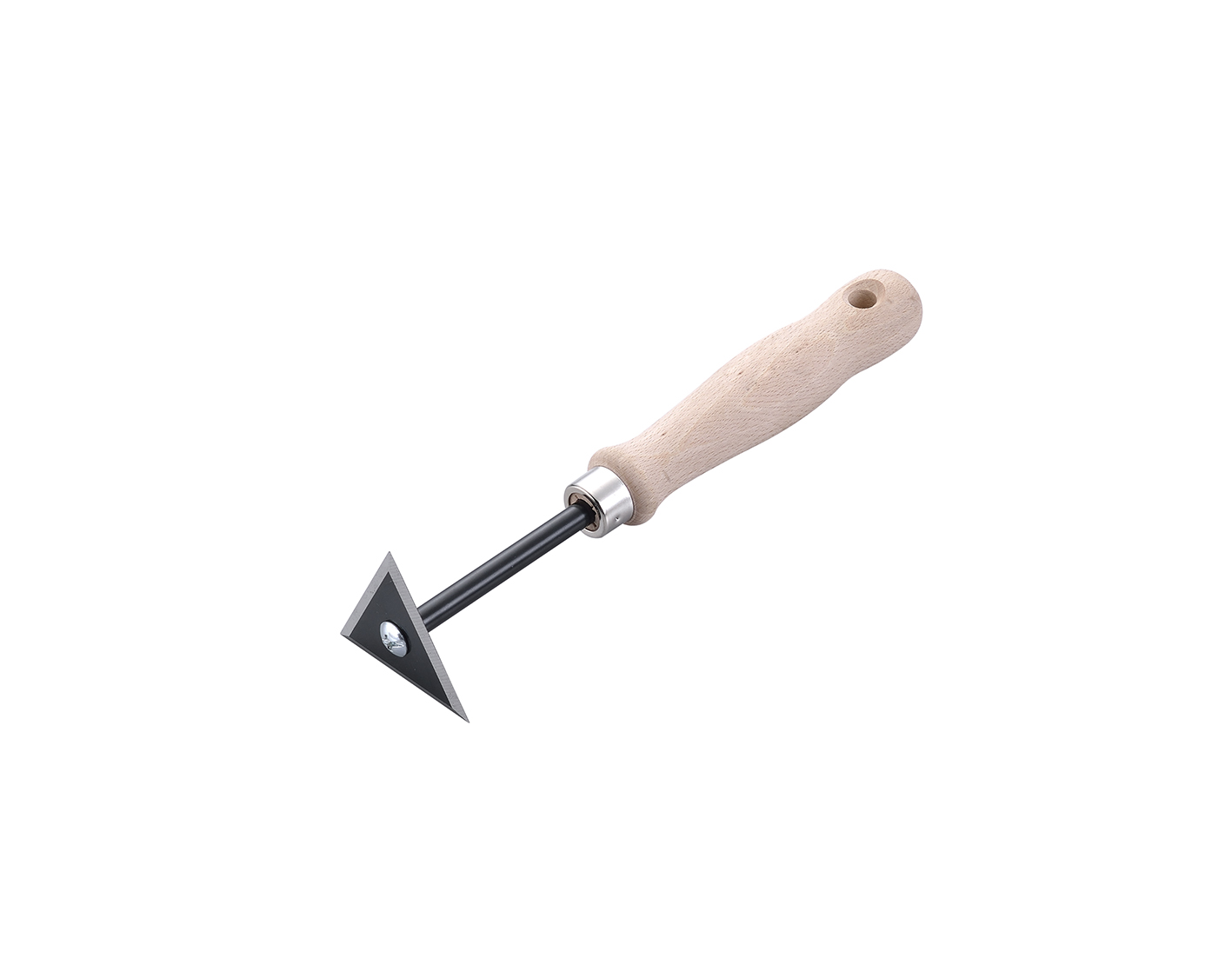
Combination Shave Hook
Product Description
Product name: Combination Shave Hook
Material line: Carbon Steel
Art. Nr (two sizes): 300501 (60 mm), 300502 (80 mm).
A shave hook is a painter's and decorator's stripping scraper: a small steel blade mounted crosswise on the end of a handle, so the working edge is presented at ninety degrees to the direction of pull.
What the tool is for. Its primary application is stripping paint and varnish, on window frames and sashes, moldings, doors, furniture, skirting boards, architraves, coving, panels and pipework. It also removes glue and wallpaper-paste residue, works on wood, metal and concrete, and suits plaster and drywall corners and profiled trim.
One point of clarification: it is not a wallpaper-stripping tool. Removing wallpaper paste and glue residue is a legitimate secondary job for the triangular scraper, but the tool a decorator reaches for to strip a papered wall is a wide flat stripping knife or a steamer. Buy this one for coatings and profiled work.
300501 is the 60 mm blade; 300502 is the 80 mm blade. Both are Carbon Steel.
Leading Tools also makes the Shave Hook — Straight Blade, art number 300504, also in carbon steel. It is not another size of this tool: it has a different head: a single straight beveled edge across the head rather than the triangular three-edge head fitted to 300501 and 300502. The Selection Guide below sets out how to choose between the two.
Three edges on one head means the profile follows the work. The reason a decorator carries a shave hook rather than only a flat scraper is geometry. A flat stripping knife has one straight edge and one blade width; it can only work a flat plane.
A shave hook presents a small triangular head with three separately usable edges, so the operator turns the tool rather than changing tools: a long edge for the flat of a panel or a door, the point for the corner where a glazing bar meets the frame, an edge worked at an angle for a molding or a bead. The principle is several edges on one head, each matched to a different part of the profile: flat runs, moldings, beads, skirting boards.
The blade reaches into the places a wide scraper cannot. Tight, awkward spaces need a small head and precise control rather than area coverage. That is the working case for the 60 mm size in particular.
The handle keeps the hand back from the work. Old oil paint and varnish are often softened first with a hot-air gun and then scraped off while warm; an open-flame torch is not recommended. Do not heat or dry-scrape paint that may contain lead; follow local regulations.
Carbon steel can be filed back to a scraping edge. A stripping scraper dulls with use, and a file restores the edge. The trade-off: the carbon steel blade must be wiped dry and given a thin coat of tool oil after use, otherwise it rusts (see Care & Maintenance below).
A wooden handle with a hanging hole suits how the tool is actually stored. This is a tool that gets used, wiped and hung on a nail or a board. The drilled butt is the storage feature that matters for a scraper whose blade should never sit loose in the bottom of a bag against other steel.
A screw-fixed blade is a serviceable blade. Because the head is fixed with a screw rather than welded or forged in one piece with the shank, it can be removed from the tool to be filed flat and square on a bench, which is far easier than trying to dress three edges with the shank in the way.
Two sizes cover the split in the work. 60 mm for detail and confined work, 80 mm for the long runs. A trade buyer who strips joinery for a living will typically stock both; a distributor who lists both can serve the whole job from one product family.
| Situation | Use the shave hook? | Why |
|---|---|---|
| Paint or varnish on moldings, beads, coving, architraves | Yes, primary use | The head profile follows the section; this is the job the tool is made for |
| Window frames, sashes and glazing bars | Yes | The point reaches the rebate corner where a flat blade cannot sit |
| Skirting boards and door frames | Yes, prefer 80 mm | Long straight runs; more edge in contact per pass |
| Furniture and panel stripping | Yes, with care | Keep the edge angle low to avoid digging into the timber |
| Old varnish softened with a hot-air gun | Yes | Soften a short section, then scrape while it is warm |
| Removing hardened wallpaper paste or glue residue | Yes | Also works on glue and paste residue |
| Stripping wallpaper off a wall | No | Use a wide stripping knife and a steamer; this pattern is not a wallpaper-stripping tool |
| Cleaning solder and scale from metal | Yes | Works on metal as well as timber; expect faster edge wear |
| Prying, levering, chiselling | Never | The blade will be damaged and the user may be injured |
| Step | Action | Note |
|---|---|---|
| 1 | Hold the handle firmly and lay the blade against the surface at an angle, not flat on. | The bevel does the cutting; the angle controls how deep it bites |
| 2 | Choose the edge that matches the section: a long edge for flats, the point for corners and rebates. | Turning the tool replaces changing the tool |
| 3 | Apply light pressure and pull the scraper towards you in a smooth, continuous movement. | Pull, do not push |
| 4 | Where old paint or varnish resists, soften it first with a hot-air gun, then scrape while it is warm. | Keep the hand back on the handle; do not heat paint that may contain lead |
| 5 | Work with the grain on timber, and take several light passes rather than one heavy one. | |
| 6 | Stop and re-file the edges when the tool starts to skid rather than cut. | |
| 7 | Never lever or chisel with the blade. | Damages the blade and risks injury |
This is the classic job for the pattern and the reason a decorator owns one. Work the point into the rebate where the glazing bar meets the glass line, then bring a long edge along the flat of the bar. Take the paint off in the direction of the run.
On a sash window, do the meeting rails and the beads with the 60 mm head; the frame and the outer casing take the 80 mm. Where the paint is thick and old, soften it in short sections with a hot-air gun and scrape while it is warm. Mask or shield the glass: carbon steel will score it.
Typical elements are moldings, beads, skirting boards and architraves. The method is to break the run into sections of profile and pick the edge that matches each: the flat between moldings, then the angle, then the quirk at the top of the skirting.
Do not force the tool into a section it does not fit, that is how a bevel gets rolled over. On coving and curved trim, work in short strokes and let the corner of the edge do the cutting rather than trying to bed the whole edge into the curve.
Softening the coating first is a common method for old oil paint and varnish. Use a hot-air gun; an open-flame torch is not recommended. Heat a section, put the heat aside, scrape while it is soft, move on. Keep the scraped material off the floor as you go, it will still be hot. Do not heat or dry-scrape paint that may contain lead, which is possible in older buildings; follow local regulations.
Small triangular scrapers suit precise removal in confined spaces, and the pattern is used for furniture stripping. On furniture the risk is not the coating, it is the timber underneath.
Keep the blade angle shallow, keep the edge sharp: a dull edge has to be pushed harder and that is when it digs, and test in an inconspicuous area before committing to a face. On veneer, be aware that a sharp triangular scraper will go through the veneer faster than through the finish.
This pattern works on glue and wallpaper-paste residue as well as paint. Soften the residue with warm water first, then take it off with a long edge held nearly flat to the wall so the point cannot dig into the plaster. This is a legitimate secondary use of the tool; it is not designed primarily for wallpaper removal.
The shave hook also scrapes metal clean, for example removing solder, and works on concrete substrates. The technique is the same: angled blade, light pressure, pull stroke, but expect the edge to dull much faster on metal than on timber.
Q1: What is this tool actually for?
A: Stripping paint and varnish from joinery and profiled work: window frames, moldings, doors, furniture, skirting boards, architraves and pipework. For old oil paint and varnish, heat a short section with a hot-air gun, set the heat source aside and scrape while the coating is soft; keep the hand back on the handle. Do not heat paint that may contain lead.
Q2: What is the difference between 300501 and 300502?
A: Blade width only: 60 mm and 80 mm. They share the same carbon steel blade, triangular three-edge head and wooden handle. Take the 60 mm for detail, corners and confined work, and the 80 mm for skirting, frames and longer runs.
Q3: How is this different from 300504?
A: 300504 is the Shave Hook — Straight Blade: carbon steel with a wooden handle, but with a single straight beveled edge instead of a triangular three-edge head. Choose 300501 / 300502 for profiled work and corners, and 300504 where the surface is flatter and coverage matters.
Q4: How do I look after it?
A: Carbon steel rusts if it is stored damp, so clean it after use, dry it, oil it and hang it up. When the blade skids over the paint instead of lifting it, it is almost always a dull edge: re-file the bevel with a fine file before scraping again.
Q5: What should I not use it for?
A: Do not pry, lever or chisel with it; it is for scraping and surface removal only, and the blade can be damaged and the user injured. It is also not the tool for stripping wallpaper itself: it will take off residual paste and glue, but the paper wants a wide stripping knife or a steamer.
| Art. Nr | Size | Blade material | Handle |
|---|---|---|---|
| 300501 | 60 mm | Carbon Steel | Wood, with hanging hole |
| 300502 | 80 mm | Carbon Steel | Wood, with hanging hole |
| Feature | Detail |
|---|---|
| Head shape | Triangular, mounted crosswise on the shank |
| Working edges | Three, all beveled |
| Point | Formed where two edges meet, used for corners and rebates |
| Fixing | Single screw through the center of the head |
| Blade finish | Dark finish |
| Attribute | Value |
|---|---|
| Blade material | Carbon steel |
| Corrosion resistance | Carbon steel: wipe dry and apply a thin coat of tool oil after use, otherwise it rusts; see Care & Maintenance below |
| Attribute | Detail |
|---|---|
| Handle material | Wood, light-colored turned handle |
| Ferrule | Metal ferrule at the blade end of the handle |
| Hanging hole | Drilled through the butt of the handle |
| Shank | Round steel shank, dark finish, set into the handle through the ferrule |
| The job | The right tool |
|---|---|
| Stripping paint or varnish from moldings, beads, glazing bars, architraves, coving | Shave hook, the blade profile follows the section |
| Stripping paint from a large flat door or panel | A wide flat stripping knife or a pull scraper; a shave hook is unnecessarily slow over area |
| Cleaning off residual wallpaper paste after the paper is off | Shave hook or flat scraper: both work |
| Stripping a papered wall | A wide stripping knife and a steamer, not a shave hook |
| Plaster or drywall corner clean-up, profiled trim | Shave hook / molding scraper |
| Levering, chiselling, opening tins | None of the above: this tool must never be used to pry or chisel |
| 300501 — 60 mm | 300502 — 80 mm | |
|---|---|---|
| Best for | Glazing bars, beads, small moldings, confined corners, furniture and restoration work | Skirting boards, architraves, door and window frames, longer runs of molding |
| Control | Higher, smaller head, less edge in contact, easier to keep off the substrate | Lower per pass, but fewer passes |
| Speed over area | Slower | Faster |
| Typical buyer | Restorers and finish-detail painters; small triangular scrapers are specifically bought for precise work in confined spaces | General decorators stripping joinery through a whole property |
If the buyer can only take one: the 60 mm suits detail and confined work; the 80 mm suits long runs. The larger head is an efficiency upgrade for long runs, not a different capability.
If the buyer is stocking a range: both. They are the same tool at two working widths and a trade customer stripping a whole property will use both in the same day.
The Leading Tools range also carries the Shave Hook — Straight Blade, 300504: carbon steel with a wooden handle, but with a single straight beveled edge instead of the triangular three-edge head. Choose between them by head shape.
| 300501 / 300502 (this product) | 300504 (Shave Hook — Straight Blade) | |
|---|---|---|
| Blade | Triangular, three ground edges, screw-fixed | Single straight beveled edge across the head |
| Strength | Versatility: one head covers flats, angles and corners | Area coverage on a single working edge |
| Choose it when | The work is profiled: moldings, beads, glazing bars, corners | The work is flat or gently curved and speed matters |
| Tool changes | Fewer: turn the tool instead of swapping it | More: pair it with a triangular head for detail |
Many decorators carry both patterns, which is why Leading Tools offers both in the same series.
300501/300502 are fitted with a wooden handle. Wooden handles are the traditional choice on a shave hook, and they take a hanging hole cleanly. Other handle options can be supplied on request; contact us.
A shave hook is one part of a stripping kit, not the whole of it. Old paint and varnish are often softened first with a hot-air gun; an open-flame torch is not recommended. Plan for the hot-air gun, for a flat scraper to go with the shave hook, and for a file to keep the edges live.
Every article number in this product family.
| Art. Nr | Size | Blade material | Blade type | Handle | Handle feature |
|---|---|---|---|---|---|
| 300501 | 60 mm | Carbon Steel | Triangular head, three ground edges, center-screw fixed | Wood | Hanging hole in butt, metal ferrule |
| 300502 | 80 mm | Carbon Steel | Triangular head, three ground edges, center-screw fixed | Wood | Hanging hole in butt, metal ferrule |
Conversion note: this product is specified in millimeters only. Where an inch figure is needed, 60 mm ≈ 2-3/8" and 80 mm ≈ 3-1/8", converted at 1" = 25.4 mm and rounded.
| Art. Nr | Product name | Size | Blade material | Relationship |
|---|---|---|---|---|
| 300504 | Shave Hook — Straight Blade | 60 mm | Carbon Steel | Same series, different head: single straight beveled edge; see Step 3 of the Selection Guide above |
| Attribute | Value |
|---|---|
| Product family | Scraper |
| Blade material | Carbon steel |
| Handle material | Wood |
| Blade fixing | Single center screw |
| Working edges per head | 3 |
| Primary application | Paint and varnish stripping on joinery, moldings and profiled work |
| Secondary applications | Wallpaper paste and glue residue removal; plaster and drywall corner clean-up; metal cleaning |
Where rust actually starts on this tool. Two places: under the head where the blade meets the shank, and in the screw recess, because both trap moisture and debris that a wipe-over misses. If the tool has been used on paste or glue residue, wash the residue off rather than leaving it to dry on the blade: dried paste holds moisture against the steel.
| Situation | Recommendation |
|---|---|
| Shop or workshop | Hang by the handle hole; oil the blade if the shop is unheated |
| Tool bag | Blade cover or a wrap over the head, so the edges are not knocked out of true |
| Long-term storage | Clean, dry, oil, wrap in an oiled cloth; store away from damp floors and unheated outbuildings |
| After exterior or wet work | Dry and oil the same day, do not put it away damp |

In compliance with EU personal data protection laws, we are committed to protecting and providing you with control over your personal data. By clicking "Accept All", you allow us to place cookies to enhance your experience on this site, help us analyze site performance and usage, and enable us to deliver relevant marketing content. You can manage your cookie settings below. By clicking "Agree" you agree to the current settings. For more information, please visit the Privacy Statement.
This website uses cookies
In compliance with EU personal data protection laws, we are committed to protecting your personal data and providing you with control over it. By clicking "Agree", you allow us to place cookies to improve your experience on this site, help us analyze site performance and usage, and allow us to deliver relevant marketing content.
By clicking "Only necessary" you allow us to place only necessary cookies. The website cannot function without these cookies and you cannot switch them off on your system. These cookies are typically set only in response to an action you perform (i.e. a service request), such as setting privacy preferences, logging in, or filling in a form. You can set your browser to block or prompt you for these cookies, but this may prevent some site features from working.