
Copyright 2026 © Leading Tools Industrial Co., Ltd.
All Rights Reserved. Website Design by Awakening Design
CATALOG TYPE
Product Categories
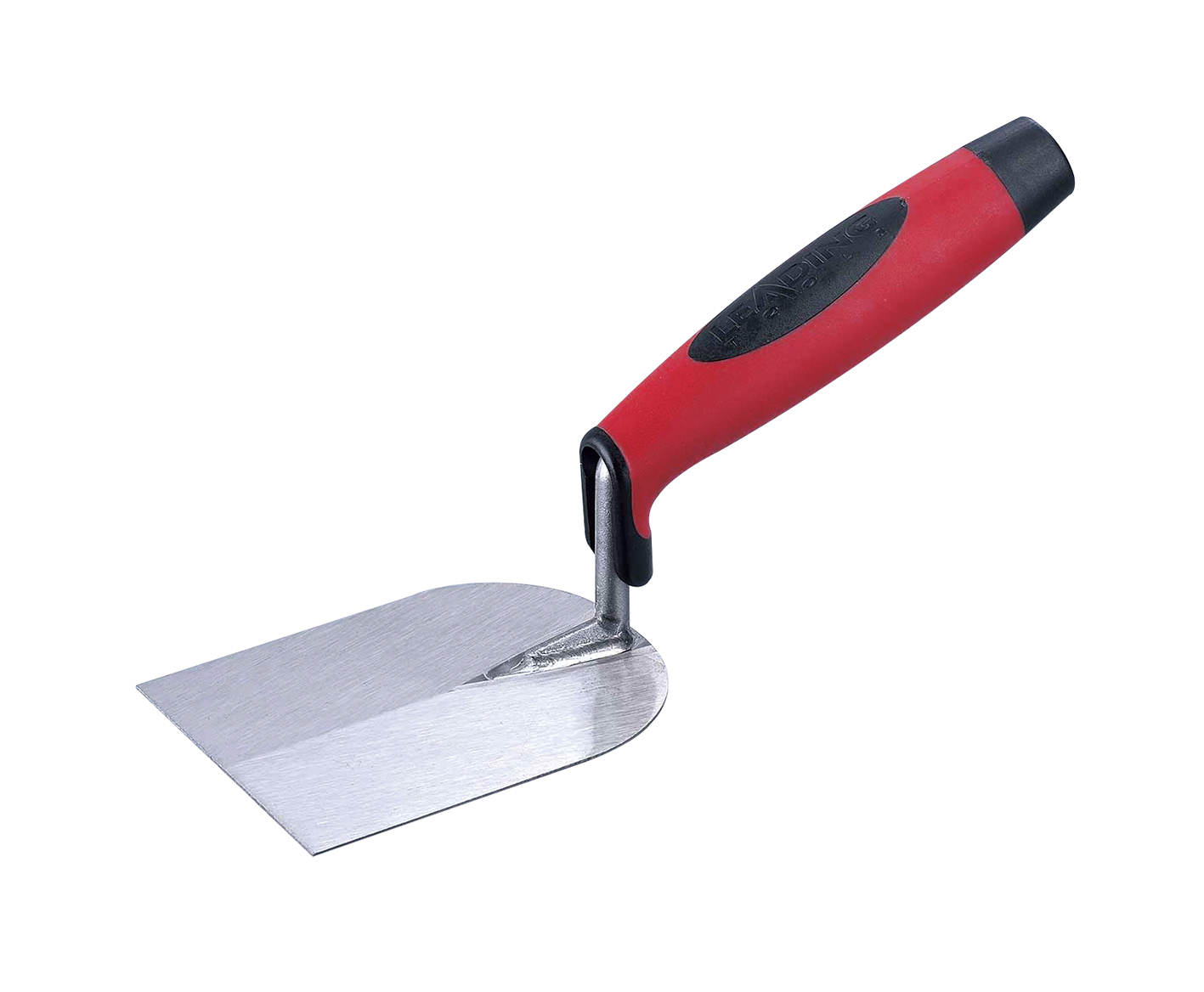
European Margin Trowel — CO2 Welded Carbon Steel
Product Description
Product name: European Margin Trowel
Construction line: CO2 Welded Carbon Steel
Art. Nr (eight sizes): 243621 (30 mm), 244621 (40 mm), 245621 (50 mm), 246621 (60 mm), 247621 (70 mm), 248621 (80 mm), 240621 (100 mm), 242621 (120 mm).
These eight art numbers are one product family in one blade pattern. They differ only in blade size, and are offered as one range, "European Margin Trowel / CO2 Welded Carbon Steel", alongside the stainless steel sister line.
The European Margin Trowel is used for filling corners, smoothing and patching.
The blade is flat with a straight, square leading edge (toe), lightly rounded toe corners, near-parallel sides and a semicircular heel where the shank joins the blade. This is the European margin/bucket-trowel outline, not a plain rectangle and not a pointed brick-trowel blade. The square toe is the working feature: it lets the operator run material right into a corner, along a window reveal, or up against a screed rail without leaving an unfinished radius, while the rounded heel keeps the tool from digging in when the blade is drawn back.
The blade face is flat and continuous, with no notches, serrations or teeth of any kind. It is a spreading, filling and smoothing tool, not an adhesive-combing tool; for notched adhesive application see the Leading Tools Notched Trowel range.
The family runs 30, 40, 50, 60, 70, 80, 100 and 120 mm. The catalog lists the size in mm only; contact Leading Tools sales for the measured blade dimensions of each size.
The blade is carbon steel. The carbon steel blade costs less, and it must be wiped dry and given a thin coat of tool oil after use, or it will rust. Leading Tools also offers the stainless sister line 243821–242821 in the identical eight sizes.
The blade and the shank are separate steel components joined by CO2 welding at the heel.
The handle is the BF21 soft grip handle. Soft grip is the practical choice for detail work, because a margin trowel is held for long spells at low force and a wet, hard handle is what makes narrow work drift off line.
A contractor selects the tool by the band he actually has to fill or finish. Eight steps between 30 mm and 120 mm mean the blade can be matched to a reveal, a joint, a patch or a cornice run instead of forcing a fixed blade into it.
US-pattern margin trowels are specified as width × length in inches, which gives four or five choices in a narrow band around 38–51 mm wide. The metric series covers a range those patterns do not reach at either end.
At 30–40 mm the blade goes into channels and reveals that a standard trowel does not enter easily; at 60–80 mm it does the general narrow-band finishing that a small plastering trowel is clumsy at; at 100–120 mm it spreads a broad strip fast while staying narrower than a finishing trowel.
243621–242621 (carbon steel) and 243821–242821 (stainless steel) are the same eight widths, the same blade pattern and the same soft grip handle; only the blade material and construction change. The stainless version suits wet trades, renovation crews and humid climates; the carbon version suits dry work.
Other handles can be fitted on request: contact Leading Tools sales.
The European Margin Trowel CO2 is a width-controlled detail tool for filling corners, smoothing and patching. Its value is placing and finishing a measured band of material accurately, not carrying a large load of mortar.
| Situation | Why this tool | Suggested width |
|---|---|---|
| Plaster or render edge finishing around window reveals, door frames and corners | Square toe finishes hard into the corner; narrow blade keeps the band straight | 40–80 mm |
| Patching small cracks, blown plaster and spalled areas | Small blade places filler exactly where it is needed and wastes less material | 30–60 mm |
| Back-buttering small tiles and mosaics | Standard margin trowel task; the flat face loads the tile back evenly | 50–80 mm |
| Mixing and lifting small quantities of thinset, grout or filler from a bucket | The classic secondary use of a margin trowel | 80–120 mm |
| Working mortar around pipe penetrations, boxes and services | A narrow blade reaches behind and around them more easily | 30–50 mm |
| Detail and cornice work in plastering and rendering | : | 30–60 mm |
| Narrow finishing bands too tight for a plastering trowel | Width-matched blade avoids overrunning the band | 80–120 mm |
| Step | Action | Note |
|---|---|---|
| 1 | Grip with the thumb on top of the handle and the remaining fingers wrapped underneath; keep the hand relaxed | A relaxed grip reduces fatigue over long detail sessions |
| 2 | Load only part of the blade: roughly the front half, from the hawk or bucket | Overloading the blade is the most common cause of losing control |
| 3 | Present the blade at a low angle to the surface, not steeply | A shallow angle spreads rather than scrapes |
| 4 | Move in smooth, continuous sweeps at even pressure | Uneven pressure is the second common fault and shows as ridging |
| 5 | Feather the edges of the applied band so it blends into the surrounding surface | Feathering is what makes a patch invisible after paint |
| 6 | Check the band width against the tool width and change size rather than fighting the tool | The reason for buying an eight-step family in the first place |
| 7 | Scrape the blade clean and rinse before the material starts to set | Hardened mortar on a carbon blade both scars the face and starts corrosion |
For local smoothing, band work, edge cleanup and narrow render corrections around windows, corners and architectural transitions, the 30–60 mm sizes give the control that a full-size plastering trowel cannot. Work the material in from the corner outwards, then feather back into the existing render.
In tile installation the margin trowel is the everyday tool for back-buttering small units, adjusting mortar at cut pieces and borders, and mixing small amounts of thinset. Use the 50–80 mm sizes: wide enough to load a tile back in two passes, narrow enough to reach an edge without disturbing the neighboring joint. This is a flat blade; for combed adhesive beds you still need a notched trowel.
For local defects, cracks, voids and patch areas, the narrower sizes reduce both overspread and clean-up. Fill slightly proud, let the material take up, then cut back and feather with the same blade. Because carbon steel is being used against fresh plaster and mortar, this is the application where the post-use routine in Care & Maintenance below matters most.
For narrow vertical or horizontal finishing bands with restricted access: behind downpipes, beside frames, along service runs; pick the width that matches the band rather than adapting a wider tool.
Q: What does the "30 mm–120 mm" figure measure, and which sizes should a first order carry?
A: It is the nominal size in mm as listed in the catalog; contact Leading Tools sales for the measured blade dimensions of each size. A practical opening is a mid-range core: a distributor covering both ends can open with 40, 60, 80 and 120 mm and add 30, 50, 70 and 100 mm on repeat orders.
Q: Is this the same as a US margin trowel, and is the blade notched?
A: It is the same tool family but a different specification system.
US patterns are specified as width × length in inches (5" × 1.5", 5" × 2", 6" × 2", 8" × 2"), clustering around 38–51 mm of blade width, while the EU series is listed in mm only, from 30 mm to 120 mm, so a US part number cannot be substituted directly for a metric width. The blade face is flat and unnotched; if you need a combed adhesive bed, use a notched trowel.
Q: Carbon steel or the stainless version, which should I stock?
A: Both lines run the same eight sizes.
Carbon steel (243621–242621) must be dried and oiled after use or it will rust; stainless (243821–242821) has high corrosion resistance and a low maintenance burden, though chlorinated water, coastal air or prolonged soaking can still cause rust spots, so rinse with clean water and dry after use. Wet trades, renovation crews and humid climates suit the stainless version.
Q: How do I deal with material sticking, rust or a blade that is the wrong width?
A: If material sticks heavily, the usual causes are residue build-up, a roughened blade face, or a mix that is too wet or too dry, so clean the face fully and adjust the mix.
If rust appears, remove it early with fine steel wool or a plastic pad, dry fully and apply protective oil after each wash; rust or discoloration at the heel weld means moisture is trapped in the junction, so clean and oil that area deliberately. If the blade feels too wide or coverage is too slow, change the size: drop to 30–50 mm when control is the issue, and move up to 80–120 mm when the band is wider than the blade.
Q: The shank feels loose or the joint looks fatigued. What now?
A: Stop using the tool and inspect the weld. Visible cracking or structural looseness at the blade-shank junction means replacement, not repair; a welded joint that has started to move will not be brought back by tightening or re-bending.
The European Margin Trowel uses a flat, unnotched blade with a square toe, lightly rounded toe corners and a rounded heel, sized across an eight-step metric ladder. Compared with US margin trowels, the EU version is built around metric width selection rather than a small set of imperial width × length combinations.
This makes the family practical for users who choose the blade primarily by:
This model is specified as CO2 Welded Carbon Steel. Blade and shank are separate steel components joined by CO2 welding at the heel. The blade-to-shank junction is the area to inspect during service life; see Care & Maintenance below.
| Item | Specification |
|---|---|
| Type | Soft grip handle |
| Handle code | BF21 |
| Item | Specification |
|---|---|
| Product type | European Margin Trowel (square-toe, rounded-heel detail trowel) |
| Blade material | Carbon steel |
| Blade face | Flat, unnotched |
| Construction | CO2 welded blade-to-shank joint |
| Size system | Metric size (mm), 30–120 mm in eight steps |
| Sizes offered | 30, 40, 50, 60, 70, 80, 100, 120 mm |
| Shank | Cranked shank |
| Handle | Soft grip, BF21 |
| Item | European Margin Trowel | US Margin Trowel |
|---|---|---|
| Primary sizing logic | Metric size (mm) only | Blade width × blade length in inches |
| Sizes offered | 30, 40, 50, 60, 70, 80, 100, 120 mm | 5" × 1-1/2", 5" × 2", 6" × 2", 8" × 2" |
| Typical orientation | European plaster, render, tile-edge and masonry detail work | US masonry and tile detail work |
| Selection method | Choose the width the work band needs | Choose width and reach length together |
| Blade outline | Square toe, rounded heel, near-parallel sides | ; |
Both are called "margin trowel", but they are not the same specification system, and a US part number cannot be mapped one-to-one onto a metric width. The EU version is best understood as a European-width margin/detail trowel family.
Leading Tools also offers the European Margin Trowel — Spot Welded Stainless Steel line in the identical eight widths: 243821 (30 mm), 244821 (40), 245821 (50), 246821 (60), 247821 (70), 248821 (80), 240821 (100), 242821 (120). The blade is stainless steel and the construction is spot welded rather than CO2 welded.
| Size | Recommended use |
|---|---|
| 30 mm | Very fine detail, narrow channels, edge correction, access-limited repairs |
| 40 mm | Fine repair work, slim joints, small adhesive placement |
| 50 mm | Precision finishing where a little more coverage per pass helps |
| 60 mm | Balanced control for general narrow-area work. |
| 70 mm | General-purpose EU margin work |
| 80 mm | Broader finishing strip with good control. |
| 100 mm | Faster coverage on medium-width bands |
| 120 mm | Widest option, for efficient spreading in confined but not ultra-tight areas. |
| Decision factor | CO2 Welded Carbon Steel (243621–242621) | Spot Welded Stainless Steel (243821–242821) |
|---|---|---|
| Blade material | Carbon steel | Stainless steel |
| Corrosion behavior | Will rust if stored wet or with mortar residue; needs drying and oiling | High corrosion resistance and low maintenance; chlorinated water, coastal air or prolonged soaking can still cause rust spots, so rinse with clean water and dry after use. |
| Best fit | Dry trades, crews with tool-care discipline | Wet trades, renovation and repair crews, humid climates |
| Widths offered | 30–120 mm, eight steps | 30–120 mm, eight steps |
Choose the European Margin Trowel when your workflow selects tools by metric width; when the job is plaster, render or tile-edge detail work of the kind metric margin trowels are used for; or when you need a specific working width rather than a fixed imperial pattern.
For the traditional imperial width × length format, see the Leading Tools Margin Trowel (art. 044721–048721 and 144721–148721, 1-1/2" × 5" to 2" × 8").
All eight art numbers in the European Margin Trowel CO2 Welded Carbon Steel line.
| ART.NR | Blade size | Blade type | Material | Construction | Handle type |
|---|---|---|---|---|---|
| 243621 | 30 mm | European Margin Trowel, square toe / rounded heel | Carbon steel | CO2 welded | Soft grip, BF21 |
| 244621 | 40 mm | European Margin Trowel, square toe / rounded heel | Carbon steel | CO2 welded | Soft grip, BF21 |
| 245621 | 50 mm | European Margin Trowel, square toe / rounded heel | Carbon steel | CO2 welded | Soft grip, BF21 |
| 246621 | 60 mm | European Margin Trowel, square toe / rounded heel | Carbon steel | CO2 welded | Soft grip, BF21 |
| 247621 | 70 mm | European Margin Trowel, square toe / rounded heel | Carbon steel | CO2 welded | Soft grip, BF21 |
| 248621 | 80 mm | European Margin Trowel, square toe / rounded heel | Carbon steel | CO2 welded | Soft grip, BF21 |
| 240621 | 100 mm | European Margin Trowel, square toe / rounded heel | Carbon steel | CO2 welded | Soft grip, BF21 |
| 242621 | 120 mm | European Margin Trowel, square toe / rounded heel | Carbon steel | CO2 welded | Soft grip, BF21 |
Carbon steel needs a routine; stainless needs less upkeep but still needs rinsing and drying after use. The following is the standard routine for carbon steel trowels.

In compliance with EU personal data protection laws, we are committed to protecting and providing you with control over your personal data. By clicking "Accept All", you allow us to place cookies to enhance your experience on this site, help us analyze site performance and usage, and enable us to deliver relevant marketing content. You can manage your cookie settings below. By clicking "Agree" you agree to the current settings. For more information, please visit the Privacy Statement.
This website uses cookies
In compliance with EU personal data protection laws, we are committed to protecting your personal data and providing you with control over it. By clicking "Agree", you allow us to place cookies to improve your experience on this site, help us analyze site performance and usage, and allow us to deliver relevant marketing content.
By clicking "Only necessary" you allow us to place only necessary cookies. The website cannot function without these cookies and you cannot switch them off on your system. These cookies are typically set only in response to an action you perform (i.e. a service request), such as setting privacy preferences, logging in, or filling in a form. You can set your browser to block or prompt you for these cookies, but this may prevent some site features from working.