
Copyright 2026 © Leading Tools Industrial Co., Ltd.
All Rights Reserved. Website Design by Awakening Design
CATALOG TYPE
Product Categories
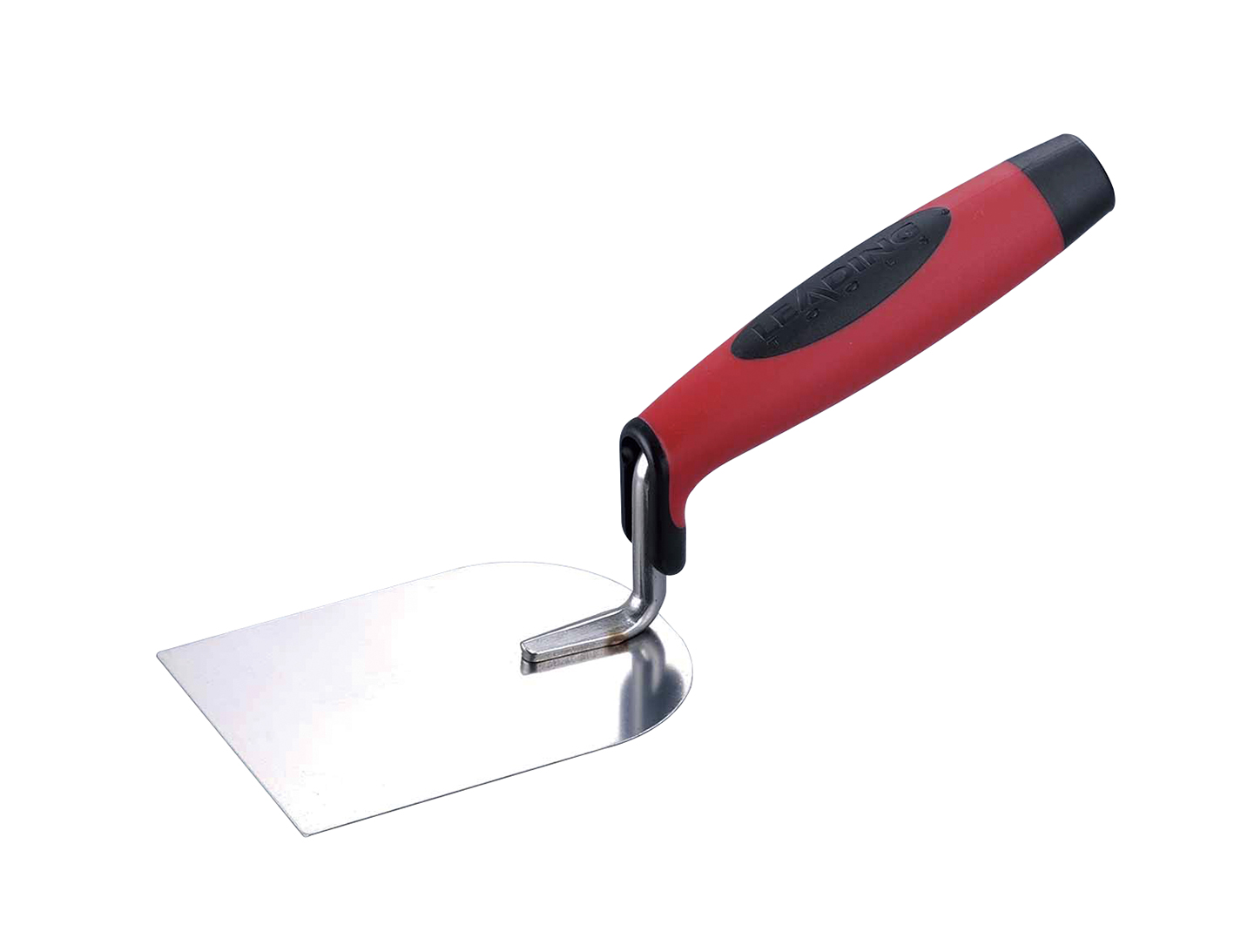
European Margin Trowel — Spot Welded Stainless Steel
Product Description
Product name: European Margin Trowel
Construction line: Spot Welded Stainless Steel
Art. Nr (eight metric sizes): 243821 (30 mm), 244821 (40 mm), 245821 (50 mm), 246821 (60 mm), 247821 (70 mm), 248821 (80 mm), 240821 (100 mm), 242821 (120 mm).
This is the stainless line of the European Margin pattern. Alongside it Leading Tools offers its carbon-steel twin, European Margin Trowel CO2 Welded Carbon Steel (243621, 244621, 245621, 246621, 247621, 248621, 240621, 242621), in the identical eight sizes.
The two lines differ in blade material and in joining process; the blade pattern, the size ladder and the handle are the same. See the Selection Guide for the choice between the two.
The European Margin Trowel is used for filling corners, smoothing and patching.
The European Margin blade. The blade is a European square-toe margin blade: a trapezoid that widens from a narrow heel at the shank to a wide, straight, squared working edge at the toe.
It is not the narrow parallel-sided rectangle of the American Margin Trowel (forged 044721, 045721, 046721, 048721; CO2 144721, 145721, 146721, 148721), which is a different tool sold in inch sizes. The names are close; the blades are not. See the comparison table in Specifications Overview.
Corrosion resistance where the work is wet. This is the main reason to buy this line rather than the CO2 carbon-steel line. Carbon steel tools rust in wet work and can leave iron staining on adjacent brick and stone; a stainless blade lowers that risk. Stainless is not rust-proof: chlorinated water, coastal air or prolonged soaking can still cause rust spots.
Lower risk of rust staining on the finished face. Patching and smoothing are finishing operations; whatever the blade leaves behind stays visible. On pale brick, light-coloured stone and pigmented decorative mortars, an iron stain from a rusting blade is a defect that has to be cleaned off the wall, not off the tool. A stainless blade carries a lower risk of rust staining than carbon steel.
Lower maintenance burden in the field. High corrosion resistance and low maintenance; chlorinated water, coastal air or prolonged soaking can still cause rust spots, so rinse with clean water and dry after use. Stainless does not require the oil-after-every-use discipline that keeps a carbon blade serviceable, which is a practical advantage for crews working outdoors, in rain, or away from a workshop.
A metric size ladder that matches the work. Eight widths from 30 mm to 120 mm cover tight corners and small patches at the narrow end through to wider smoothing bands and larger patches at the top. The squared toe fills corners and leaves a flat, regular face.
Intended use. This tool is for spreading, filling and finishing mortar-type materials and should not be worked against hard surfaces. It is not a pry bar, not a chisel, and not a substitute for a forged brick trowel where the blade will be leveraged. See the Selection Guide and Care & Maintenance sections for where the line is.
Two views on blade material. Stainless is chosen for corrosion resistance and for lower risk of staining the work. Carbon steel blades cost less, but they must be wiped dry and thinly oiled after use, or they will rust. Leading Tools offers both constructions in the same eight sizes so the buyer can decide.
| Situation | Use the European Margin SS? | Notes |
|---|---|---|
| Filling corners, reveals and returns in plaster or render | Yes, primary use | The squared toe runs right into the corner |
| Smoothing and levelling small areas and edges | Yes | The flat blade leaves a flat, regular face |
| Patching small cracks, holes, honeycombing and spalled areas | Yes | Fill slightly proud, then cut back and smooth with the same blade |
| Mortar work in confined space: reveals, returns, around fixtures | Yes | Margin trowels exist for applying mortar and adhesive where a full trowel will not fit |
| Stucco / EIFS detail and edge work | Yes | , |
| Tile work: back-buttering, mixing a small batch of thinset, cleaning an edge | Yes | Standard tile-trade use of a margin trowel |
| Pressing and compacting mortar into brick or block joints | No | Use a Tuck Pointing Trowel or a Brick Jointer |
| Laying a full bed of mortar for brickwork | No | Use a brick trowel: this blade is too small to carry a bed |
| Prying, levering, chopping, working against hard surfaces | No | A spot-welded stainless trowel is specified for mortar-type materials only, and should not be used on hard surfaces |
| Mixing a full bucket of mortar | No | Use a mixing paddle; this blade will bend |
| Step | Action | Notes |
|---|---|---|
| 1 | Load the blade from the board or hawk | Take less than a brick-trowel load; on the 30–40 mm sizes take only a small ribbon |
| 2 | Present the blade to the work with the square toe against the corner or edge | The squared toe is what produces a flat, regular face |
| 3 | Work the material in at a shallow angle (about 15°–30°) to the working surface | Lay the blade flatter for the final levelling pass |
| 4 | Fill the corner or patch slightly proud, then smooth it level | Filling and smoothing is the defined purpose of this blade |
| 5 | Smooth with consistent single-direction passes | Avoid reversing direction inside one pass |
| 6 | Clean the blade before the material sets | Wash and dry |
This is the tool's main job. In plaster, render and masonry detail work, the squared toe runs right into a corner or up to an edge, fills it, and smooths the surface level. For a patch, fill the defect slightly proud, let the material take up, then cut back and smooth with the same blade.
Match the blade width to the work: the 40–60 mm sizes for corners and edges, 80–120 mm for wider bands and larger patches. Pressing and compacting mortar into brick or block joints is the job of the Tuck Pointing Trowel or the Brick Jointer, not of this blade.
The stainless argument is strongest here. Patching and smoothing happen on a visible face, and rust marks transferred from a carbon blade onto a light-coloured surface have to be cleaned off the wall.
Narrow piers, wall returns, reveals around windows and doors, the margin between new work and an existing surface, and work around fixtures all restrict lateral clearance. A margin trowel is bought precisely to apply mortar and adhesive where a larger trowel cannot reach. The same reach argument extends to patching and small render areas: filling honeycombing in a concrete face, smoothing a patch, and working a small parge area, using the 70–120 mm sizes for area coverage.
In render and stucco work the square toe cuts a clean edge at a stop bead or a reveal, and the stainless blade has high corrosion resistance and suits wet mortar and render work.
In tile setting the same tool is used to back-butter a tile, to mix a small batch of thinset or grout, to lift and reset a tile, and to clean adhesive off an edge. The 40–60 mm sizes are the practical band for this work. A stainless blade is the sensible choice here because thinset and grout are worked wet and the tool spends its day in a bucket of water.
Q: Which size should I order if I can only stock one, and can I use it for tiling?
A: 50 mm (245821) or 60 mm (246821); that band covers general corner filling, smoothing and patching and is the most versatile for mixed work. If the customer works mainly on larger patches or render, go to 80 mm (248821) instead. The tile trade uses a margin trowel to back-butter tiles (spread adhesive on the tile back), mix small batches of thinset or grout, lift tiles and clean edges, and the 40–60 mm sizes are the practical band for that.
Q: How is it different from the Margin Trowel (US pattern) and from a Pointing Trowel?
A: The Margin Trowel is a narrow, parallel-sided rectangular blade sold in inch sizes from 1-1/2" x 5" to 2" x 8", while this is a European trapezoidal margin blade sold in metric widths from 30 to 120 mm; do not substitute one for the other on an order without checking with the customer.
Compared with a Pointing Trowel, the difference is the toe and the job: a Pointing Trowel has a pointed toe and is used for picking up small amounts of mortar, patching and small rebuilds, and carrying mortar to the edge of the joint, while a margin trowel has a flat, square end that fills corners and smooths a patch flat. Neither presses mortar into a joint; that is the job of the Tuck Pointing Trowel or the Brick Jointer.
Q: Carbon steel or stainless, which should I choose?
A: There is no single answer. Stainless has high corrosion resistance and suits wet mortar work where staining on the finished face matters, while carbon steel must be wiped dry and oiled after use. Leading Tools offers both lines in the same eight sizes, so specify whichever matches the customer's work and habits.
Q: My stainless blade shows rust spots, a rainbow tint, or mortar drying on it. What do I do?
A: Rust spots are most often iron transferred onto the surface from a steel wire brush, steel wool or rusting carbon-steel tools; chlorinated water, coastal air or long immersion can also cause them on stainless.
Clean them off with a stainless cleaner or a non-ferrous (iron-free) abrasive pad, then remove the source. A rainbow tint is a cosmetic heat-tint effect, but it means the blade has been heated, so check the edge for softening if it was ground hot. If mortar is drying on the blade, do not chisel it or use a wire brush; soak the blade in water, lift the softened material off with a wooden or plastic scraper, then wash and dry the tool.
Q: What should I watch for at the blade-to-shank joint, and when do I replace it?
A: A spot-welded assembly suits the loading a margin trowel normally sees, such as carrying, spreading, filling and striking off mortar, but it is not built for leverage, prying or work against hard surfaces.
Visible separation at any weld point, movement or flex at the joint, or a click or knock from the joint means the tool comes out of service. Replace it for a bent blade, a loose or separated spot weld, or significant corrosion or pitting at the joint, and dress minor edge roll back with a fine stone.
The construction line for this product is "Spot Welded Stainless Steel". The blade and the shank are two stainless parts joined by spot welding. The result is a fabricated tool, in contrast to a one-piece forging.
Two practical points follow:
| Attribute | Specification |
|---|---|
| Blade shape | Trapezoidal margin blade: straight squared toe, flanks tapering inward to a narrower heel |
| Toe | Straight and square, full width |
| Blade material | Stainless steel |
| Size designation | Width across the squared toe, 30–120 mm |
| Attribute | Specification |
|---|---|
| Handle type | Soft grip handle, BF21 |
| Other handles | Can be fitted on request: contact Leading Tools sales |
| Shank | Spot welded to the blade heel |
| Blade-to-shank joint | Spot welded |
Stainless has high corrosion resistance and a low maintenance burden, and it is chosen for that reason where iron staining on adjacent surfaces is unacceptable. It is not maintenance-free, however: chlorinated water, coastal air or prolonged soaking can still cause rust spots, so a stainless trowel should be rinsed with clean water and dried after use.
| Attribute | European Margin SS (this line) | European Margin CO2 | Margin Trowel (US pattern) |
|---|---|---|---|
| Art. Nr | 243821–242821 (eight sizes) | 243621–242621 (eight sizes) | Forged 044721, 045721, 046721, 048721; CO2 144721, 145721, 146721, 148721 |
| Blade shape | Trapezoid, squared toe | Trapezoid, squared toe | Narrow parallel-sided rectangle, squared toe |
| Blade material | Stainless steel | Carbon steel | Forged: high carbon steel; CO2 welded: carbon steel |
| Construction | Spot welded | CO2 welded | Forged one-piece, or CO2 welded |
| Sizing | Metric, 30–120 mm | Metric, 30–120 mm | Imperial, 1-1/2"x5" to 2"x8" |
| Handle | Soft grip | Soft grip | Soft grip |
| Bought for | Wet, staining-sensitive work | Dry, indoor work | US-pattern margin and detail work |
| Size band | Art. Nr | Typical work |
|---|---|---|
| 30–40 mm | 243821, 244821 | Narrow corners, fine edge correction, small repairs |
| 50–70 mm | 245821, 246821, 247821 | General corner filling, smoothing and patching: the everyday working band |
| 80–100 mm | 248821, 240821 | Wider smoothing bands and larger patches |
| 120 mm | 242821 | Widest band, spreading and smoothing over area |
These bands are practical guidance, not a standard, so the ranges above should be read as a starting point for selection and confirmed against the customer's own work.
Both lines run the same eight sizes. The decision is not about quality; it is about where the tool works and how the crew maintains it.
Choose this stainless line when:
Choose the CO2 carbon-steel line (243621–242621) when:
Match the line to what the tradesman already uses and to the work.
| Task | Recommended width | Reason |
|---|---|---|
| Very narrow corners and fine edges | 30–40 mm (243821, 244821) | Only the narrowest blade reaches into the corner without riding onto the adjacent surface |
| Corner filling and edge smoothing | 40–60 mm (244821, 245821, 246821) | The common working band |
| Wider bands of smoothing | 60–80 mm (246821, 247821, 248821) | Enough width to work at speed while still controllable |
| Larger patches and wide bands | 80–120 mm (248821, 240821, 242821) | Covers more area per pass, fewer passes |
| General purpose, mixed work | 50–70 mm (245821, 246821, 247821) | The most versatile band for a crew carrying one size |
| Render and concrete patch repair | 70–120 mm (247821, 248821, 240821, 242821) | Larger face for spreading over area |
| Tile detail work, back-buttering, small thinset batches | 40–60 mm (244821, 245821, 246821) | The band the tile trade works a margin trowel in |
A crew that stocks two sizes typically wants one in the 50–60 mm band and one at 80 mm or above.
The square toe is the point of this blade. It runs right into a corner, fills it, and smooths the surface flat. If the customer actually needs a pointed toe to work mortar into a small void or to carry mortar to the edge of a joint, the correct tool is a Pointing Trowel, which is a different blade shape.
The tool that presses mortar into a joint and compacts it is the Tuck Pointing Trowel or the Brick Jointer. Check those ranges before substituting a European Margin size for them.
| ART. Nr | Size | Best for |
|---|---|---|
| 243821 | 30 mm | Narrow corners and fine edge work |
| 244821 | 40 mm | Narrow corners, fine patching |
| 245821 | 50 mm | General corner filling and smoothing |
| 246821 | 60 mm | General smoothing, general purpose |
| 247821 | 70 mm | Smoothing and patching, wider bands |
| 248821 | 80 mm | Wide bands, larger patches |
| 240821 | 100 mm | Large patches and render work |
| 242821 | 120 mm | Widest band, spreading over area |
All eight art numbers in the European Margin Trowel Spot Welded Stainless Steel line.
| ART. Nr | Size | Blade type | Material | Construction | Blade-to-shank connection | Handle type |
|---|---|---|---|---|---|---|
| 243821 | 30 mm | European Margin — trapezoid, squared toe | Stainless steel | Spot welded | Stainless shank, spot welded to blade heel | Soft grip, BF21 |
| 244821 | 40 mm | European Margin — trapezoid, squared toe | Stainless steel | Spot welded | Stainless shank, spot welded to blade heel | Soft grip, BF21 |
| 245821 | 50 mm | European Margin — trapezoid, squared toe | Stainless steel | Spot welded | Stainless shank, spot welded to blade heel | Soft grip, BF21 |
| 246821 | 60 mm | European Margin — trapezoid, squared toe | Stainless steel | Spot welded | Stainless shank, spot welded to blade heel | Soft grip, BF21 |
| 247821 | 70 mm | European Margin — trapezoid, squared toe | Stainless steel | Spot welded | Stainless shank, spot welded to blade heel | Soft grip, BF21 |
| 248821 | 80 mm | European Margin — trapezoid, squared toe | Stainless steel | Spot welded | Stainless shank, spot welded to blade heel | Soft grip, BF21 |
| 240821 | 100 mm | European Margin — trapezoid, squared toe | Stainless steel | Spot welded | Stainless shank, spot welded to blade heel | Soft grip, BF21 |
| 242821 | 120 mm | European Margin — trapezoid, squared toe | Stainless steel | Spot welded | Stainless shank, spot welded to blade heel | Soft grip, BF21 |
Matching carbon-steel line, same eight sizes: European Margin Trowel CO2 Welded Carbon Steel — 243621 (30 mm), 244621 (40 mm), 245621 (50 mm), 246621 (60 mm), 247621 (70 mm), 248621 (80 mm), 240621 (100 mm), 242621 (120 mm).
| Condition | Carbon steel (European Margin CO2) | Stainless steel (this line) |
|---|---|---|
| Surface rust in wet work | Develops readily; oiling after use is required | Resists corrosion; still wash and dry after use |
| Iron staining on the finished face | A known problem on pale brick and stone | Lower risk of rust staining than carbon steel |
| Pitting after long damp storage | : | Possible in bad storage conditions; rinse and dry |
| Routine after use | Wash, dry, oil | Wash, dry |

In compliance with EU personal data protection laws, we are committed to protecting and providing you with control over your personal data. By clicking "Accept All", you allow us to place cookies to enhance your experience on this site, help us analyze site performance and usage, and enable us to deliver relevant marketing content. You can manage your cookie settings below. By clicking "Agree" you agree to the current settings. For more information, please visit the Privacy Statement.
This website uses cookies
In compliance with EU personal data protection laws, we are committed to protecting your personal data and providing you with control over it. By clicking "Agree", you allow us to place cookies to improve your experience on this site, help us analyze site performance and usage, and allow us to deliver relevant marketing content.
By clicking "Only necessary" you allow us to place only necessary cookies. The website cannot function without these cookies and you cannot switch them off on your system. These cookies are typically set only in response to an action you perform (i.e. a service request), such as setting privacy preferences, logging in, or filling in a form. You can set your browser to block or prompt you for these cookies, but this may prevent some site features from working.