
Copyright 2026 © Leading Tools Industrial Co., Ltd.
All Rights Reserved. Website Design by Awakening Design
CATALOG TYPE
Product Categories
Flooring Trowel
Product Description
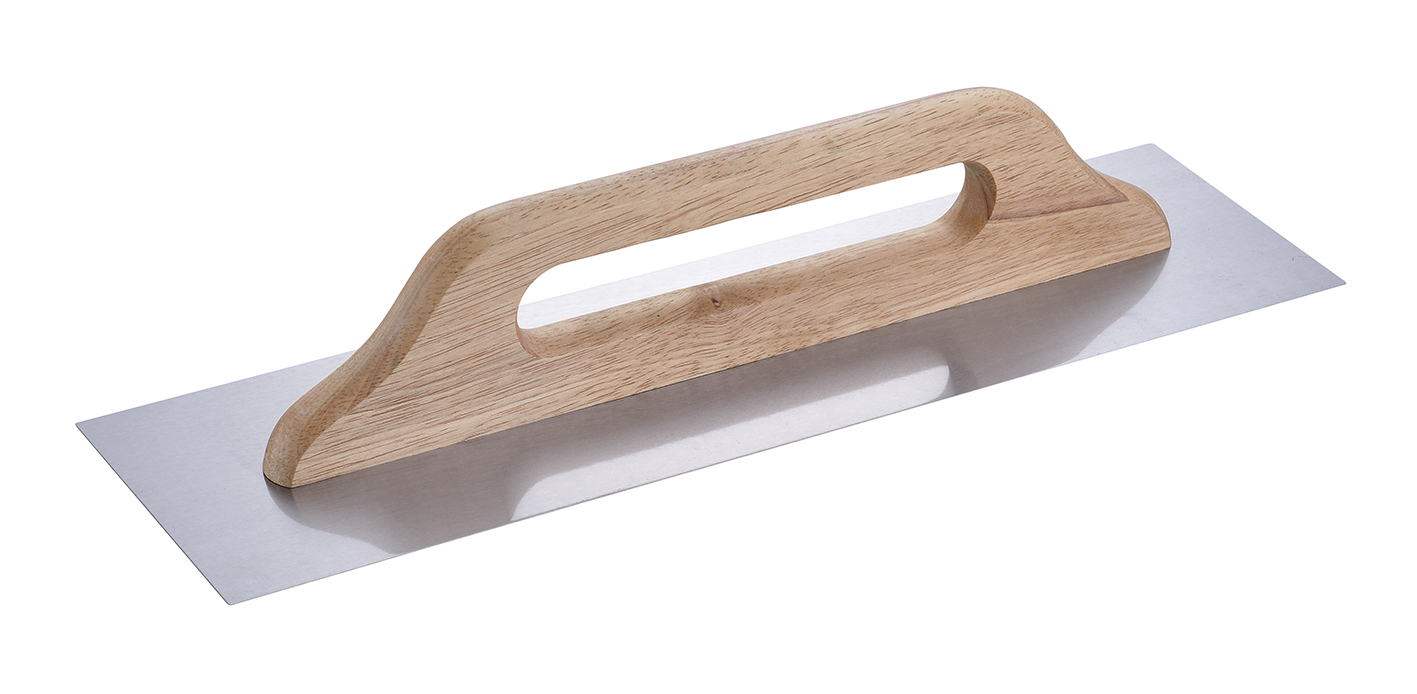
Flooring Trowel — Art. Nr 711100, 130 mm x 480 mm (5.1" x 18.9")
The Flooring Trowel is Leading Tools' long flat-blade trowel, sitting in the Plaster Trowel line alongside the German Standard Trowel and sharing that group's three construction notes: Spot Riveted, Carbon & Stainless Steel available, Quality Consistent.
The four art numbers on this page are carbon steel; each art number corresponds to one blade material. Art. Nr 711100 is the 130 mm x 480 mm size; three further sizes complete the group, 712100 (130 x 500 mm), 713100 (120 x 480 mm) and 714100 (120 x 500 mm). All four carry the same one-piece wooden handle, mounted along the full length of the blade with an oval hand opening rather than the bridge-type handle used on the German Standard Trowel alongside it in the range.
The Flooring Trowel has a flat, un-notched blade for spreading, levelling and finishing. For combing tile adhesive into ribs, use a notched trowel; the two tools do different jobs in the same sequence.
Correct tool for the levelling stage. 711100 spreads and flattens material before a notched trowel combs the adhesive; use 711100 for pre-spread and finishing work, and a notched trowel for combing.
Blade length matched to the work, not to the shelf. At 480 mm the blade spans roughly 1.7x the length of the 280 mm German Standard Trowel in the Leading Tools range, so each pass covers more ground and fewer overlapping strokes are needed on open floor. On a screed or slab this directly reduces the number of joint lines the finisher has to work out of the surface.
Carbon steel blade, stainless through sales. The listed art numbers are carbon steel, used in general mortar work. Each art number corresponds to one blade material; wash-down users who need stainless steel can contact Leading Tools sales.
Spot Riveted mounting. Spot Riveted is the specified construction for this whole trowel group.
Wooden handle with a full-length grip. The handle is a solid wooden block spanning the blade with an oval hand opening. Note that a wooden handle will absorb a small amount of water from the mortar during use.
Who buys this tool
| Buyer | What they use it for |
|---|---|
| Screed and floor-levelling crews | Final smoothing pass on cement screed after the float board |
| Concrete finishers | Hand steel-trowel pass on small slabs, edges and areas a power trowel cannot reach |
| Tile installers | Flat pre-spread of adhesive over open floor before combing with a notched trowel |
| Plasterers and renderers | Spreading and levelling render, plaster and filler over wide wall areas |
| Repair and topping contractors | Distributing repair mortar and thin toppings over patches and transition zones |
| Stage of work | Use 711100? | Why |
|---|---|---|
| Compacting fresh screed | No: use a float board first | The screed is compacted and struck with a float board before the steel trowel comes out |
| Smoothing / closing cement screed | Yes | The steel smoothing trowel (Glättekelle) is drawn diagonally to flatten and close the surface after the float board |
| Hand-finishing a concrete slab | Yes | After the power trowel, finishers make a final hand pass with a steel trowel, pressing the surface smooth and dense |
| Spreading render, plaster or filler on a wall | Yes | Applying and levelling plaster, mortar, filler and adhesive over wide areas is the core use of this tool class |
| Pre-spreading tile adhesive before combing | Yes | Flat trowels are levelling tools used before the notched trowel stage |
| Combing tile adhesive into ribs | No | Notching is a separate operation with a separate tool; a flat blade must not be substituted |
| Buttering the back of a large-format tile | Supporting use only | Follow the adhesive manufacturer's notch and coverage requirements; notch sizing is set by tile size |
| Corners, small patches, confined areas | No | Use a shorter trowel; a 480 mm blade needs room to swing |
| Step | Action | Reason |
|---|---|---|
| 1 | Mix the material to the consistency the manufacturer specifies | A mix that is too dry makes the long blade chatter and skip |
| 2 | Place a workable quantity onto the substrate | The trowel distributes material; it is not a scoop |
| 3 | Where the substrate is fresh screed, compact and strike it with a float board before the steel trowel | Steel troweling an uncompacted bed drags material instead of closing it |
| 4 | Hold the blade at a shallow working angle and draw it in long passes | Pull the steel trowel diagonally across the bay |
| 5 | Work diagonally across the bay rather than in a single direction only | Diagonal passes cross the previous pass lines and average out ridges |
| 6 | Keep pressure even across the full blade width | Loading one end of a 480 mm blade produces a thickness taper from end to end |
| 7 | At the edges, lift the surplus material away gently rather than dragging it | Dragging surplus at the perimeter tears the surface that has already been closed |
| 8 | If the system requires ribs, change to the correct notched trowel | Combing is a separate operation with its own tool and notch size |
| 9 | Wash the blade before the material sets | Cured mortar on a long straight edge is the fastest way to ruin the tool |
When laying cement screed the order is clear: the screed is placed and levelled to the rails, compacted and struck with a float board using a sweeping motion, and only then smoothed with the steel trowel drawn diagonally across the surface; at the perimeter the surplus mortar is lifted away carefully so the finished surface is not broken open. A 480 mm blade is used in this pass because a longer straight edge bridges the ripples left by the float board instead of following them.
On concrete floors the mechanical power trowel does the bulk of the finishing, but finishers commonly follow it with a hand steel-trowel pass, pressing the surface to make it smoother and denser: the steel-trowel finish. This is where a long flat blade earns its place: edges, columns, doorways and any strip the power trowel cannot reach still have to match the machine-finished field.
On open floor sections the adhesive has to be placed and flattened quickly before it skins over, then combed.
Flat plastering trowels are levelling tools and notched trowels are a separate adhesive-application category, so where needed the adhesive can first be flattened with the flat trowel and then combed with a notched trowel. Using the long flat blade for the pre-spread reduces the number of short overlapping passes a notched trowel would otherwise have to make while also carrying material.
Spreading and levelling plaster, mortar, filler and adhesive across large wall areas is the primary use for this tool class. A rectangular flat trowel like this one is for spreading and levelling wide areas, while a triangular trowel is for picking up and placing material.
Q1. Is this a notched "flooring trowel" for tile adhesive?
No. Some tools sold as a "flooring trowel" or "floor trowel" are notched trowels for combing tile adhesive. Art. Nr 711100 is a flat, un-notched long trowel: a long plastering trowel with a flat blade.
Q2. Can I use it to comb tile adhesive instead of buying a notched trowel?
No. A flat trowel levels, while a notched trowel is a separate step that sets the bed thickness and coverage to suit the tile size. The two tools are bought together, not one instead of the other.
Q3. Which of the four article numbers should I stock first?
711100 (130 x 480 mm): the wider 130 mm blade at the 480 mm length, which is easier to control in rooms with fixtures and walls close in (see Selection Guide).
Q4. Carbon steel or stainless steel?
The listed art numbers are carbon steel, the routine site option; each art number corresponds to one blade material. Stainless is the choice where the tool is washed frequently or used in wet conditions, because it has high corrosion resistance and low maintenance; chlorinated water, coastal air or prolonged soaking can still cause rust spots, so rinse with clean water and dry after use; contact Leading Tools sales for a stainless steel blade.
Q5. Is a wooden handle a drawback compared with plastic?
Not for this application, but it behaves differently. A wooden handle absorbs a small amount of water from the mortar during use. Wash and dry it like the blade and keep it out of standing water.
| Item | Detail |
|---|---|
| Product name | Flooring Trowel |
| Article number | 711100 |
| Size | 130 mm x 480 mm (5.1" x 18.9") |
| Construction | Spot Riveted |
| Blade material | Carbon Steel |
| Blade edge | Flat, un-notched |
| Handle | Wooden, full-length with oval hand opening |
| Note | Quality Consistent |
| Product line | Plaster Trowel |
The blade is a plain rectangular sheet with no notches, no radius stamped into the working edge and no reinforcing rib. Length-to-width ratio at 480 x 130 mm is about 3.7:1, so the long blade bridges across humps and hollows rather than following the substrate.
A fresh floor surface scratches easily at the blade corners. For decorative-concrete work, check the blade corners against a sample before starting the job.
The handle is a single wooden block, shaped along the top of the blade, with a long oval opening for the hand and a rounded rear end. This is a different mounting philosophy from the bridge-type handle on the German Standard Trowel in the same line, where a metal bracket lifts a shaped grip clear of the blade. The full-length wooden block spreads hand load along the blade rather than concentrating it at two mounting points.
| Art. Nr | Size | Width | Length | Blade material | Handle |
|---|---|---|---|---|---|
| 711100 | 130 mm x 480 mm | 130 mm | 480 mm | Carbon steel | Wooden |
| 712100 | 130 mm x 500 mm | 130 mm | 500 mm | Carbon steel | Wooden |
| 713100 | 120 mm x 480 mm | 120 mm | 480 mm | Carbon steel | Wooden |
| 714100 | 120 mm x 500 mm | 120 mm | 500 mm | Carbon steel | Wooden |
If your customer's job is combing tile adhesive into ribs, they need a notched trowel, and the notch size is chosen from tile size (for example a 1/4" x 1/4" square notch for medium wall and floor tile, 3/8" x 3/8" for medium floor tile). 711100 has no notches and cannot do that job. If the job is spreading, levelling or finishing a flat surface, 711100 is the right family.
| Length | Article numbers | Choose when |
|---|---|---|
| 480 mm | 711100 (130 mm), 713100 (120 mm) | 480 x 130 mm; easier to control in rooms with fixtures and walls close in |
| 500 mm | 712100 (130 mm), 714100 (120 mm) | Large open floors; gives the longest single pass in the group |
The 130 mm width (711100, 712100) puts more blade area on the surface per pass. The 120 mm width (713100, 714100) reduces the material load per pass and the effort needed to keep the blade flat, which suits lighter compounds and operators working long shifts.
The listed art numbers are carbon steel. Each art number corresponds to one blade material; for a stainless steel blade, contact Leading Tools sales. The comparison below is for reference.
| Version | Best for | Main consideration |
|---|---|---|
| Carbon Steel | General mortar, screed and routine site work | Needs drying after washing and light rust prevention in storage |
| Stainless Steel | Wet conditions, frequent wash-down, easier cleaning | High corrosion resistance and low maintenance; chlorinated water, coastal air or prolonged soaking can still cause rust spots, so rinse with clean water and dry after use |
Complete article number and size reference for the Flooring Trowel group.
| Article number | Size | Blade material | Construction | Handle |
|---|---|---|---|---|
| 711100 | 130 mm x 480 mm | Carbon Steel | Spot Riveted | Wooden |
| 712100 | 130 mm x 500 mm | Carbon Steel | Spot Riveted | Wooden |
| 713100 | 120 mm x 480 mm | Carbon Steel | Spot Riveted | Wooden |
| 714100 | 120 mm x 500 mm | Carbon Steel | Spot Riveted | Wooden |
All four sizes carry the same construction notes: Spot Riveted, carbon steel blade (stainless steel: contact sales), Quality Consistent.
Why this matters more on a long trowel: a flat 480 mm blade is a straight edge as well as a spreading tool. Once it is bowed, twisted, or carrying cured material along the edge, it stops producing a flat surface, and unlike a short trowel, the error it introduces is spread across the whole length of every pass.

In compliance with EU personal data protection laws, we are committed to protecting and providing you with control over your personal data. By clicking "Accept All", you allow us to place cookies to enhance your experience on this site, help us analyze site performance and usage, and enable us to deliver relevant marketing content. You can manage your cookie settings below. By clicking "Agree" you agree to the current settings. For more information, please visit the Privacy Statement.
This website uses cookies
In compliance with EU personal data protection laws, we are committed to protecting your personal data and providing you with control over it. By clicking "Agree", you allow us to place cookies to improve your experience on this site, help us analyze site performance and usage, and allow us to deliver relevant marketing content.
By clicking "Only necessary" you allow us to place only necessary cookies. The website cannot function without these cookies and you cannot switch them off on your system. These cookies are typically set only in response to an action you perform (i.e. a service request), such as setting privacy preferences, logging in, or filling in a form. You can set your browser to block or prompt you for these cookies, but this may prevent some site features from working.