
Copyright 2026 © Leading Tools Industrial Co., Ltd.
All Rights Reserved. Website Design by Awakening Design
CATALOG TYPE
Product Categories
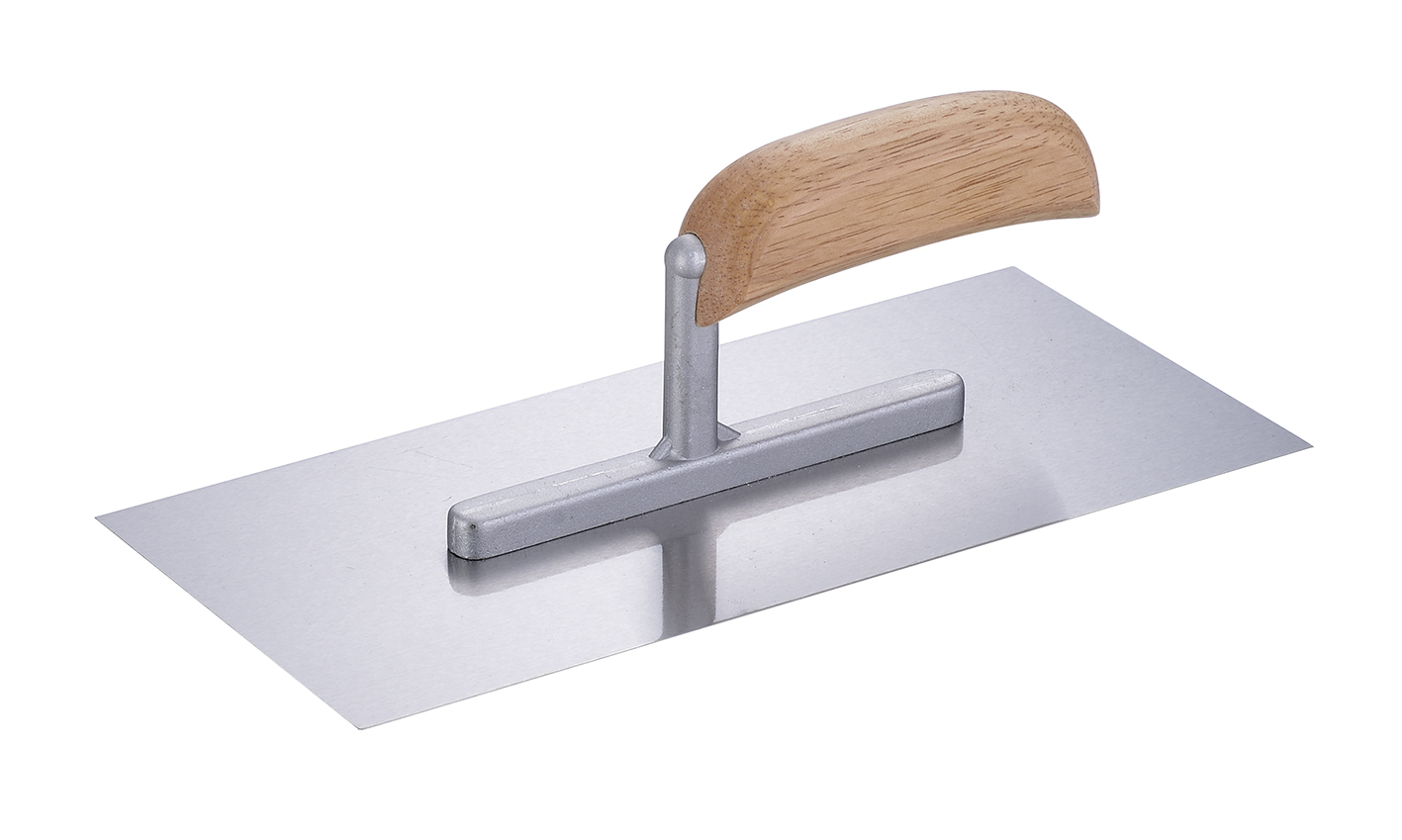
German Standard Trowel
Product Description
German Standard Trowel — Art. Nr 702301.
The German Standard Trowel is a flat rectangular plastering trowel built on the European "Glättekelle" pattern: a plain (untoothed) rectangular blade, a metal shank with a transverse mounting bar, and an arched wooden handle bridging the bar. It sits in the Plaster Trowel family, with three headline notes: Spot Riveted, Carbon & Stainless Steel available, and Quality Consistent. The single listed size is 130 mm × 280 mm (approx. 5-1/8" × 11") under Art. Nr 702301.
Art. Nr 702301 is a stainless steel blade on a wooden handle; a carbon steel blade is offered on the same pattern: "Carbon & Stainless Steel available". Contact us for the carbon-steel article number.
| Item | Detail |
|---|---|
| Product name | German Standard Trowel |
| Article number | 702301 |
| Size | 130 mm × 280 mm |
| Blade profile | Flat rectangular, plain (untoothed) working edge |
| Construction | Spot Riveted |
| Blade material | Carbon steel or stainless steel available; Art. Nr 702301 is stainless steel |
| Handle | Arched wood handle on a metal shank with transverse mounting bar; other handles available on request: contact us |
| Quality note | Quality Consistent |
Four features do the actual work on site:
Who buys 702301, and what they get out of it:
Two further advantages:
| Task | Use 702301? | Notes |
|---|---|---|
| Laying on and smoothing concrete, screed, gypsum or render | Yes | The core use for this tool class |
| Skim coating to smooth a textured finish | Yes | Standard plaster-trowel application |
| Spreading and feathering drywall jointing compound | Yes, stainless preferred | A drywall-trade tool at this size; stainless avoids oxidation marks under paint |
| Patch repair on damaged wall areas | Yes, a strength of this size | Short plate allows precise pressure at the repair boundary |
| Finishing beside beads, trims, reveals and frames | Yes | |
| Small mortar spreading in masonry and tiling | Yes | This tool class is listed for masonry and tiling work |
| Continuous rendering of large open walls | Marginal | A 16–18" trowel covers faster |
| Floor screed levelling | No | 30–45 cm class tool territory |
| Bedding tiles to a set adhesive thickness | No | Plain edge cannot meter notch depth |
| Carrying material from the bucket to the wall | No | Use a hawk |
| Step | Action | Angle / pressure |
|---|---|---|
| 1 | Load a moderate amount of material onto the blade from a hawk or board; do not overload | — |
| 2 | Present the loaded edge to the surface and lay material on | Lay on at about 20–30° for coverage and control while depositing |
| 3 | Push the stroke in one direction: upward on a wall, and progressively flatten the blade as the material transfers | Blade flattens through the stroke |
| 4 | Overlap each pass slightly and reduce pressure at the overlap so adjacent passes blend instead of leaving a ridge | Light pressure at the join |
| 5 | Build thickness in controlled passes; do not force one heavy coat | Moderate, even pressure |
| 6 | After laying on in vertical passes, change to horizontal passes to level the area | About 10–15° |
| 7 | Wait for the material to tighten (start to firm up), then drop the blade angle and close the surface | 5–10°, light pressure |
| 8 | Wipe the blade with a damp sponge or cloth throughout the work | — |
Grip and posture: hold the arched handle firmly but without clenching, keep the wrist as neutral as you can, and drive the stroke from the forearm rather than the wrist. Long single-direction passes produce a flatter result than short diagonal back-and-forth strokes.
702301 suits skim coating where the operator wants more control than a long finishing trowel offers. It works particularly well on:
Sequence: lay the coat on at 20–30°, level with cross passes, let the material tighten, then close it at 5–10° with light pressure. On light-colored gypsum skim, use the stainless version; carbon steel can leave oxidation marks that telegraph through paint.
The compact length makes this model practical for wall patch repairs, corner-adjacent finishing, door and window reveal touch-up, and small resurfacing jobs.
The technique that decides whether the patch disappears is feathering: work outward from the centre of the repair, reduce pressure as the blade crosses the boundary onto sound existing surface, and extend the finishing passes well beyond the repair edge so there is no step to catch the light. Do not try to finish the whole patch inside one short stroke.
In cement-lime render and similar mineral finishes, use the trowel in stages: place the material, compress it once it has begun to firm, then refine the surface with light low-angle passes. Stainless steel is the safer choice where moisture exposure is frequent or where finish cleanliness matters. Because the blade is short, treat it as a tool for repair zones and detail bays rather than for whole-elevation render.
At this 280 × 130 mm size the tool suits spreading jointing compound evenly, and the general plaster-trowel role includes bringing a drywall joint to a paint-ready state. Load a moderate bead, spread across the joint, then feather each edge with reduced pressure so no ridge remains at the compound boundary. Keep the blade wiped clean between coats; dried compound on the blade edge scores the fresh surface.
Q1. Which material should I order, carbon steel or stainless steel?
A: Choose stainless for interior finishing, gypsum skim, jointing compound, lime work and humid climates.
It has high corrosion resistance and low maintenance; chlorinated water, coastal air or prolonged soaking can still cause rust spots, so rinse with clean water and dry after use, and it avoids oxidation marks under light-colored paint.
Choose carbon steel for general cement and screed work if the crew will clean and oil the tool every day. Art. Nr 702301 is the stainless steel version, and carbon steel is available on the same pattern.
Q2. What blade angle should I work at?
A: Lay material on at roughly 20–30° for coverage with control, and level at about 10–15°. Once the material has begun to tighten, drop to about 5–10° with light pressure to close the surface.
Q3. Material drags instead of spreading smoothly. What is wrong?
A: Usually one of three things: the blade angle is too closed, the mix is too stiff, or there is dried material on the blade. Open the angle slightly, adjust the mix, and wipe the blade with a damp sponge.
Q4. Is 130 × 280 mm too small for a professional?
A: It is the wrong size for continuous large-area rendering, and the right size for wall coats, skim, repair and obstructed interiors. Longer 16–18" trowels cover faster but demand more skill to keep flat, and many crews carry both.
Q5. Do I need a hawk as well?
A: Yes, for most plastering work. A hawk holds and presents the material, and the trowel applies and finishes it. They are complementary tools, not substitutes.
| Art. Nr | Size (W × L) | Construction | Blade material | Handle | Note |
|---|---|---|---|---|---|
| 702301 | 130 mm × 280 mm | Spot Riveted | Stainless steel; carbon steel available | Wood handle on metal shank | Quality Consistent |
| Additional specification | Value |
|---|
Carbon steel version
Stainless steel version (Art. Nr 702301)
At 130 mm × 280 mm this is a mid-to-small plate. Trowel length maps to task as follows: ~18 cm for thin finish coats, 20–30 cm for wall and ceiling coats in cement render or diatomaceous finishes, and 30–45 cm for floor levelling. 702301 sits squarely in that 20–30 cm wall-coat band.
By length in inches, 11–14" (≈28–35 cm) favors control and 16–18" (≈40–45 cm) gives fast coverage at the cost of a harder-to-master tool. At 11", 702301 is at the control end of that scale.
What that means on site:
Choose 702301 (130 × 280 mm) when the job calls for:
| Version | Best for | Main consideration |
|---|---|---|
| Carbon steel | General site work and cement-based materials where the tool is cleaned and oiled every day | Rusts; requires drying and oiling after every use |
| Stainless steel (Art. Nr 702301) | Finish plaster, lime-based work, gypsum skim and jointing compound, wet or humid environments | High corrosion resistance and low maintenance; usually preferred where upkeep cannot be guaranteed |
Rule of thumb: choose carbon steel if you finish cement and screed all day and clean your tools religiously; choose stainless for interior finishing and drywall work, and in any humid environment.
| Situation | Better choice | Why |
|---|---|---|
| Large open walls, speed and long flat passes matter | A 400–500 mm finishing trowel, e.g. Leading Tools' own Flooring Trowel 711100–714100 at 480–500 mm | Longer plates cover faster and bridge high spots, at the cost of controllability |
| Floor screed levelling | 30–45 cm class tool | Floor work is usually done with blades in the 30–45 cm band |
| Very thin final finish coats over small areas | ~18 cm class tool | Thin finish coats are usually done around 18 cm |
| Carrying and feeding material to the wall | A hawk (mortar board), not a trowel | A hawk holds and presents material; the trowel applies and finishes it; they are complementary, not interchangeable |
| Bedding tile adhesive to a notch depth | A notched trowel | 702301 has a plain edge; it cannot meter adhesive thickness |
| Two-handed rendering of very large panels | Long two-handed floats | Different tool class for a different scale of work |
702301 therefore sits in the middle of the range. It is a controlled all-rounder, not an extreme specialist: the trowel a crew reaches for when the wall is not a simple open rectangle.
This model is offered as a single article number.
| Art. Nr | Size (W × L) | Blade material | Handle | Construction |
|---|---|---|---|---|
| 702301 | 130 mm × 280 mm (≈ 5-1/8" × 11"; 1" = 25.4 mm) | Stainless steel; carbon steel available on the same pattern | Wood handle on metal shank; other handles available on request: contact us | Spot Riveted |
Notes:
Key care principle: a plastering trowel performs only as well as its blade is flat, smooth and free of hardened material. Every maintenance step above exists to protect those three properties.

In compliance with EU personal data protection laws, we are committed to protecting and providing you with control over your personal data. By clicking "Accept All", you allow us to place cookies to enhance your experience on this site, help us analyze site performance and usage, and enable us to deliver relevant marketing content. You can manage your cookie settings below. By clicking "Agree" you agree to the current settings. For more information, please visit the Privacy Statement.
This website uses cookies
In compliance with EU personal data protection laws, we are committed to protecting your personal data and providing you with control over it. By clicking "Agree", you allow us to place cookies to improve your experience on this site, help us analyze site performance and usage, and allow us to deliver relevant marketing content.
By clicking "Only necessary" you allow us to place only necessary cookies. The website cannot function without these cookies and you cannot switch them off on your system. These cookies are typically set only in response to an action you perform (i.e. a service request), such as setting privacy preferences, logging in, or filling in a form. You can set your browser to block or prompt you for these cookies, but this may prevent some site features from working.