
Copyright 2026 © Leading Tools Industrial Co., Ltd.
All Rights Reserved. Website Design by Awakening Design
CATALOG TYPE
Product Categories
Aluminum Hawk
Product Description
Aluminum Hawk
| Item | Detail |
|---|---|
| Product name | Aluminum Hawk |
| Working face | Flat, nothing protruding through the plate |
| Article numbers | 300369, 300370, 300372, 300373, 300374 |
| Sizes | 9"×9", 10"×10", 12"×12", 13"×13", 14"×14" |
| Platform material | Aluminum, square plate |
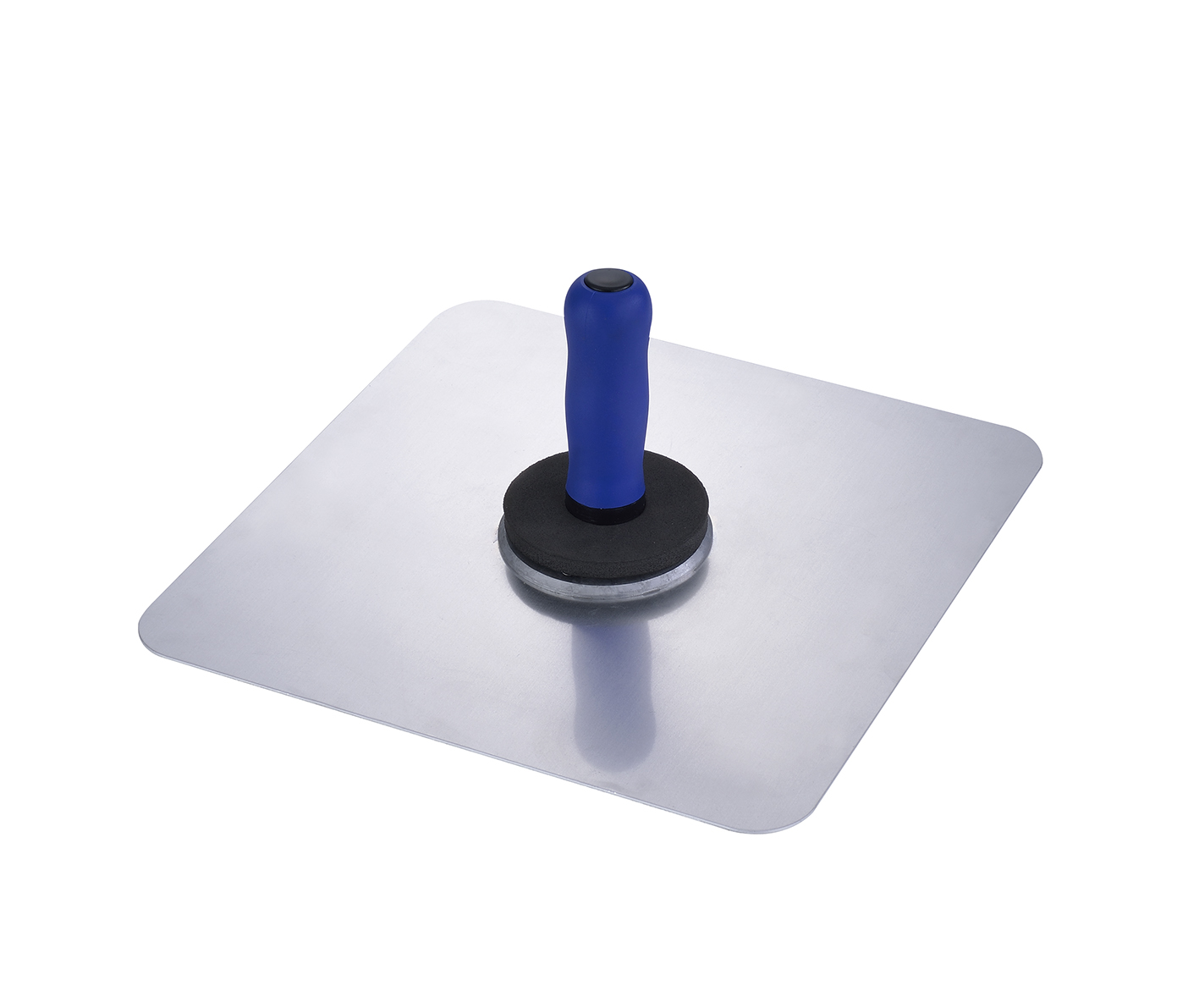
| Grip | Center-mounted vertical grip on a circular base disc |
| Product family | Float |
A hawk is the flat hand-held platform a plasterer carries mortar or compound on so the trowel in the other hand always has material within reach of the wall. It is a holding tool, not an application or finishing tool: the hawk holds the material, the trowel places it.
Flat working face. Nothing protrudes through the top face of the plate. A trowel can therefore be drawn across the full width of the plate in one stroke. This is the clearest point of difference against the Plastic Hawk in the same Leading Tools range (300301 / 300302 / 300303), whose face carries visible ribs and a raised handle spigot.
| Advantage | What it means on the job | Who benefits most |
|---|---|---|
| Five sizes in one material family | A crew standardizes on one platform type and still fits the tool to the task | Contractors buying for a crew; distributors stocking a full ladder |
| Aluminum plate | Does not rust; rinse after use | Full-time plastering and rendering crews |
| Flat working face | The trowel crosses the whole plate without meeting a rivet head or raised hardware, so material has nothing to harden around | Anyone running stiffer mixes, where plate build-up becomes a surface defect |
| Center grip directly under the load | The plate balances on the hand instead of hanging off it, which is what makes the chest-to-shoulder carrying position workable for hours | Overhead and long-session work |
| Soft grip body | A soft grip is comfortable to hold for long periods | Crews holding a loaded tool for hours at a time |
| Color palette | Applicators working multi-color plaster can keep separate colors in separate zones on the same plate | Decorative and Venetian plaster applicators |
| Work type | Use the hawk for | Typical size |
|---|---|---|
| Wall plastering / skimming | Carrying gypsum plaster or skim coat within reach of the trowel | 300372 (12") |
| Stucco and cement render | Carrying mortar to the wall between hawk and trowel | 300372–300374 |
| Drywall / joint compound | Holding compound as an alternative to a mud pan | 300370 / 300372 |
| Repointing brick joints | Holding mortar close to the joint being filled | 300369 / 300370 |
| Ceiling and overhead | Reduced load carried above the shoulder | 300369 / 300370 |
| Multi-color decorative plaster | Palette: separate colors in separate zones on one plate | 300373 / 300374 |
| Step | Action | Why |
|---|---|---|
| 1 | Scoop material from the bucket or mixing tub onto the plate with a trowel or scoop; spread a thin skim over the plate first, then build up the pile | The thin base coat keeps the main load from sliding on a dry plate |
| 2 | Load to about half of the plate's capacity rather than filling it | An overfilled plate spills while walking and multiplies arm fatigue |
| 3 | Hold the hawk close to the body, plate close to level with a slight tilt toward you, at chest-to-shoulder height, elbow near 90° | Holding the tool away from the body is the main cause of shoulder and neck strain |
| 4 | To pick up, slide the trowel edge under the base of the pile and tip the plate up so roughly half the load rolls onto the trowel | Transfers a controlled portion without the load sliding off the far edge |
| 5 | Alternatively, drag the trowel across the plate at a shallow angle along the edge to shave material off | Preferred by some applicators for thinner, more even trowel loads |
| 6 | Reload once about half the plate load has been used, rather than scraping the plate dry | Keeps the remaining material centered and the tool balanced |
| 7 | Clear hardened material from the plate edges regularly | Dried lumps falling into fresh material cause visible surface defects |
| 8 | For a break, cover the material on the plate with a damp cloth instead of returning it to the bucket | Keeps the mix workable without a bucket trip |
Carry a reduced load and use 300369 (9") or 300370 (10"). The limiting factor overhead is not plate capacity but how long the arm can hold weight above the shoulder, the standard chest-to-shoulder carrying position no longer applies, so weight, not area, decides comfort.
Applicators working multi-color plaster use one hawk as a palette, keeping each color in its own zone on the plate and picking up from the zone required. That argues for the larger plates: 300373 (13") or 300374 (14"), since zoned loading uses more plate area than a single centered pile.
For continuous production the largest plates in the range, 300373 and 300374, carry the most material per trip to the mixing station. The trade-off is arm strength: 13" is already a size for experienced applicators, so specify the largest sizes for long flat runs, not for overhead work.
While loading from a bucket, rest the plate across the mouth of a second empty bucket so the grip hangs into the opening and the plate sits level.
Q: Which size should a first-time buyer choose?
A: 12" (300372). It is the general-purpose size for ordinary plastering jobs. Add 300369 or 300370 for ceilings once you are using the tool every day.
Q: Material slides off while I carry it, and my wrist and shoulder ache after a shift. What should I change?
A: Usually there is too much material on the plate or the plate is tilted too far. Load about half the plate and hold it close to level with a slight tilt toward you, close to the body at chest-to-shoulder height. Holding it away from the body is the main cause of aching; for overhead work drop to 300369 (9") or 300370 (10").
Q: Should I buy aluminum or plastic?
A: Aluminum: flatter working face, heavier. Plastic: lighter, ribbed face. Choose by weight and face. In the Leading Tools range the plastic version is the Plastic Hawk (300301–300303).
Q: Material is sticking to the plate. What should I do?
A: Dried residue is the usual cause. Clear the plate edges regularly and clean the plate before material sets. On a break, cover the load with a damp cloth so it stays workable instead of skinning over.
The platform is a flat square aluminum plate with a flat top face. The plate has to stay flat so that material does not migrate to a low corner while it is carried.
| Platform specification | Value |
|---|---|
| Material | Aluminum |
| Shape | Square |
| Working face | Flat, nothing protruding through the plate |
| Attribute | Specification |
|---|---|
| Grip type | Center grip: vertical grip on a circular base disc |
| Grip material | Soft grip |
| Grip color | Blue grip body on black base disc |
| Art. Nr | Size | Metric (1" = 25.4 mm) | Positioning |
|---|---|---|---|
| 300369 | 9" × 9" | 229 × 229 mm | Smallest; overhead and confined areas |
| 300370 | 10" × 10" | 254 × 254 mm | Small-to-mid; patching, ceilings |
| 300372 | 12" × 12" | 305 × 305 mm | All-round everyday size |
| 300373 | 13" × 13" | 330 × 330 mm | Large-area work; needs more arm strength |
| 300374 | 14" × 14" | 356 × 356 mm | Largest; production work |
Leading Tools offers both an Aluminum Hawk (300369–300374, five sizes) and a Plastic Hawk (300301 10"×10", 300302 12"×12", 300303 13"×13"). They overlap at 10", 12" and 13", so this is a real purchasing decision.
| Aluminum Hawk (300369–300374) | Plastic Hawk (300301–300303) | |
|---|---|---|
| Sizes offered | 9", 10", 12", 13", 14" | 10", 12", 13" |
| Working face | Continuous flat plate, nothing protruding | Molded face with visible ribs and a raised handle spigot |
| Weight | Heavier than plastic | Lighter than aluminum |
| Choose it when | A flat metal working face, or a 9" or 14" size | Lighter weight, or overhead-heavy work |
Short version: choose by weight and working face. Aluminum has a flat metal face and is heavier; plastic is lighter and has a ribbed face.
| Situation | Recommended size | Art. Nr | Why |
|---|---|---|---|
| Overhead / ceiling runs | 9"–10" | 300369 / 300370 | Least weight held above the shoulder for the longest time |
| Patching and repairs | 9"–10" | 300369 / 300370 | Load matches the job; fits confined areas |
| General wall plastering | 12" | 300372 | The all-round everyday size; a good first hawk |
| Large flat walls | 13" | 300373 | For experienced applicators with the arm strength to carry a bigger load |
| Production / commercial runs | 13"–14" | 300373 / 300374 | Fewer trips back to the mixing station per square meter |
| Decorative / multi-color plaster | 12"–14" | 300372 / 300373 / 300374 | Room to keep separate colors in separate zones on one plate |
A practical starter pair is 300372 (12") for everyday work plus 300369 or 300370 (9"/10") for ceilings and patching; production crews add 300373 or 300374.
All five article numbers in the Aluminum Hawk range:
| Art. Nr | Size (inch) | Size (mm) | Platform material | Grip |
|---|---|---|---|---|
| 300369 | 9" × 9" | 229 × 229 mm | Aluminum | Center soft grip on circular base disc |
| 300370 | 10" × 10" | 254 × 254 mm | Aluminum | Center soft grip on circular base disc |
| 300372 | 12" × 12" | 305 × 305 mm | Aluminum | Center soft grip on circular base disc |
| 300373 | 13" × 13" | 330 × 330 mm | Aluminum | Center soft grip on circular base disc |
| 300374 | 14" × 14" | 356 × 356 mm | Aluminum | Center soft grip on circular base disc |
Metric values converted at 1" = 25.4 mm.
Clear hardened material from the plate edges regularly; dried material carried into a fresh mix is a common cause of grit and specks in the finished surface.

In compliance with EU personal data protection laws, we are committed to protecting and providing you with control over your personal data. By clicking "Accept All", you allow us to place cookies to enhance your experience on this site, help us analyze site performance and usage, and enable us to deliver relevant marketing content. You can manage your cookie settings below. By clicking "Agree" you agree to the current settings. For more information, please visit the Privacy Statement.
This website uses cookies
In compliance with EU personal data protection laws, we are committed to protecting your personal data and providing you with control over it. By clicking "Agree", you allow us to place cookies to improve your experience on this site, help us analyze site performance and usage, and allow us to deliver relevant marketing content.
By clicking "Only necessary" you allow us to place only necessary cookies. The website cannot function without these cookies and you cannot switch them off on your system. These cookies are typically set only in response to an action you perform (i.e. a service request), such as setting privacy preferences, logging in, or filling in a form. You can set your browser to block or prompt you for these cookies, but this may prevent some site features from working.