
Copyright 2026 © Leading Tools Industrial Co., Ltd.
All Rights Reserved. Website Design by Awakening Design
CATALOG TYPE
Product Categories
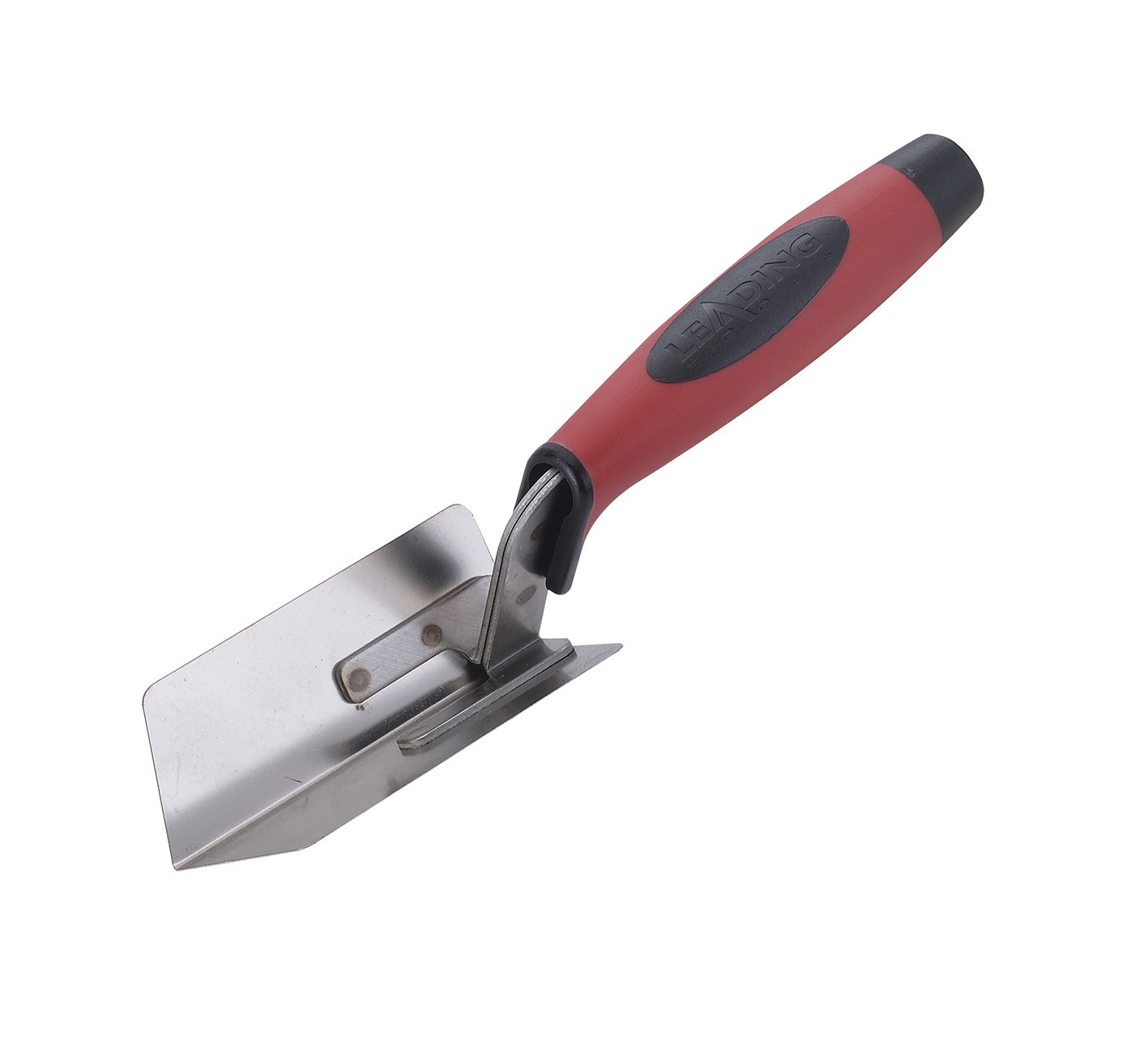
Inside Corner Trowel — 80 / 108 mm
Product Description
Inside Corner Trowel
Art. Nr: 300255-80 (60 mm × 80 mm), 300255-108 (38 mm × 108 mm)
The Inside Corner Trowel is a hand finishing tool with a blade folded to a 90° internal angle, so that both faces bear on the two wall surfaces of an inside corner at the same time and the corner is shaped in a single pass instead of being built up face by face. It is used to bed and smooth joint compound over paper tape at a drywall inside corner, and to form the 90° internal angle in wet plaster or render.
300255-80 and 300255-108 are the small-format members of the same family as 300255 (4" × 5"). The outside-corner counterpart is 300265 (4" × 5"). The handle is a red/black two-tone soft grip.
An inside corner is the hardest part of a taped or plastered wall to keep straight, because each face has to be finished without disturbing the one next to it.
A folded 90° blade bears on both faces simultaneously, so both faces are shaped in the same pass and stay square to each other; with multiple coats, each coat still has to dry. It is a corner-forming and finishing tool used with a broad knife, not instead of one. On wet plaster and render this is the whole argument for the tool: the corner is formed once rather than being cut back and re-filled.
The 4" × 5" 300255 is the general-purpose corner trowel. It stops being usable when the corner is short, obstructed or too narrow to admit a 100 mm-wide blade: behind pipework, inside cupboards and ducts, in window and door reveals, at the head of a riser. Together, 300255 / 300255-80 / 300255-108 cover open rooms and restricted corners with one tool family and one finish quality.
Stainless steel offers high corrosion resistance and low upkeep, and in normal use it does not deposit rust-colored specks into white filler or light plaster; chlorinated water, coastal air or prolonged soaking can still cause rust spots, so rinse with clean water and dry after use. Carbon-steel versions: please contact us. On a corner that is going to be painted white, a single rust bleed mark means cutting the corner back and re-doing it, so the stainless choice on this tool is a working decision, not a cosmetic one.
| Situation | Use the inside corner trowel? | Why |
|---|---|---|
| Bedding and smoothing joint compound over paper tape at a drywall internal angle | Yes | This is the primary application: the folded blade smooths the final coat over the tape on both faces at once |
| Forming the 90° internal angle in wet gypsum plaster or render | Yes | The corner is formed once as the plaster is worked, instead of being cut back and re-filled |
| Corner too narrow or obstructed for a 4" × 5" tool | Yes, 300255-108 | The 38 mm face enters gaps a normal corner trowel cannot |
| Loading compound into the corner in the first place | No | Load both faces with a broad knife (typically 6"), then run the corner trowel |
| External / outside 90° angle | No | Use the outside corner tool, 300265 |
| Cutting a control joint or groove in concrete or plaster | No | Wrong tool class; use a concrete groover |
| Both faces of the corner still wet from a previous coat | No | Many finishers do one face at a time and let it dry, often overnight, before working the other |
| Step | Action | Notes |
|---|---|---|
| 1 | Tape the internal angle and bed the paper tape | Standard drywall practice; the corner trowel finishes over the tape, it does not replace taping |
| 2 | Load both faces of the corner with a broad knife | Approximately a 2"-wide band of compound on each face, using a 6" knife, covering the tape |
| 3 | Place the trowel in the corner with both faces in contact | Both blade faces should bear on their own wall surface before you start moving |
| 4 | Run the tool from the bottom up in one pass where you can reach it; on taller walls, run up to about mid-height, then from the top down to overlap it | This is the pass sequence described by working finishers; it forms the 90° angle on both faces in one movement |
| 5 | Clean off surplus compound with the broad knife | Remove what the corner trowel has pushed out of the angle onto the flat |
| 6 | Run the corner trowel once more as the finishing pass | Two-stage working: coat, let dry, second coat, corner trowel, broad knife, final corner trowel pass |
| 7 | Rinse the tool immediately | Compound left to dry on the blade will change how the tool sits in the angle; see Care & Maintenance below |
The corner trowel is a finishing tool in a taping sequence, not a substitute for taping. Bed the paper tape in the angle, then coat both faces, then form.
Working finishers commonly split the work in two stages: a thin first coat that holds the tape, left to dry; then a second coat finished with the corner trowel, cleaned back with a broad knife, and given a final corner-trowel pass. Many also work only one face of the angle per day, letting that side dry before doing the other, because two wet faces make it hard to form the angle without pulling material off the opposite side.
In wet plastering and rendering the argument for the tool changes: instead of finishing over a taped joint, the trowel forms the 90° angle directly in the plaster as it is worked, so the corner comes out square in one operation and fewer finishing passes are needed.
Fit-out work is full of internal angles a full-size corner trowel cannot reach: service risers, duct and boxing enclosures, the inside of built-in cupboards, deep window and door reveals, and corners crowded by pipework or cable trays. The 38 mm face of 300255-108 is made precisely for this. The 108 mm blade length compensates for the narrow face by covering more of the run per pass.
Q1: What is the difference between 300255-80 and 300255-108?
A: Face width against reach. 300255-80 is 60 mm wide × 80 mm long, so it gives more coverage per pass. 300255-108 is 38 mm wide × 108 mm long, so it enters corners the wider tool cannot while still covering a useful run of the corner.
Q2: Do I need these if I already stock 300255 (4" × 5")?
A: If your work includes fit-out, second-fix or anything with reveals, risers and cupboards, yes. The 4" × 5" tool cannot enter a narrow corner, and that access problem is exactly what the smaller sizes are for.
Q3: How do I use it, and why is my corner wavy or out of square?
A: Load the corner with a broad knife, typically 6", then use the corner trowel only to form and finish. Many finishers do one face at a time, letting it dry before the other. For a clean angle, both blade faces must bear on their own wall surface before you start, and the pass should run in one continuous movement, bottom-up to mid-height then top-down to meet it.
Q4: How do I clean it?
A: It is stainless steel, with high corrosion resistance and low upkeep, and it needs no oiling. Chlorinated water, coastal air or prolonged soaking can still cause rust spots, so rinse with clean water and dry after use. Material builds up in the fold of the blade first, so rinse while it is still wet; dried material in the angle stops the blade sitting flat next time.
| Art. Nr | Blade size | Approx. imperial | Material | Handle |
|---|---|---|---|---|
| 300255-80 | 60 mm × 80 mm | ≈ 2-3/8" × 3-1/8" | Stainless Steel | Red/black two-tone soft-grip |
| 300255-108 | 38 mm × 108 mm | ≈ 1-1/2" × 4-1/4" | Stainless Steel | Red/black two-tone soft-grip |
Imperial figures are conversions at 1" = 25.4 mm.
Both art numbers are specified in Stainless Steel. What that delivers in service:
Carbon-steel versions: please contact us.
The handle is a red/black two-tone soft-grip handle the same handle family as 300255 and 300265 in the range.
300255 is included in this comparison because the real purchasing decision is a three-way one within the same family.
| Factor | 300255 (4" × 5") | 300255-80 (60 × 80 mm) | 300255-108 (38 × 108 mm) |
|---|---|---|---|
| Face width | ≈ 102 mm, widest | 60 mm, medium | 38 mm, narrowest |
| Blade length along the corner | ≈ 127 mm | 80 mm, shortest | 108 mm, longest of the two small sizes |
| Coverage per pass | Highest | Medium | Lowest |
| Access into restricted corners | Lowest | Good | Best |
| Typical job | Open room corners, full-height wall angles | Short corners, reveals, mixed access | Narrow gaps, risers, cupboards, behind services |
| Passes needed on a full-height corner | Fewest | More | Most |
Choose 300255 (4" × 5") when:
Choose 300255-80 (60 × 80 mm) when:
Choose 300255-108 (38 × 108 mm) when:
Buy both when: the work mix includes fit-out and second-fix, where restricted corners are the norm rather than the exception. The two sizes solve different problems and are not substitutes for each other.
| Art. Nr | Size | Material | Handle |
|---|---|---|---|
| 300255-80 | 60 mm × 80 mm | Stainless Steel | Red/black two-tone soft-grip |
| 300255-108 | 38 mm × 108 mm | Stainless Steel | Red/black two-tone soft-grip |
| Art. Nr | Product name | Size | Material | Relationship |
|---|---|---|---|---|
| 300255 | Inside Corner | 4" × 5" | Stainless Steel | Full-size version of the same tool; see Selection Guide above |
| 300265 | Outside Corner | 4" × 5" | Stainless Steel | External-angle counterpart |
| Feature | Inside Corner 300255 (4" × 5") | Inside Corner 300255-80 / -108 | Outside Corner 300265 (4" × 5") |
|---|---|---|---|
| Angle formed | Internal 90° | Internal 90° | External 90° |
| Blade fold | Faces fold toward the operator | Faces fold toward the operator | Faces fold away from the operator |
| Primary use | Open, full-height internal angles | Short or restricted internal angles | External angles, corner beads, returns |
| Material | Stainless Steel | Stainless Steel | Stainless Steel |
| Size | 4" × 5" | 60 × 80 mm / 38 × 108 mm | 4" × 5" |
| Stainless (this product) | Carbon steel | |
|---|---|---|
| Rust risk | Low; chlorinated water, coastal air or prolonged soaking can still cause rust spots | Rust spots can appear overnight if left damp |
| After-use routine | Rinse, dry | Rinse, dry thoroughly, wipe with a thin oil film (e.g. a light penetrating oil) |
| Effect on light-colored finishes | No rust bleed into white filler or plaster in normal use | Rust can bleed into the finish and stain it |

In compliance with EU personal data protection laws, we are committed to protecting and providing you with control over your personal data. By clicking "Accept All", you allow us to place cookies to enhance your experience on this site, help us analyze site performance and usage, and enable us to deliver relevant marketing content. You can manage your cookie settings below. By clicking "Agree" you agree to the current settings. For more information, please visit the Privacy Statement.
This website uses cookies
In compliance with EU personal data protection laws, we are committed to protecting your personal data and providing you with control over it. By clicking "Agree", you allow us to place cookies to improve your experience on this site, help us analyze site performance and usage, and allow us to deliver relevant marketing content.
By clicking "Only necessary" you allow us to place only necessary cookies. The website cannot function without these cookies and you cannot switch them off on your system. These cookies are typically set only in response to an action you perform (i.e. a service request), such as setting privacy preferences, logging in, or filling in a form. You can set your browser to block or prompt you for these cookies, but this may prevent some site features from working.