
Copyright 2026 © Leading Tools Industrial Co., Ltd.
All Rights Reserved. Website Design by Awakening Design
CATALOG TYPE
Product Categories
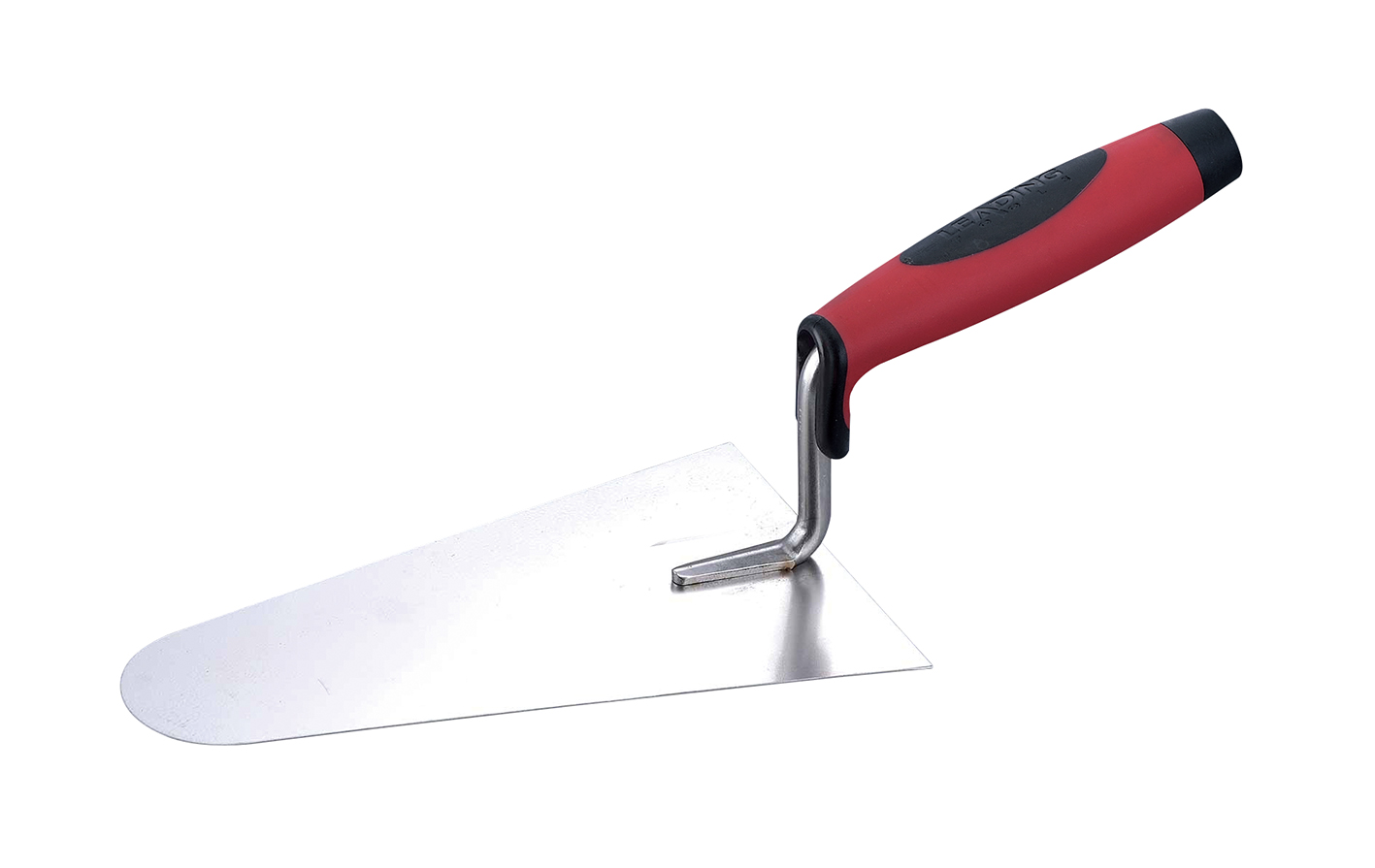
Italian Round Trowel — Spot Welded Stainless Steel
Product Description
Product name: Italian Round Trowel
Construction line: Spot Welding Stainless Steel
Sizes (seven): 140, 160, 180, 200, 220, 240, 260 mm
Art. Nr: 222821–228821.
The seven sizes are one product family in one blade pattern, differing only in blade length. All seven are offered as "Italian Round Trowel / Spot Welding Stainless Steel" and share the same tool: a broad steel blade with a rounded toe and a two-tone soft grip handle.
Alternative construction: the identical blade family is also offered as CO2 Welding Carbon Steel in the same seven sizes: 222621 (140 mm) through 228621 (260 mm). The Selection Guide below compares the two.
The rounded toe is the whole product. The blade is wide with a round nose, used to apply, spread and finish material, and it is not used to drive mortar into narrow joints. The reason a buyer cares: the wide face and rounded head let you spread and clean off material without scoring the substrate. That is a genuine functional advantage.
Stainless closes the gap that the carbon steel version leaves open. Leading Tools carries both lines side by side, which means the buying decision is construction and material only: same pattern, same seven sizes, same BF21 handle. Where the work is wet, lime-based, or where an iron stain on a porous face is unacceptable, the stainless line is the version to specify.
The soft grip is a point of difference. Leading Tools ships the same pattern on a two-tone soft grip, handle code BF21.
Seven sizes from 140 to 260 mm. The Leading Tools range spans 140–260 mm in 20 mm steps, from a small detail size to three large sizes.
Primary use: applying and spreading mortar, render and plaster; leveling; finishing work against faces that a pointed toe would score.
| Situation | Use the Italian Round? | Why |
|---|---|---|
| Spreading and leveling render, plaster or mortar over an area | Yes | Wide blade face, no corner to gouge the surface |
| Working next to a fragile, porous or finished face | Yes | The rounded contact does not score the substrate |
| Working wet, outdoors, or with lime-based mixes | Yes, this is the reason to buy the stainless line rather than the carbon steel line | Stainless blade, stainless weld zones |
| Buttering head joints / pointing into narrow joints | No | A round nose cannot direct mortar into a narrow joint; use a pointed pattern |
| Laying brick unit by unit | No | Use a Philadelphia or London pattern |
| Prying, levering or chiseling | No | The toe is a working profile, not a pry bar; deforming it removes the tool's whole advantage |
| Step | What to do | Note |
|---|---|---|
| 1. Grip | Four fingers around the handle, thumb pointing down toward the base of the blade | |
| 2. Load | Draw the rounded toe under the material on the board or hawk and lift; keep the blade level | The round nose is what makes this a clean pick-up |
| 3. Apply | Press the material onto the surface with the flat of the blade, aiming for an even coat | |
| 4. Spread and level | Draw the blade across the surface in long strokes, keeping the toe slightly clear so it does not dig in | |
| 5. Cut off excess | Slice excess material upward and off the face, then return it to the board | General trowel practice |
| 6. Clean before it sets | Rinse the blade before the material hardens; do not let mortar cure on the face | See Care & Maintenance below |
For reference, a pointed brick trowel is used quite differently: mortar is slapped down and stopped abruptly, then cut into a line with a wrist roll; units are buttered with a "cutting the cake" motion; a brick is tapped down rather than pushed; and surplus is sliced upward.
Those motions belong to the pointed patterns. Substituting the round nose into them is a misuse of this tool, because the toe has no corner to make the cut with.
The round-point trowel suits render and plaster work: applying, spreading and finishing the coat, with the wide face doing the work and the round head avoiding scratches on the substrate. It is also used as a professional bricklaying and plastering tool to apply and level mortar and plaster.
In practice the sequence is: load off the board or hawk, press the coat on with the blade face, then level it with long strokes. The stainless blade matters here for two reasons: it carries a far lower risk of rust-staining a light-colored or lime-based coat, and it needs only a rinse with clean water and a dry rather than oiling.
The round nose loads and spreads the mortar bed; a pointed trowel does the head joints and the unit-by-unit work.
The round-point trowel also suits tiling and surface-finishing work, on the same argument: a wide face and a blunt head that cleans off and levels material without cutting into what is underneath. This is where the unpolished stainless face is an advantage over carbon steel in daily use: far less rust bloom between jobs and a lower risk of iron transfer onto a light grout or a porous tile body.
This pattern comes in both carbon steel and stainless, and the split is the same one a buyer faces between the two Leading Tools construction lines.
Lime mortars have a high water content, and carbon steel rusts readily on contact with them, leaving rust marks on light-colored faces; on heritage and restoration work, where an iron stain on porous historic masonry is difficult to remove, a stainless tool is the safer choice. The rule of thumb: stainless where the work is wet or lime-based, carbon steel where it is dry.
Q1: What exactly is an "Italian Round" trowel, and what is it for?
A: Italian Round is the name of the blade pattern, which is also called the Italian pattern. It is used for applying and spreading mortar, render and plaster, and for any work against a face that a pointed toe would score.
Q2: Can I use it to point or to butter head joints?
A: No. A round-nosed trowel cannot direct mortar into a narrow joint, because there is no corner to steer with, so it is not a pointing tool. Pair it with a pointed pattern for that work.
Q3: How does the stainless version differ from the carbon steel version, and which size should I stock first?
A: Only in blade material and joining method: this line has stainless blades joined by spot welding, while 222621–228621 are carbon steel blades joined by CO2 welding, with the same pattern, the same seven sizes and the same soft-grip handle.
Stock 180 mm and 200 mm first; 220 mm is the next step up. The stainless art numbers are 222821–228821.
Q4: Rust spots or discoloration around the welds have appeared on the blade. Is it defective?
A: Usually not. Rust spots on stainless are most often iron contamination from a carbon steel tool, a steel wire brush or a shared abrasive; clean with a stainless cleaner and use only non-metallic or stainless tools on the blade. Light discoloration around the weld points is cosmetic and does not affect use; if in doubt, contact Leading Tools sales.
Q5: What if the spot weld fails or the toe is dented?
A: If a spot weld fails, take the tool out of service: it cannot be reliably repaired on site. Prying with the toe is the usual cause, and the weld line should be inspected as part of routine checks. A minor dent in the rounded toe can sometimes be dressed back, but the rounded profile is the whole advantage of this pattern, so if the deformation is visible against a straight reference, replace the tool.
The defining feature is the toe. On this blade the two side edges converge toward the front and then close in a continuous arc rather than meeting at a point. Everything the tool is good at, and everything it is bad at, follows from that one geometric fact.
What the round nose does well is distribute contact force. A pointed toe concentrates load into a very small contact patch; a rounded toe spreads the same hand pressure across a broad convex arc. Working against a soft brick face, a lime render, or a set-but-green surface, that is the difference between leaving a mark and not leaving one: the tool does not scratch what you are working on.
What the round nose cannot do is direct mortar into a narrow vertical joint. A round-nosed trowel is not the tool for pointing, because there is no sharp corner to steer material into the joint. The pointed patterns exist precisely for that duty. A buyer who needs one tool for both bed joints and head joints needs a pointed pattern as well; this trowel is a companion to a pointed trowel, not a replacement for it.
| Blade family | Nose shape | Primary role |
|---|---|---|
| Philadelphia | Pointed toe, deep square heel | Bricklaying: mortar direction, head-joint buttering |
| London (narrow / wide) | Tapered to a pointed toe | Brick placement and joint work |
| Italian Round / round point | Fully rounded toe | Spreading and finishing mortar, render and plaster; protective handling of fragile faces |
Against a soft brick, a calcium silicate unit or a terracotta unit, a pointed steel toe can cause arris chipping, face spalling and drag scratching; the rounded nose removes the concentrated contact that produces all three. A round nose protects the work surface.
The construction line for this family is "Spot Welding Stainless Steel," which distinguishes it from the "CO2 Welding Carbon Steel" line of the same blade.
Spot welding joins the blade and the shank at discrete weld points along the joint line rather than a continuous bead. On the finished tool the joint is visible as a short line of small marks where the shank meets the blade.
Welding stainless steel can leave light discoloration around the weld points; it is cosmetic and does not affect use. If in doubt, contact Leading Tools sales.
The handle is the BF21 two-tone soft grip with an end cap, on a spot-welded shank.
| Attribute | Specification |
|---|---|
| Product name | Italian Round Trowel |
| Construction line | Spot Welding Stainless Steel |
| Blade material | Stainless steel |
| Blade finish | Stainless, unpolished |
| Blade nose shape | Fully rounded toe, no point |
| Blade length range | 140 mm – 260 mm |
| Sizes available | 7 |
| Shank | Spot-welded to blade |
| Handle | Soft grip, BF21 |
| Corrosion resistance | High relative to the carbon steel line: stainless blade and stainless weld zones |
Seven blade lengths from 140 mm to 260 mm in 20 mm steps. The size bands below are a purchasing guide.
| Size range | Art. Nr | Best for |
|---|---|---|
| 140 – 160 mm | 222821, 223821 | Detail and repair work, small batches, working into confined spaces and around openings |
| 180 – 200 mm | 224821, 225821 | The volume band. General rendering, plastering and mortar work |
| 220 – 260 mm | 226821–228821 | Material carrying and large-area spreading. |
Size selection in practice comes down to three trade-offs. Shorter blades give more control per stroke and less fatigue over a full day, which is why the small sizes suit detail and overhead work. Mid-length blades carry a useful load without becoming unwieldy. The longest blades move the most material per trip from the board, at the cost of wrist load and of precision near an edge.
Both lines are offered in the same seven sizes on the same BF21 soft grip. The blade material and the joining method are the only variables.
| Attribute | Spot Welding Stainless Steel | CO2 Welding Carbon Steel (222621–228621) |
|---|---|---|
| Blade material | Stainless steel | Carbon steel |
| Joining method (construction line) | Spot welding | CO2 welding |
| Blade pattern | Italian Round, rounded toe | Italian Round, rounded toe |
| Sizes | 140–260 mm, 7 sizes | 140–260 mm, 7 sizes |
| Handle | BF21 soft grip | BF21 soft grip |
| Corrosion resistance | High; rinse and dry after use | Low: carbon steel rusts if left wet |
| Risk of staining the work | Far lower risk of rust marks on a porous face | Can leave rust marks on porous or light-colored material |
| Best environment | Wet work, exterior, lime-based mixes, coastal and humid sites | Dry interior work where the tool is cleaned and dried after each use |
Specify the stainless line when: the work is exterior or wet; the mixes are lime-based; the site is coastal or humid; the finished face is porous, light-colored or historic and an iron stain would be a defect; or the tools will not reliably be dried and oiled between sessions.
Specify the carbon steel line when: the work is dry and interior and the tools are maintained after every use.
This is the more consequential decision.
| Task | Italian Round (this tool) | Pointed pattern (Philadelphia / London) |
|---|---|---|
| Head-joint buttering, pointing into narrow joints | Not suitable: no corner to steer mortar with | The defining duty of the pattern |
| Spreading and leveling render or plaster | Suitable: wide face, no corner to catch | Usable; the toe can score the surface |
| Working against a fragile or finished face | Preferred: rounded contact does not scratch the substrate | The point can mark the face |
| Brick-by-brick laying | Not the tool | The tool |
The Italian Round is therefore an addition, not a substitute: it is the second trowel on the belt, alongside a pointed trowel, and it is the one that comes out for spreading and finishing, and for anything the pointed toe would damage.
All seven art numbers for the Italian Round Trowel Spot Welding Stainless Steel family.
| ART. NR | Blade length | Blade length (in) | Blade material | Handle |
|---|---|---|---|---|
| 222821 | 140 mm | 5.5" | Stainless steel | Soft grip BF21 |
| 223821 | 160 mm | 6.3" | Stainless steel | Soft grip BF21 |
| 224821 | 180 mm | 7.1" | Stainless steel | Soft grip BF21 |
| 225821 | 200 mm | 7.9" | Stainless steel | Soft grip BF21 |
| 226821 | 220 mm | 8.7" | Stainless steel | Soft grip BF21 |
| 227821 | 240 mm | 9.4" | Stainless steel | Soft grip BF21 |
| 228821 | 260 mm | 10.2" | Stainless steel | Soft grip BF21 |
Inch values are conversions at 1" = 25.4 mm.
Carbon steel cross-reference: 222621 / 223621 / 224621 / 225621 / 226621 / 227621 / 228621 at the same 140 / 160 / 180 / 200 / 220 / 240 / 260 mm.
The maintenance advantage of the stainless line is that the routine is short.
Stainless steel is corrosion-resistant, not corrosion-proof.
| Check | Look for | Action |
|---|---|---|
| Spot weld line, blade to shank | Cracking, gaps, lifting, separation | Withdraw from service; field repair of a spot weld is not practical |
| Rounded toe profile | Flats, dents, deformation | Replace if the arc is no longer continuous |
| Blade face | Pitting, rust spots, embedded iron | Clean with a stainless cleaner; identify and remove the contamination source |
| Blade flatness | Twist or set | Replace |
| Soft grip | Splits, separation, movement on the shank | Replace |

In compliance with EU personal data protection laws, we are committed to protecting and providing you with control over your personal data. By clicking "Accept All", you allow us to place cookies to enhance your experience on this site, help us analyze site performance and usage, and enable us to deliver relevant marketing content. You can manage your cookie settings below. By clicking "Agree" you agree to the current settings. For more information, please visit the Privacy Statement.
This website uses cookies
In compliance with EU personal data protection laws, we are committed to protecting your personal data and providing you with control over it. By clicking "Agree", you allow us to place cookies to improve your experience on this site, help us analyze site performance and usage, and allow us to deliver relevant marketing content.
By clicking "Only necessary" you allow us to place only necessary cookies. The website cannot function without these cookies and you cannot switch them off on your system. These cookies are typically set only in response to an action you perform (i.e. a service request), such as setting privacy preferences, logging in, or filling in a form. You can set your browser to block or prompt you for these cookies, but this may prevent some site features from working.