
Copyright 2026 © Leading Tools Industrial Co., Ltd.
All Rights Reserved. Website Design by Awakening Design
CATALOG TYPE
Product Categories
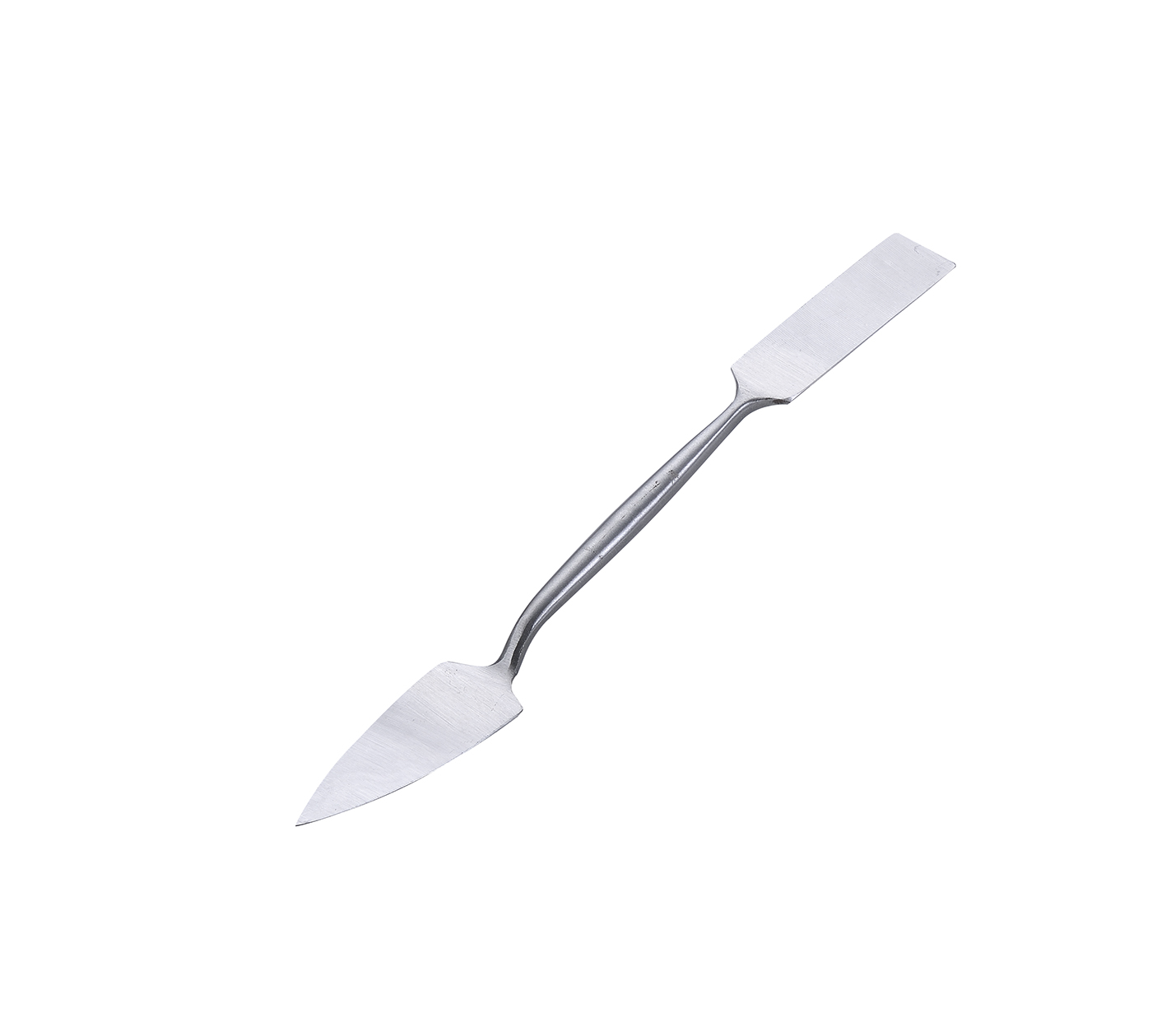
Leaf and Square Small Tool — Forged in One Piece
Product Description
Leading Tools — Leaf and Square Small Tool, Forged in One Piece
The Leaf and Square Small Tool is a double-ended, one-piece forged finishing tool for plaster, render, stucco, mortar and concrete detail work. One end is a square-cut flat blade, the other a leaf-shaped pointed blade, joined by a slim forged shank that lets both ends reach into places a full-size trowel cannot enter. It is used for designing and shaping decorative details in foam, plaster and concrete, for intricate mortar and masonry work, and for finishing, trimming and shaping in areas larger trowels cannot reach.
When a run of cornice, a molding return, an arris, a reveal, a small patch or a tight internal corner is too small for a plastering trowel and too fine for a filling knife, this is the tool that finishes it. It is not a paint scraper.
| Situation | Use this tool? | Why |
|---|---|---|
| Shaping a decorative detail in plaster, stucco or concrete | Yes, primary use | Made specifically for designing and shaping ornamental detail |
| Finishing a molding return, arris or reveal a trowel cannot enter | Yes, primary use | Designed for finishing and trimming where larger trowels cannot reach |
| Intricate mortar or masonry pointing detail | Yes | Made for intricate mortar and masonry work |
| Detailing ornate shapes and irregular wall surfaces in plasterwork or drywall | Yes | Made for ornate shapes and unusual wall surfaces |
| Working into a tight internal corner or narrow junction | Yes | Made for the tightest spaces and corners |
| Skimming a large flat wall area | No | Use a plastering / finishing trowel: this tool has no coverage |
| Removing paint or coatings from a substrate | No | Use a scraper or shave hook from the Leading Tools range; this is a different tool category |
| Step | Action | Note |
|---|---|---|
| 1 | Choose the size that matches the detail, then choose the end: leaf point for angles and profiles, square end for flats and straight lines | Match the size to the detail |
| 2 | Load a small quantity of material onto the square end from a hawk or a larger trowel | Keep the load small; this tool places material, it does not carry it |
| 3 | Work the material into the detail with the leaf point, filling the deepest part of the profile first | |
| 4 | Level and consolidate with the flat of the square end, holding it at a low angle to the surface | |
| 5 | Use the square edge as a straightedge to trim back and straighten the line where the detail meets the flat surface | The square edge is intended for marking, trimming and straightening |
| 6 | Draw the tool out of the corner rather than into it on the finishing pass | |
| 7 | Wipe the blade between passes and reclean at the end of the working session | Set material on the blade drags the finish |
This is the tool's defining application. Cornices, coving returns, panel moldings, rosettes, banding and any run of profiled plasterwork all present sections too small and too shaped for a trowel.
The leaf end follows the profile, the square end straightens the flats between the profiles, and the narrow shank keeps the operator's hand clear of the finished section. It is a tool for designing and shaping decorative detail in foam, plaster and concrete, and for finishing and detailing ornate shapes and unusual wall surfaces.
Where an angle is short, interrupted by a service, or too tight for a corner trowel, this tool works it locally. Pull the tool out of the angle on the finishing stroke rather than pushing into it, and finish the arris on each side of the angle before brushing out. This is also the tool for finishing around window and door reveals, service penetrations, angle-bead terminations and stop-bead ends.
For pointing detail, joint corrections and small mortar repairs, the tool gives controlled placement into a joint that would otherwise take a full pointing trowel and a lot of clean-up.
In board systems the tool handles bead ends, cut-outs, corner terminations, screw-head touch-ups in awkward positions and any patch too small for a taping knife.
Q1. Is this a paint scraper?
No. It is a plastering and ornamental finishing tool, used for shaping and finishing plaster, stucco, concrete, mortar and drywall detail rather than for removing coatings. For paint removal, use the Combination Shave Hook (300501 / 300502), the Shave Hook — Straight Blade (300504) or the Scraper (314124).
Q2. Which size should a first-time buyer take?
Please confirm the size with us for the detail to be finished; 13 mm is the smallest and 25 mm the largest in the series.
Q3. Why does it have no handle, and which end do I use?
It is forged in one piece, so the shank is the grip. That removes any handle joint and keeps the tool slim enough to enter recesses a handled tool would not fit. The square end picks up material, levels and straightens, while the leaf point works material into angles, undercuts and profiles; the square end then levels it.
Q4. It has started to rust. Is it ruined?
Not necessarily. Light surface rust on carbon steel comes off with a fine abrasive; re-oil it immediately afterwards. Deep pitting on a working edge changes the profile the tool leaves and is a reason to replace it, so dry and oil the tool after every use.
| Field | Value |
|---|---|
| Product name | Leaf and Square Small Tool |
| Product line | Forged in One piece |
| Art. Nr | 300611, 300612, 300613, 300614 |
| Sizes | 13 mm, 16 mm, 19 mm, 25 mm |
| Series | Scraper section of the Leading Tools range |
| Handle | None, integral forged shank with no separate handle component |
Sizes. A single size figure is quoted per article number: 13 mm, 16 mm, 19 mm and 25 mm (approx. 1/2", 5/8", 3/4" and 1"). Please confirm with us which dimension the figure refers to.
Square end. A straight, square-cut flat blade. It performs three jobs: loading and spreading a small quantity of material, flattening and consolidating it, and acting as a straightedge for marking, trimming back and straightening an edge.
Leaf (pointed) end. A tapered leaf profile with a point. It works into internal angles, molding returns, undercut profiles and any recess that a straight edge cannot follow, and it is the end that works material into a narrow void.
Blade ends and shank are forged in one piece, with no separate handle part.
The tool is offered in four sizes: 13, 16, 19 and 25 mm. Choose the size to suit the detail to be finished; for help matching a size to the work, please confirm with us.
| Art. Nr | Size |
|---|---|
| 300611 | 13 mm |
| 300612 | 16 mm |
| 300613 | 19 mm |
| 300614 | 25 mm |
| All four | 13–25 mm (full set) |
Versus plastering trowel. A plastering trowel covers area; this tool finishes what the trowel cannot enter: returns, reveals, moldings, narrow beads and small patches. They are sequential, not alternatives.
Versus corner trowel. A corner trowel (internal or external angle trowel) forms a full 90° angle in one pass along its length. This tool works a corner locally, point-first, where the angle is short, profiled or interrupted. Corner work is finished by drawing the tool out of the angle and then sharpening the arris with a smaller blade, which is this tool's role.
Versus margin / finger trowel. A margin trowel is single-ended with a handle and is used for mixing, loading and narrow flat work. This tool is double-ended, handle-less and forged in one piece, and carries a shaped point in addition to the flat edge; it is the more specialized detailing tool of the two.
Versus filling / putty knife. A filling knife carries a broad blade for skimming filler over a flat face. This tool is far narrower, and its point lets it work profiles. Use the filling knife on the flat, this tool on the detail.
Versus paint scraper. These are different tool categories. A paint scraper removes coatings from a substrate; this tool places, shapes and finishes plaster, render and mortar. For coating removal, the Leading Tools range carries the Combination Shave Hook (300501 / 300502), the Shave Hook — Straight Blade (300504) and the Scraper (314124).
All four article numbers in the series, in full:
| Art. Nr | Size | Approx. imperial (1" = 25.4 mm) | Handle | Construction |
|---|---|---|---|---|
| 300611 | 13 mm | approx. 1/2" | None, integral forged shank | Forged in one piece |
| 300612 | 16 mm | approx. 5/8" | None, integral forged shank | Forged in one piece |
| 300613 | 19 mm | approx. 3/4" | None, integral forged shank | Forged in one piece |
| 300614 | 25 mm | approx. 1" | None, integral forged shank | Forged in one piece |
Plaster, render and mortar are far easier to remove wet than cured, and a build-up of set material on this tool destroys the very thing you bought it for: a true edge and a clean profile. Clean the tool at the end of every working session, and wipe it between passes on fine ornamental work.
Blade steel grade: contact us. If the blade is carbon steel, treat it as follows:
Dress nicks and burrs with a fine stone and keep the original shape; take particular care on the leaf point, where over-dressing changes the profile the tool produces.
| Situation | Recommendation |
|---|---|
| Workshop / van | Hang or lay flat, blades clear of other steel; oil if carbon steel |
| Tool bag | Wipe dry and oil before it goes in; a closed bag holds moisture |
| Between jobs on site | Clean and dry at the end of each session; do not leave in a water bucket |
| Long-term storage | Clean, dry, oil, wrap in an oiled cloth |
| Damp or coastal site | Increase the oiling frequency; carbon steel corrodes fastest here |

In compliance with EU personal data protection laws, we are committed to protecting and providing you with control over your personal data. By clicking "Accept All", you allow us to place cookies to enhance your experience on this site, help us analyze site performance and usage, and enable us to deliver relevant marketing content. You can manage your cookie settings below. By clicking "Agree" you agree to the current settings. For more information, please visit the Privacy Statement.
This website uses cookies
In compliance with EU personal data protection laws, we are committed to protecting your personal data and providing you with control over it. By clicking "Agree", you allow us to place cookies to improve your experience on this site, help us analyze site performance and usage, and allow us to deliver relevant marketing content.
By clicking "Only necessary" you allow us to place only necessary cookies. The website cannot function without these cookies and you cannot switch them off on your system. These cookies are typically set only in response to an action you perform (i.e. a service request), such as setting privacy preferences, logging in, or filling in a form. You can set your browser to block or prompt you for these cookies, but this may prevent some site features from working.