
Copyright 2026 © Leading Tools Industrial Co., Ltd.
All Rights Reserved. Website Design by Awakening Design
CATALOG TYPE
Product Categories
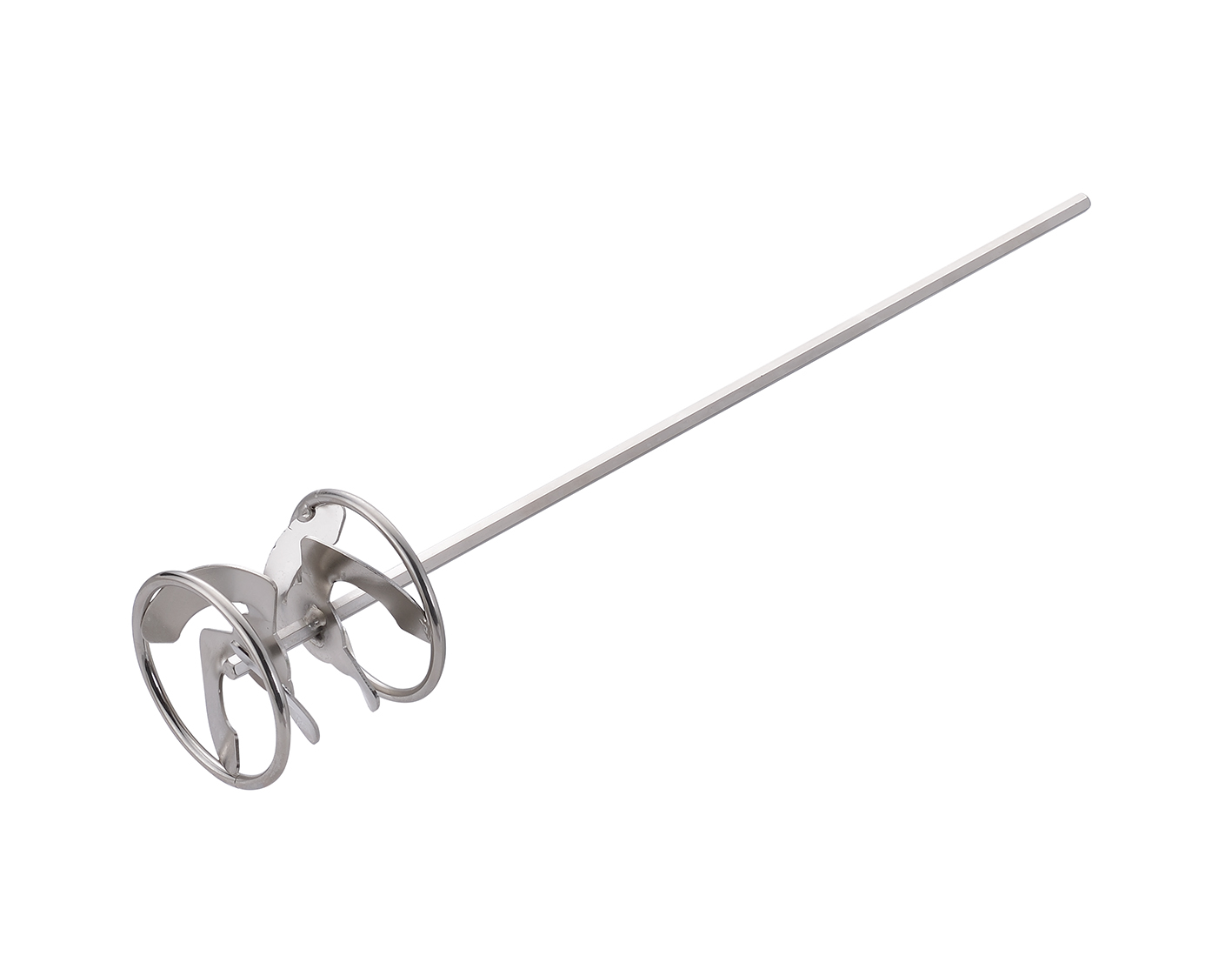
Mixing Paddle — 85 mm Helical Paddle
Product Description
Mixing Paddle — 85mm Helical Paddle, 8mm Shaft, 500mm
Art. Nr: 390501
The Mixing Paddle is a single-specification product: one art number, 85mm blade diameter, an 8mm shaft, 500mm overall length, rated 5-15kgs per batch. It sits between the Wire Mixer and the Plaster Mixer in the Leading Tools mixer range.
Identify the model by all four specification figures, not by blade diameter alone: the Wire Mixer 390401 also has an 85mm blade on an 8mm shaft, but it is 400mm long and rated 5-10kgs. Blade diameter and shaft size do not separate the two products; length and rated capacity do.
One specification, no variants to get wrong. 85mm blade, 8mm shaft, 500mm length, 5-15kgs rated capacity: a single art number covers the whole product. There is no diameter choice, no connection choice and no length choice to specify on the purchase order.
Helical open-loop blade that lifts the batch from the bottom. The blade is a helical paddle with open loops rather than a closed cage or a flat ribbon. The working action is turning and lifting the mix from bottom to top, which suits dense, viscous materials such as plaster and mortar.
8mm shaft: runs in the drill you already own. The connection is an 8mm shaft that clamps in an ordinary drill chuck, so no dedicated M14 mixing machine is required. M14 is the most common connection on professional mixing equipment, and it is the connection you step up to when you outgrow this head: in the Leading Tools range that means 390402, 390211 or 390212.
500mm of reach. 100mm longer than the Wire Mixer 390401 (400mm) and 100mm shorter than Wire Mixer 390402, Plaster Mixer 390201 / 390211 / 390212 and the mid-size Spiral Mixing Paddles (600mm). That is enough shaft to reach the bottom of a standard builder's bucket while keeping the chuck clear of the rim.
Rated 5-15kgs: the middle rung of the Leading Tools mixer range. Below it, the Wire Mixer family stops at 10kg and the smallest Spiral Mixing Paddle starts at 1kg; above it, the Plaster Mixer family runs to 40kg. The rating is specified per art number, so selection is arithmetic rather than judgment.
One head for several thick materials. Helical paddles of this class suit thicker materials such as gypsum plaster and cement repair mortar, so a single 85mm head can cover plastering and patching without a tool change. For tile adhesive, self-levelling compound, epoxy resin, paint and other special materials, follow the material manufacturer's mixer recommendation.
It closes the gap between a grout whisk and a plaster mixer. Moving up from the Wire Mixer's 5-10kgs otherwise means jumping to 390201 at 120mm blade / 12mm shaft / 600mm / 5-25kgs: a bigger blade, a bigger shaft and a machine to match. 390501 raises the batch ceiling to 15kg while keeping the 85mm blade and the 8mm shaft, so the drill and the bucket stay the same.
No dedicated mixing machine required. An 8mm shaft runs in a standard drill chuck, which keeps the entry cost to the price of the paddle. That matters in rental fleets and where an M14 mixing machine is not a default purchase, even though M14 is the professional standard connection.
Bottom-to-top action rather than stirring. A helical paddle drives material along the axis of the shaft, not only around the bucket, so thick material does not pack at the bottom.
500mm is the length that fits both bucket sizes. With 500mm of shaft, the same head works in a small pail and in a standard builder's bucket without the operator having to tip the container to reach the bottom.
A clear ceiling. The rating is 5-15kgs. With drill-driven mixing, the limit is the machine as much as the paddle: use a drill with enough torque for the batch, and move to a dedicated mixer for sustained heavy work.
Small-to-medium batch tool. At 85mm × 500mm and rated 5-15kgs, this is a small-to-medium batch tool.
| Material | Suitability for 390501 | Why |
|---|---|---|
| Tile grout and filler | Use the Wire Mixer 390401 | Grout and filler are thin materials; see the Wire Mixer 390401 |
| Gypsum plaster and finish plaster | Well suited | Helical paddles suit plaster and filler |
| Cement repair mortar | Well suited at small-to-medium batch size | Helical heads suit mortar and render |
| Joint mortar and pointing compound | Well suited | Helical blades suit joint mortar |
| Heavy sand-cement render and screed | Not recommended at this size | In the Leading Tools range the family is the Plaster Mixer |
| Batches above 15kg of any material | Outside the rating | Rated capacity is 5-15kgs |
For tile adhesive, self-levelling compound, epoxy resin, paint and other special materials, follow the material manufacturer's mixer recommendation.
| Step | Action | Why |
|---|---|---|
| 1 | Seat the 8mm shaft fully in the chuck and tighten the collar firmly before starting | A partially seated shank is the starting condition for chuck slip |
| 2 | Inspect the blade for bends and chips before the batch | A bent blade vibrates and mixes badly |
| 3 | Use a drill with enough torque for the batch size | An under-powered machine overheats under load |
| 4 | Put the liquid in the container first, then add the powder gradually | Adding water to powder leaves dry pockets at the bottom; liquid first also reduces airborne dust |
| 5 | Place the head in the container, then start at low speed until the powder is wetted out and follow the material manufacturer's speed | Starting at working speed throws dry powder out of the container and whips in air |
| 6 | Keep the head moving: up and down and around the container on a slow path | Holding it in one place leaves unmixed material at the wall and under the blade |
| 7 | Mix to the material manufacturer's stated time, then let the batch slake if the bag calls for it, and re-mix briefly before use | Slaking is a material instruction, not a tool instruction |
| 8 | Wash the head immediately after the batch, before the material starts to set | Set material changes the blade profile and the balance of the head |
There is no single speed figure for drill mixing, so follow the material manufacturer's instructions. Start low, raise only after wet-out, and reduce speed the moment the batch splashes or foams. Behaviour, not the tachometer, is the control that matters at this scale.
Size the container so that the 85mm blade turns clear of the wall and so that the 500mm shaft reaches the bottom without the chuck entering the container. A batch inside the 5-15kgs rating in a standard builder's bucket is the working case this head is built for.
Helical paddles are the right type for plaster and repair mortar. Keep the batch inside 15kg, keep the speed low so the finish is not aerated, and pre-blend dry constituents before adding water if you are combining more than one powder, so the paddle is distributing an already-uniform powder rather than dry-blending under water. Quick-setting patching compounds leave no room for a second attempt: measure the water, have the container and the tools ready before the powder goes in.
An 8mm shank in a drill chuck depends on clamping friction alone, so confirm the chuck is fully tightened before every start rather than once per session when the paddle is not vertical and below the machine. Support and steady the drill with the second hand during angled work. For sustained overhead cement work, a threaded M14 connection is the safer arrangement, and in the Leading Tools range that means 390402, 390211 or 390212.
Q1. What exactly do I get when I order 390501?
A: One 85mm helical mixing paddle on an 8mm shaft, 500mm overall, rated 5–15kgs per batch. It is the only art number in the Mixing Paddle family, so there are no variants to specify. A helical paddle puts a solid blade face through the batch and suits heavier material than a cage paddle.
Q2. How is this different from the Wire Mixer 390401?
A: Length and rating: 390501 is 500mm and rated 5–15kgs, while 390401 is 400mm and rated 5–10kgs. For grout-only work 390401 is the purpose-built head; for plaster and repair mortar, 390501 is the better choice.
Q3. How should I mix?
A: Put the liquid in the container first, then add the powder gradually, starting at low speed until the powder is wetted out. Follow the material bag for speed, and reduce it if the batch splashes or foams. If you find dry lumps at the bottom, check the order (water first), the speed (too low and the batch does not circulate) and the batch size (not above 15kg).
Q4. What drill do I need, and can I mix 20kg in one batch?
A: Use a drill with enough torque for the batch size. Not 20kg with this head: the rating is 5–15kgs, so for 15kg and above step up to the Plaster Mixer, 390201 (5–25kgs) or 390211 / 390212.
Q5. How do I look after the paddle?
A: Wash it immediately after each batch rather than leaving it standing in the material, because cured material changes the blade profile and balance. Soak dried residue in warm water instead of chipping it off with metal tools. Replace the paddle when the helix is bent, the edges are visibly worn or the shaft no longer runs true.
| ART. Nr | Dia. | Shaft | Length | Capacity |
|---|---|---|---|---|
| 390501 | 85mm | 8mm | 500mm | 5-15kgs |
In inch terms, 85mm is 3.35in and 500mm is 19.7in (1in = 25.4mm).
The head is a helical paddle: a spiral blade forming open loops around the shaft axis, without the closed wire cage of the 390401 Wire Mixer and without the flat ribbon of a ribbon-type mixer. The functional consequence is that the paddle turns and lifts material from the bottom of the drum to the top rather than only rotating it, which suits dense, viscous materials such as plaster and mortar.
Compared with the Wire Mixer, the difference in the bucket is shear. A cage disperses powder with minimal shear and minimal air pick-up; a helical blade puts a solid blade face through the batch on every revolution and therefore works heavier, more viscous material. Compared with a large plaster mixer, an 85mm helical head has less blade area, so it moves less material per revolution and needs less torque from the machine.
The connection is an 8mm shaft that clamps in a standard drill chuck.
What governs use is the load path. A drill chuck transmits torque by clamping friction on the shank, so grip degrades as the jaws wear, and sustained heavy mixing is exactly what wears them. That is also why M14 is the professional connection for mixing duty: a threaded joint carries torque mechanically. In the Leading Tools range, M14 is available on 390402 (Wire Mixer, 105mm) and on 390211 / 390212 (Plaster Mixer, 120mm / 140mm).
Across Leading Tools' mixing heads, 390501 is the point where blade diameter stops growing (85mm, same as the Wire Mixer 390401) but shaft length and rated capacity both step up (400mm → 500mm, 5-10kgs → 5-15kgs). Paddle selection rests on exactly these two variables: match the paddle to the batch volume and to the driving machine, and there is no universal diameter-to-kilogram table, so the rated figure is the number to design around.
There is no handle on this product: the drive end is the shaft itself, and the operator's grip is on the machine.
390501 has an 8mm shaft and no M14 option, so it is a drill-driven paddle by definition.
| Your typical batch | Leading Tools family | Art. Nr | Why |
|---|---|---|---|
| 1–5kg, small repairs and touch-ups | Spiral Mixing Paddle | 390601 (60mm, 8mm, 400mm) | Lowest rating in the range |
| 5–10kg, grout and air-sensitive low-viscosity material | Wire Mixer | 390401 (85mm, 8mm, 400mm) | Same blade diameter and shaft as 390501, shorter and rated lower |
| 5–15kg, plaster, repair mortar | Mixing Paddle | 390501 (85mm, 8mm, 500mm) | The product described here |
| 10–20kg on a drill shaft | Spiral Mixing Paddle | 390603 (100mm, 10mm, 600mm) | Larger blade and 10mm shaft |
| 5–25kg, heavy cement and render | Plaster Mixer | 390201 (120mm, 12mm, 600mm) | 12mm drill shaft, 120mm head, rated 5-25kgs |
| 15kg and above, daily, on a mixing machine | Plaster Mixer | 390211 / 390212 (M14) | M14 removes the chuck from the load path |
Helical paddles are the type for thick materials such as plaster and repair mortar. For grout and filler, the Wire Mixer 390401 is the purpose-built choice, and it is rated for the smaller batches that grout work usually involves. For tile adhesive, self-levelling compound, epoxy resin, paint and other special materials, follow the material manufacturer's mixer recommendation.
Choose 390501 when your work is plaster, cement repair mortar and light plastering in the 5–15kg range; when you drive the paddle with an ordinary drill rather than an M14 machine; when you want one head that covers several materials across a workday; and when your containers are standard builder's buckets rather than drums.
Choose 390401 (Wire Mixer) instead when you work almost exclusively with grout, joint compound and similar low-viscosity air-sensitive materials, when your batches stay at or below 10kg, and when you do not need the extra shear of a solid blade.
Choose 390201 / 390211 (Plaster Mixer) instead when you regularly handle batches above 15kg, when the material is heavy cement, mortar or render, and when you have a drill with a 13mm chuck (for the 12mm shaft) or an M14 machine to drive the larger blade.
Choose the Spiral Mixing Paddle family instead when you need either a smaller head than 85mm (390601, 60mm, rated 1-5kgs) or a longer reach than 600mm (390605, 760mm).
Ordering 390501 for heavy cement work. For sustained heavy cement, mortar or render, the family is the Plaster Mixer.
Ordering 390501 when grout is all you mix. 390401 shares the same 85mm blade and 8mm shaft, is rated for the batch size grout work usually needs, and a cage disperses powder with less shear.
Confusing 390501 with 390401 on a thumbnail. Both are 85mm on an 8mm shaft. The separating figures are 500mm / 5-15kgs versus 400mm / 5-10kgs. Specify the art number on the order, not "the 85mm one".
Using a container that is too narrow. A blade running close to the bucket wall vibrates, wears at the tips and circulates the batch badly rather than mixing it. Size the container so the blade turns clear of the wall.
| Product | Art. Nr | Dia. | Shaft | Length | Capacity | What it is for |
|---|---|---|---|---|---|---|
| Plaster Mixer | 390201 / 390202 / 390211 / 390212 | 120mm / 135mm / 140mm | 12mm or M14 | 600mm / 750mm | 5-40kgs | Highest rated capacity in the range; the only family offering M14 at 140mm blade diameter |
| Wire Mixer | 390401 / 390402 | 85mm / 105mm | 8mm or M14 | 400mm / 600mm | 5-10kgs | Pail-scale heads; both connections carry the same 5-10kgs rating |
| Mixing Paddle | 390501 | 85mm | 8mm | 500mm | 5-15kgs | Single art number, drill shaft only, no M14; the mid rung between cage and plaster mixer |
| Spiral Mixing Paddle | 390601 / 390602 / 390603 / 390604 / 390605 | 60mm / 80mm / 100mm / 120mm / 140mm | 8mm / 10mm / 12mm | 400mm / 600mm / 760mm | 1-35kgs | Widest size ladder and the only family reaching down to 1-5kgs; no M14 anywhere in the family |
Complete art-number reference for the Mixing Paddle family.
| ART. Nr | Dia. | Shaft | Length | Capacity |
|---|---|---|---|---|
| 390501 | 85mm | 8mm | 500mm | 5-15kgs |
One art number, and no variants. Units are mm and kgs; 85mm is 3.35in and 500mm is 19.7in at 1in = 25.4mm.
Attribute view of the same model:
| Attribute | 390501 |
|---|---|
| Blade diameter | 85mm |
| Connection | 8mm shaft, for a standard drill chuck |
| Length | 500mm |
| Rated capacity | 5-15kgs |
| Blade geometry | Helical open-loop paddle |
| Working action | Turns and lifts the batch from bottom to top |
| Handle | None, the drive end is the shaft itself |
Related art numbers elsewhere in the Leading Tools mixer range, for cross-reference when 390501 is not the right rung:
| Family | ART. Nr | Dia. | Shaft | Length | Capacity |
|---|---|---|---|---|---|
| Plaster Mixer | 390201 | 120mm | 12mm | 600mm | 5-25kgs |
| Plaster Mixer | 390202 | 135mm | 12mm | 750mm | 20-30kgs |
| Plaster Mixer | 390211 | 120mm | M14 | 600mm | 15-25kgs |
| Plaster Mixer | 390212 | 140mm | M14 | 600mm | 25-40kgs |
| Wire Mixer | 390401 | 85mm | 8mm | 400mm | 5-10kgs |
| Wire Mixer | 390402 | 105mm | M14 | 600mm | 5-10kgs |
| Spiral Mixing Paddle | 390601 | 60mm | 8mm | 400mm | 1-5kgs |
| Spiral Mixing Paddle | 390602 | 80mm | 8mm | 400mm | 5-10kgs |
| Spiral Mixing Paddle | 390603 | 100mm | 10mm | 600mm | 10-20kgs |
| Spiral Mixing Paddle | 390604 | 120mm | 10mm | 600mm | 15-25kgs |
| Spiral Mixing Paddle | 390605 | 140mm | 12mm | 760mm | 25-35kgs |
Wash the head immediately after mixing, while the material is still wet. Cementitious and gypsum materials cure on the blade, and once cured they change the blade profile and the balance of the head.
Practical routine: run the paddle in a container of clean water at low speed to flush loose material, rinse under running water, then finish with a nylon brush, paying attention to the inside of the blade loops and to the junction between blade and shaft where material collects.
Soak dried residue in warm water before brushing rather than chipping it off. Remove dried residue with a plastic scraper or nylon brush; do not use a steel brush, metal scrapers or abrasive pads, which scratch the surface. Dry the head before storage.
Store dry. Hang the paddle vertically or lay it flat with no load on the blade, and do not stack weight on stored paddles. For long storage, a light oil film on the shaft limits surface oxidation.
Do not wear loose gloves when operating rotating tools: general power-tool safety instruction is that gloves can be caught by rotating parts, with finger and thumb injuries as the result.
Wear eye protection: powered mixing of dry powders throws both dust and splash, and the highest-exposure moment is the transition from wet-out to working speed.
Keep the machine's speed control under positive control before the head enters the container; starting at working speed with the head already submerged is how containers get thrown. Use a drill with enough torque for the batch size; an overheating machine is itself a hazard.
Service life depends far more on material abrasiveness and cleaning discipline than on calendar age. The two factors that shorten it are high sand content, which abrades the blade edges, and material left to cure on the blade, which changes the profile. Replace the paddle when the helix is visibly bent, when the blade edges have worn enough to change how the batch circulates, or when the shaft no longer runs true in the chuck.

In compliance with EU personal data protection laws, we are committed to protecting and providing you with control over your personal data. By clicking "Accept All", you allow us to place cookies to enhance your experience on this site, help us analyze site performance and usage, and enable us to deliver relevant marketing content. You can manage your cookie settings below. By clicking "Agree" you agree to the current settings. For more information, please visit the Privacy Statement.
This website uses cookies
In compliance with EU personal data protection laws, we are committed to protecting your personal data and providing you with control over it. By clicking "Agree", you allow us to place cookies to improve your experience on this site, help us analyze site performance and usage, and allow us to deliver relevant marketing content.
By clicking "Only necessary" you allow us to place only necessary cookies. The website cannot function without these cookies and you cannot switch them off on your system. These cookies are typically set only in response to an action you perform (i.e. a service request), such as setting privacy preferences, logging in, or filling in a form. You can set your browser to block or prompt you for these cookies, but this may prevent some site features from working.