
Copyright 2026 © Leading Tools Industrial Co., Ltd.
All Rights Reserved. Website Design by Awakening Design
CATALOG TYPE
Product Categories
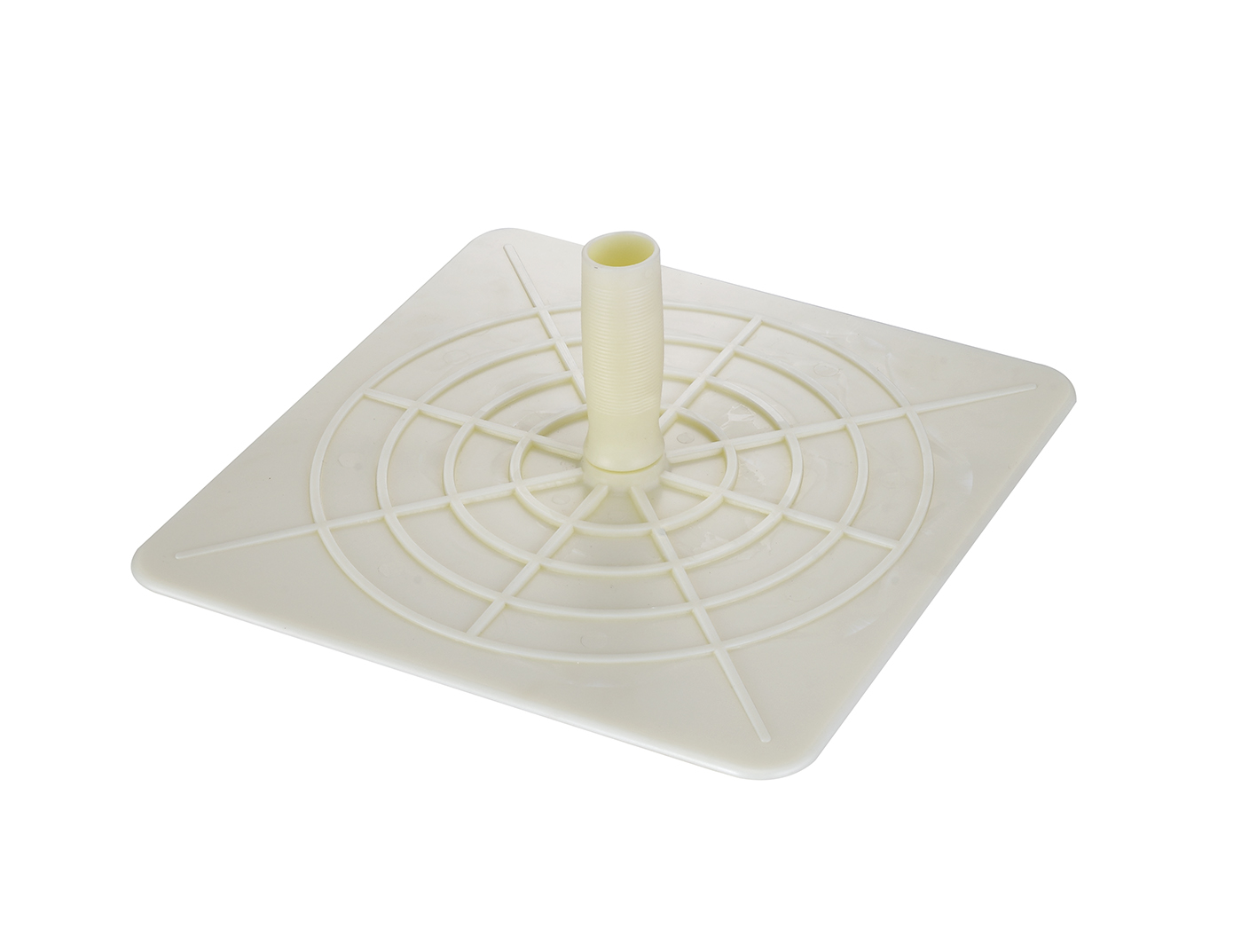
Plastic Hawk
Product Description
Plastic Hawk
Art. Nr: 300301, 300302, 300303 — Float range
| Art. Nr | Size |
|---|---|
| 300301 | 10" × 10" |
| 300302 | 12" × 12" |
| 300303 | 13" × 13" |
A hawk is the flat carrying platform with a vertical center handle that a plasterer holds in the non-dominant hand while the dominant hand works the trowel. The trade uses several names for the same tool: plasterer's hawk, mason's hawk, hand board, more or less interchangeably.
These are the reasons a buyer specifies the plastic board rather than the aluminum one in the same Leading Tools range. Operating instructions are under How to Use below.
The Selection Guide below sets out the comparison with the aluminum hawk.
| Job | What the hawk does | Size to reach for |
|---|---|---|
| Plastering / rendering walls and ceilings | Holds a working quantity of plaster at the wall so the trowel reloads without returning to the spot board | 300302 general; 300301 overhead |
| Brick and block pointing | Carries mortar to the joint and feeds the pointing trowel | 300301 |
| Drywall taping and jointing | Holds joint compound while the taping knife works the seam | 300301 or 300302 |
| Small repairs and patching | Carries just enough material for the patch, so there is no surplus to manage | 300301 |
| Large-area production plastering | Minimizes the number of reloads across a big wall | 300303 |
| Thin-set tile work, wall installations | Holds modified thin-set within reach of the notched trowel | 300301 or 300302 |
| Step | Action | Why it matters |
|---|---|---|
| 1. Prime the board | Wipe a thin skim of material across the panel with the trowel or a jointing knife before loading the first full batch | Stops the whole load sliding around on a clean, dry panel |
| 2. Grip and position | Hold the hawk in the non-dominant hand, handle down in the fist, platform up and roughly level with a slight tilt toward you; trowel in the dominant hand | Keeps the load over the wrist and presents the working edge of the pile to the trowel |
| 3. Load the board | Scoop compound from the spot board or bucket onto the center of the platform with a pointing trowel or jointing knife | A centered load balances the board and keeps material off the edges |
| 4. Meter the load | Cover about half the platform rather than filling it, and reload more often. Overloading is the classic beginner error and causes both spillage and fatigue. | A part-filled board can still be tilted and steered; a full one cannot |
| 5. Carry | One-hand carry: platform flat, handle down, for short moves across the work area. For longer moves or a heavier load, steady the leading edge with the free hand. | Prevents the load sliding off the leading edge on the walk |
| 6. Roll material onto the trowel | Bring the hawk up on edge to meet the trowel, set the trowel edge just under the pile, and roll the material up onto the blade in one movement | It loads the trowel cleanly without dropping material |
| 7. Apply and reload | Lay the material on the wall or ceiling with the trowel, return to the hawk, repeat | The hawk exists to shorten this cycle; the shorter the cycle, the more wall gets covered per hour |
| 8. Keep the load centered | As material is used, tilt the board slightly to walk the remaining pile back toward the middle. | Stops the last of the batch creeping over an edge |
This is the core job. The hawk lets the plasterer stand at the wall with a working quantity of material in hand, so the trowel reloads from the board instead of from the spot board on the floor. For a ceiling or any sustained overhead run, drop one size: a 300301 at 10" × 10" carries less, but it is far easier to hold above shoulder height for a long period, and reduced fatigue is the specific reason plastic is chosen for this work.
For brick and block pointing, the hawk holds a small quantity of mortar close to the joint being filled while the pointing trowel does the work. The same applies to patch repairs in plaster or drywall: load only what the patch needs, which is exactly the case where the 10" × 10" 300301 is the right tool rather than the largest board.
Q: What is a hawk used for?
A: A hawk is a flat board with a handle in the middle. You hold it in one hand and load plaster or mortar onto it, then work the trowel with the other hand.
Q: Which size should I buy first?
A: 300302 (12" × 12"). It is the middle size and balances load against control; add 300301 (10" × 10") later for ceilings and other overhead work.
Q: Is a plastic hawk as good as an aluminum one?
A: Choose by weight and working face. Plastic is lighter and easier on the arm and shoulder; aluminum has a continuous flat metal face and is also available in 9" and 14" sizes.
Q: The compound keeps sliding off the board. What am I doing wrong?
A: Usually one of two things. Wipe a thin skim of material over the board before the first full load so the batch stays put, and load only about half the board and keep it close to level while you carry it.
Q: How do I clean and store it?
A: Rinse it with water as soon as you stop work. If material has already set, soak it and scrape it off with a plastic scraper. Keep paint thinners and similar solvents off it, and store it flat, out of direct sun and away from heaters.
| Attribute | Specification |
|---|---|
| Platform shape | Square |
| Platform sizes | 10" × 10" (300301); 12" × 12" (300302); 13" × 13" (330 × 330 mm, 300303) |
| Platform material | Plastic (panel material: please contact us) |
| Platform face | Concentric-ring and radial rib pattern molded into the panel |
| Color | Light cream / off-white |
| Attribute | Specification |
|---|---|
| Grip type | Center grip, vertical cylindrical handle at the middle of the platform |
| Grip position | Centered on platform, balances the load when carried |
Panel material: please contact us.
| Size | Art. Nr | Best for | Notes |
|---|---|---|---|
| 10" × 10" | 300301 | Small repairs; detail areas; ceilings; overhead work | Lightest of the three; easiest to maneuver in tight spaces |
| 12" × 12" | 300302 | Standard plastering and rendering; general use | Balance of capacity and control |
| 13" × 13" | 300303 | Large wall areas; production runs | Largest load per fill, so fewest trips back to the spot board |
| Attribute | 10" × 10" (300301) | 12" × 12" (300302) | 13" × 13" (300303) |
|---|---|---|---|
| Platform dimensions | 10" × 10" (254 × 254 mm) | 12" × 12" (305 × 305 mm) | 13" × 13" (330 × 330 mm) |
| Platform area | 100 sq. in. | 144 sq. in. | 169 sq. in. |
| Relative load per fill | Low | Medium | High |
| Maneuverability | High | Medium | Lower |
| Operator fatigue over a shift | Lowest | Medium | Highest |
| Ideal for | Ceilings; patches; overhead | General plastering | Large surfaces; production runs |
Leading Tools offers both tools. The Aluminum Hawk covers Art. Nr 300369 (9" × 9"), 300370 (10" × 10"), 300372 (12" × 12"), 300373 (13" × 13") and 300374 (14" × 14"): a wider ladder, reaching one size smaller and one size larger than the plastic range.
| Factor | Plastic Hawk (300301–300303) | Aluminum Hawk (300369–300374) |
|---|---|---|
| Weight in the hand | Lighter; less operator fatigue is the main reason to choose plastic | Heavier, and feels more solid in the hand |
| Working face | Molded face carrying a concentric-ring and radial rib pattern, with the handle spigot standing up from the middle | Continuous unbroken metal face, with nothing protruding |
| Cleaning | Wipes clean quickly when rinsed before material sets | Rinse clean before material sets |
| Corrosion | Does not rust | Aluminum does not rust; rinse after use |
| Sizes available | 10", 12", 13" | 9", 10", 12", 13", 14" |
| Best fit | Overhead-heavy work and general plastering | Jobs needing 9" or 14", or a continuous metal working face |
Choose the Plastic Hawk (300301–300303) when:
Choose the Aluminum Hawk (300369–300374) instead when:
All three art numbers in the Plastic Hawk range.
| Attribute | 300301 (10" × 10") | 300302 (12" × 12") | 300303 (13" × 13") |
|---|---|---|---|
| Art. Nr | 300301 | 300302 | 300303 |
| Platform dimensions | 10" × 10" (254 × 254 mm) | 12" × 12" (305 × 305 mm) | 13" × 13" (330 × 330 mm) |
| Panel material | Please contact us | Please contact us | Please contact us |
| Grip | Center grip, vertical handle | Center grip, vertical handle | Center grip, vertical handle |
| Platform face | Molded concentric-ring and radial rib pattern | As 300301 | As 300301 |
Note: 1" = 25.4 mm; the metric figures above are conversions of the nominal inch sizes, rounded to the nearest millimeter.
Related Leading Tools boards, for cross-reference: Aluminum Hawk 300369 (9" × 9"), 300370 (10" × 10"), 300372 (12" × 12"), 300373 (13" × 13"), 300374 (14" × 14"); Harling Trowel 301055 (6").

In compliance with EU personal data protection laws, we are committed to protecting and providing you with control over your personal data. By clicking "Accept All", you allow us to place cookies to enhance your experience on this site, help us analyze site performance and usage, and enable us to deliver relevant marketing content. You can manage your cookie settings below. By clicking "Agree" you agree to the current settings. For more information, please visit the Privacy Statement.
This website uses cookies
In compliance with EU personal data protection laws, we are committed to protecting your personal data and providing you with control over it. By clicking "Agree", you allow us to place cookies to improve your experience on this site, help us analyze site performance and usage, and allow us to deliver relevant marketing content.
By clicking "Only necessary" you allow us to place only necessary cookies. The website cannot function without these cookies and you cannot switch them off on your system. These cookies are typically set only in response to an action you perform (i.e. a service request), such as setting privacy preferences, logging in, or filling in a form. You can set your browser to block or prompt you for these cookies, but this may prevent some site features from working.