
Copyright 2026 © Leading Tools Industrial Co., Ltd.
All Rights Reserved. Website Design by Awakening Design
CATALOG TYPE
Product Categories
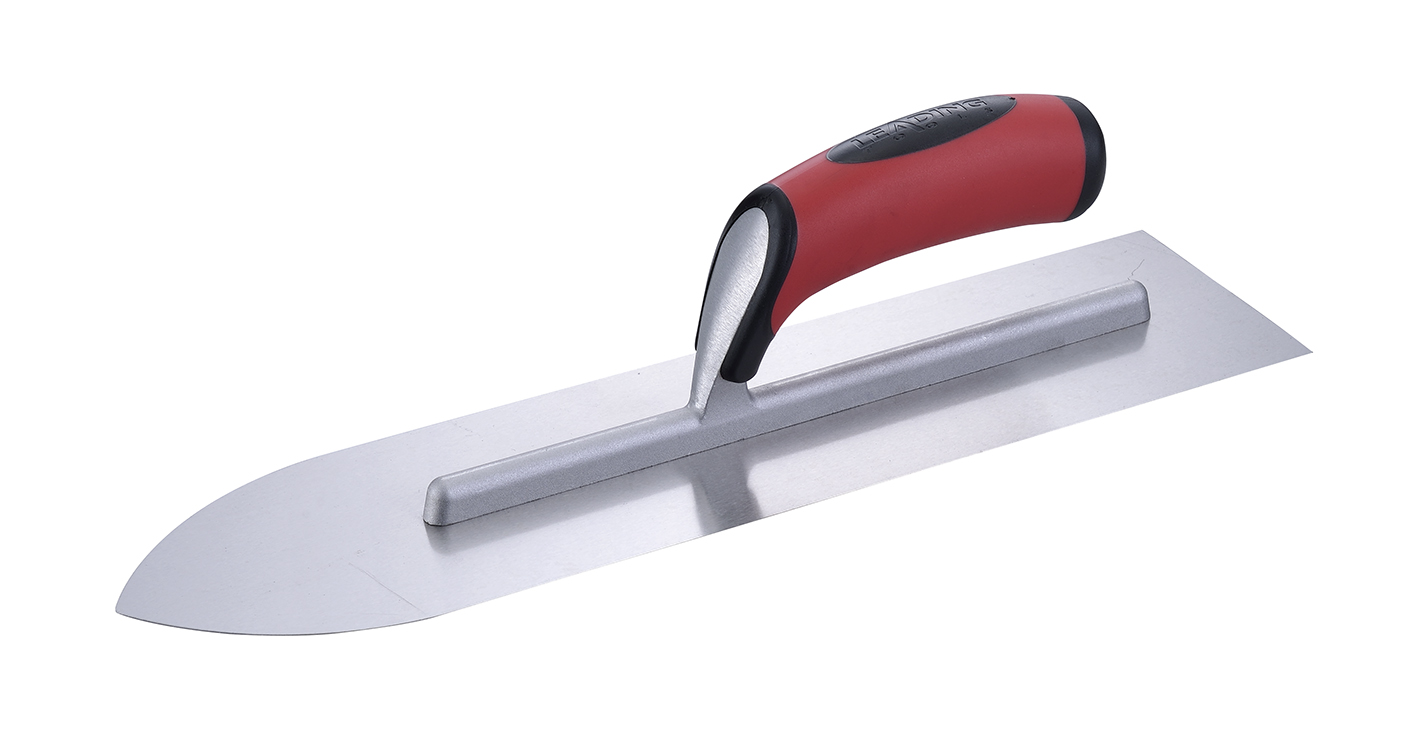
Pointed Finishing Trowel — Long Size
Product Description
Pointed Finishing Trowel 605821 (Long Size)
Art. Nr: 605821-40, 605821-45, 605821-50, 605821-60
Product family: Plaster Trowel
What this tool is. The 605821 is a long, flat, tapered-nose finishing trowel for spreading and smoothing plaster, render, screed and concrete. Its leading end narrows to a point so it can work corners, edges and confined areas that a square-nosed trowel cannot reach.
Who buys it. Plastering and rendering contractors, concrete flooring crews, screeders, and stucco applicators who need long, unbroken passes over wall and floor surfaces and who also need a nose that can reach into internal corners, along skirtings, around penetrations and up against formwork.
| Situation | Use the 605821? | Notes |
|---|---|---|
| Concrete slab has been floated and a footprint leaves an impression of no more than about 1/8" | Yes, this is the finishing window | Pointed finishing trowels are applied at this stage for corners and confined areas |
| Concrete is still soft enough to take a deep footprint | No, wait | Trowelling too early works water to the surface and weakens it |
| Plaster or render is applied and needs flattening before it sets | Yes | Flat steel finishing trowels are used to smooth the coat before it hardens |
| Final pass on a plaster or cement surface | Yes | Light pressure and a shallow blade angle reduce ripple marks |
| Internal corners, edges against formwork, around penetrations | Yes, this is the reason for the pointed nose | Square-nosed trowels cannot reach these areas |
| Mortar joints in brickwork | No | Use a Pointing Trowel and a Brick Jointer |
| Step | Action | Detail |
|---|---|---|
| 1 | Check readiness | On concrete, wait until the slab supports a footprint of about 1/8" or less; on plaster, work before the coat has gone off |
| 2 | Load the blade | Take material onto the blade from a hawk held close to the surface |
| 3 | Lay on | Apply material with the blade close to flat, working from the bottom of a wall upward or from the far side of a floor bay back toward your exit |
| 4 | Flatten | Draw the blade across the surface with light, even pressure, letting the length of the blade bridge high and low areas |
| 5 | Work the corners | Turn the tool so the 90 mm nose leads into the internal angle, edge or confined pocket |
| 6 | Finish pass | Make the final passes with minimal pressure and a very shallow blade angle to close the surface and reduce ripple lines |
| 7 | Clean | Wash the blade before material sets on it; leave nothing to cure on the steel |
Context. A power trowel or a large rectangular hand trowel handles the open field of a slab, but stops short at the wall line, at column bases, around drains and services, and in any bay too small for the machine.
Method. Once the slab has been floated and the surface takes a footprint of roughly 1/8" or less, the pointed finishing trowel is brought in to work those areas to the same standard as the machine-finished field. The 90 mm nose is what allows the blade into the angle between slab and upstand; the 110 mm heel then does the flattening on the way back out.
Size choice. 405 mm around obstructions and in small bays; 500–600 mm along long straight wall lines where the extra blade length keeps the edge strip flat and level with the field.
Context. Cement render, gypsum plaster or lime plaster applied to a wall, needing to be flattened and closed before it sets.
Method. The flat steel blade is used to spread and then smooth the coat while the material is still workable. Long passes with the blade nearly flat pull the surface level; the pointed nose is turned into the wall-to-wall and wall-to-ceiling angles, around window reveals and behind pipework, without the outer corner of the blade digging into the return.
Size choice. 455 mm as the general wall tool; 500 mm on large uninterrupted panels; 405 mm on reveals, small returns and overhead work where blade weight becomes the limiting factor.
Context. Ridge lines and ripple marks left by the corners of a square-nosed trowel are a common finish complaint, particularly on painted plaster and on polished cement surfaces where raking light shows every line.
Method. Make the last passes with very light pressure, a shallow blade angle, and overlapping strokes that do not stop mid-panel.
Size choice. The longest blade the operator can control cleanly: a longer blade means fewer stroke joins in the finished surface.
Context. Stamped or otherwise decorative concrete floors, and industrial screeds, where the finished surface is the wearing surface.
Method. The 605821 is also used on cement floor laying and decorative concrete work as well as on plaster. On these surfaces the finishing pass is what determines the final appearance, so blade cleanliness matters as much as technique: any cured material on the face will score the surface.
Size choice. 600 mm for open floor area (on large areas the constant-width series is easier to keep under even pressure), 405 mm for perimeters and detail.
Q1. Can I use it to point brickwork?
A. No. Mortar joints are filled with a Pointing Trowel and tooled with a Brick Jointer. This trowel is for rendered, plastered and concrete surfaces.
Q2. Which length should a first-time buyer order?
A. 605821-45 (455 mm) is a common general-purpose length: long enough to act as a straightedge across a wall panel, short enough to keep flat without long practice. Add 605821-60 for open floor area and 605821-40 for corner and overhead work.
Q3. Carbon steel or stainless steel?
A. The listed art numbers are stainless steel; each art number corresponds to one blade material. Carbon steel must be wiped dry and thinly oiled after use, or it will rust; contact Leading Tools sales for it. Stainless is the choice where the finish is white cement or light-colored plaster, where the tool is wet all day, or where end-of-shift care is not reliable.
Q4. I am getting ridge lines and ripple marks in the finished surface.
A. Three usual causes. First, the leading corner of the blade is digging in, so reduce the blade angle and lighten pressure on the final passes. Second, the passes stop mid-panel, so overlap strokes and carry them out to an edge. Third, the surface has already set, and further troweling will mark it rather than flatten it.
Q5. What is the difference between the 605821 series and the 608821 / 609821 / 610821 series?
A. Both are Pointed Finishing Trowels and share the Spot Riveted, stainless steel, soft-grip build. The 605821 blade is tapered, 90 mm at the nose to 110 mm at the heel, and 405–600 mm long.
The 608821 / 609821 / 610821 blades are a constant 4-1/2" wide and 14", 16" or 18" long. Choose the tapered series for corner-heavy work and maximum reach, and the constant-width series for open surfaces.
| Attribute | Detail |
|---|---|
| Blade Width (Tip) | 90 mm (≈3-1/2"), narrow, pointed leading end |
| Blade Width (Heel) | 110 mm (≈4-5/16"), widest section, at the handle end |
| Blade Shape | Tapered: 90 mm at the nose widening to 110 mm at the heel, over a rectangular body |
| Blade Length | 405 / 455 / 500 / 600 mm depending on article number |
| Blade Material | Stainless Steel (SS) |
| Attachment Method | Spot Riveted |
Tapered blade profile: what the taper buys you.
| Attribute | Detail |
|---|---|
| Handle Type | Soft-grip handle |
| Mounting | Spot Riveted |
Spot Riveted construction. Spot Riveted construction is used for the whole Pointed Finishing Trowel range.
| Article No. | Blade Width (Tip / Heel) | Blade Length | Reach class |
|---|---|---|---|
| 605821-40 | 90 / 110 mm | 405 mm (≈16") | Shortest, control-first |
| 605821-45 | 90 / 110 mm | 455 mm (≈18") | General purpose |
| 605821-50 | 90 / 110 mm | 500 mm (≈20") | Long reach |
| 605821-60 | 90 / 110 mm | 600 mm (≈24") | Longest, maximum coverage |
Inch figures are converted from the nominal millimetre dimensions at 1" = 25.4 mm and are rounded to the nearest common size.
| Specification | Value |
|---|---|
| Article Numbers | 605821-40, 605821-45, 605821-50, 605821-60 |
| Blade Width | 90 mm (nose) / 110 mm (heel) |
| Blade Length Range | 405 mm – 600 mm (≈16" – 24") |
| Blade Shape | Tapered, pointed nose |
| Material | Stainless Steel; for carbon steel, contact sales |
| Construction | Spot Riveted |
| Handle | Soft grip |
| Primary Use | Plaster, render, screed and concrete surface finishing; corner and edge work |
| Companion range | 608821, 609821, 610821: constant 4-1/2" width, 14"/16"/18" lengths |
| The customer's job | Right tool | Why |
|---|---|---|
| Spreading and smoothing plaster or render on walls | 605821 | Long flat blade, pointed nose for corners |
| Finishing a concrete slab, including edges and corners | 605821 | The pointed nose reaches the areas a square trowel cannot |
| Filling and striking mortar joints in brickwork | Not this tool: use a Pointing Trowel and a Brick Jointer | The Pointing Trowel carries mortar to the joint; the Brick Jointer compacts and tools it |
| Raking out and re-pointing old brickwork | Not this tool: Tuck Pointing Trowel plus a Brick Jointer | Mortar is pressed into the raked joint, then tooled with the jointer |
The listed art numbers are stainless steel. Each art number corresponds to one blade material; for a carbon steel blade, contact Leading Tools sales. The comparison below is for reference.
| Criteria | Carbon Steel (CS) | Stainless Steel (SS) |
|---|---|---|
| Corrosion resistance | Requires immediate drying and a thin coat of tool oil, or it will rust | High corrosion resistance and low maintenance |
| Lime-rich and cement-rich mixes | Cleans up, but corrodes if left wet | Preferred where the tool stays wet through the shift |
| Wet or exposed site conditions | Higher maintenance burden | Lower maintenance burden |
| Staining risk on white cement / light finishes | Rust marking is the risk to manage | Low risk of rust marking |
| Maintenance effort | Higher | Lower |
Buying advice. Carbon steel must be cleaned, dried and thinly oiled at the end of every shift; contact sales for it. The listed stainless art numbers suit work where the finish is white cement, lime plaster or a light decorative surface, where the tool is used continuously in wet conditions, or where the tool set is shared and end-of-shift care cannot be guaranteed.
| Work situation | Key consideration | Recommended length |
|---|---|---|
| Corners, reveals, small patches, confined plant rooms | Control in tight space | 405 mm (605821-40) |
| General wall plastering and rendering | Balance of reach and control | 455 mm (605821-45) |
| Large flat wall panels, floor screeds | Longer straightedge reference | 500 mm (605821-50) |
| Large-area slabs and open floor work | Maximum coverage per pass | 600 mm (605821-60) |
| Overhead and soffit finishing | Lower blade weight, less fatigue | 405–455 mm |
| Operators new to long-blade trowels | Easier to keep flat | 405–455 mm |
A longer blade rewards a skilled operator and punishes an unskilled one: the same reach that flattens a large panel quickly will also transfer any error in wrist angle across a longer line. Where a crew mixes experience levels, buying 455 mm as the house standard and 600 mm for the finishers is a workable split.
Both ranges are Pointed Finishing Trowels and share the Spot Riveted, stainless steel, soft-grip specification.
| Feature | 605821 series | 608821 / 609821 / 610821 series |
|---|---|---|
| Blade width | Tapered, 90 mm nose → 110 mm heel | Constant 4-1/2" (≈114 mm) |
| Blade lengths | 405 / 455 / 500 / 600 mm | 14" / 16" / 18" (≈356 / 406 / 457 mm) |
| Longest reach available | 600 mm | 457 mm |
| Nose behavior in corners | Narrower nose enters tighter angles | Wider nose, less corner access |
| Material carried on the blade | More at the heel, less at the nose | Even along the blade |
| Best for | Corner and edge work plus long flat passes | Even-pressure general finishing |
Practical rule: if the job is dominated by open flat area, the constant-width range is easier to keep even. If the job has many corners, returns and edges as well as flat area, the 605821 taper saves a tool change.
Complete art-number and size reference for the 605821 series.
| Art. Nr | Size (Width × Length) | Blade Material | Handle | Construction |
|---|---|---|---|---|
| 605821-40 | 90/110 mm × 405 mm | Stainless Steel | Soft grip | Spot riveted |
| 605821-45 | 90/110 mm × 455 mm | Stainless Steel | Soft grip | Spot riveted |
| 605821-50 | 90/110 mm × 500 mm | Stainless Steel | Soft grip | Spot riveted |
| 605821-60 | 90/110 mm × 600 mm | Stainless Steel | Soft grip | Spot riveted |
Companion range in the same product family (constant-width Pointed Finishing Trowel, specify separately):
| Art. Nr | Size | Blade Material | Handle | Construction |
|---|---|---|---|---|
| 608821 | 4-1/2" × 14" | Stainless Steel | Soft grip | Spot riveted |
| 609821 | 4-1/2" × 16" | Stainless Steel | Soft grip | Spot riveted |
| 610821 | 4-1/2" × 18" | Stainless Steel | Soft grip | Spot riveted |
Cleaning
Blade care
| Maintenance Item | Frequency | Method |
|---|---|---|
| Rust removal (CS only) | As needed | Fine emery cloth, worked along the blade length |
| Full blade inspection | Between projects | Check the whole length for warping, pitting and edge damage |
| Handle fixing inspection | Weekly | Check the Spot Riveted connection between blade and handle for movement or lifting |
| Handle inspection | Monthly | Check grip integrity and that the handle has no play at the blade |
| Blade flatness check | Monthly | Lay on a known flat surface and check for twist or bow, especially on the 600 mm variant |
| Care Aspect | Carbon Steel | Stainless Steel |
|---|---|---|
| Drying after use | Immediate and complete | Prompt |
| Oil coating for storage | Essential | Optional |
| Corrosion risk on a long blade | Higher, large exposed area | Lower |
| Maintenance effort | Higher | Lower |
| Risk of staining a light finish | Rust marking possible | Low risk |

In compliance with EU personal data protection laws, we are committed to protecting and providing you with control over your personal data. By clicking "Accept All", you allow us to place cookies to enhance your experience on this site, help us analyze site performance and usage, and enable us to deliver relevant marketing content. You can manage your cookie settings below. By clicking "Agree" you agree to the current settings. For more information, please visit the Privacy Statement.
This website uses cookies
In compliance with EU personal data protection laws, we are committed to protecting your personal data and providing you with control over it. By clicking "Agree", you allow us to place cookies to improve your experience on this site, help us analyze site performance and usage, and allow us to deliver relevant marketing content.
By clicking "Only necessary" you allow us to place only necessary cookies. The website cannot function without these cookies and you cannot switch them off on your system. These cookies are typically set only in response to an action you perform (i.e. a service request), such as setting privacy preferences, logging in, or filling in a form. You can set your browser to block or prompt you for these cookies, but this may prevent some site features from working.