
Copyright 2026 © Leading Tools Industrial Co., Ltd.
All Rights Reserved. Website Design by Awakening Design
CATALOG TYPE
Product Categories
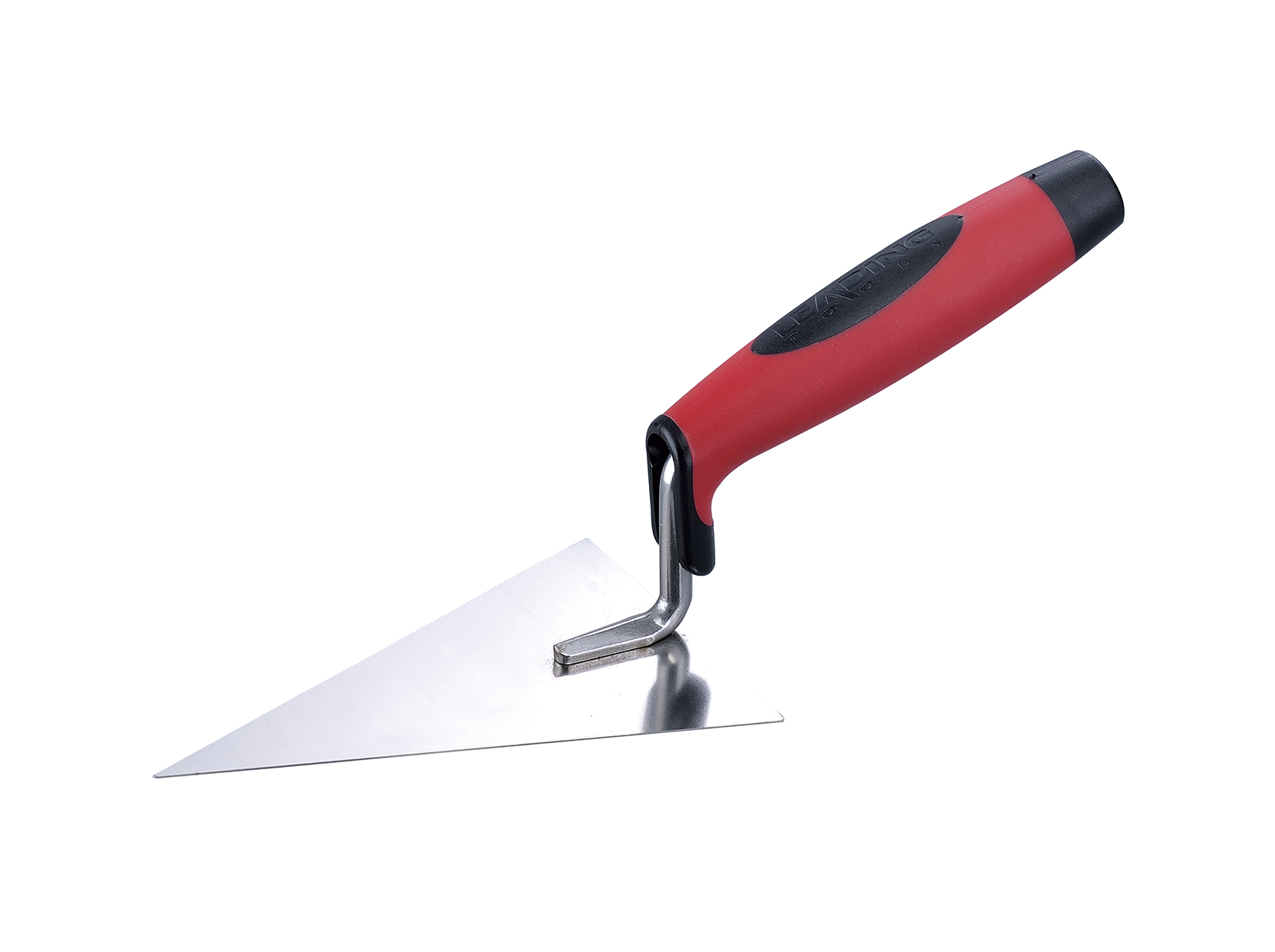
Pointed Triangle Trowel — Spot Welded Stainless Steel
Product Description
Product name: Pointed Triangle Trowel
Construction line: Spot Welded Stainless Steel
Art. Nr (three sizes): 281821 (120 mm), 282821 (140 mm), 283821 (160 mm).
The three art numbers are one product family under one name. They differ only in blade size; construction, blade material class and handle are identical across all three.
Leading Tools also builds "Pointed Triangle Trowel / CO2 Welded Carbon Steel" with art numbers 281621 (120 mm), 282621 (140 mm), 283621 (160 mm), the same three sizes in the same pattern. Buyers comparing the two are choosing between construction methods and blade material, not between blade shapes; see the Selection Guide.
The pointed toe reaches where a bricklaying trowel cannot. The narrowing delta blade lets the operator pick up a small charge of mortar, place it precisely for patching and detail work, and carry it to the edge of the joint, a different job from the wide-heel loading a Philadelphia or London bricklaying trowel is built for. Pressing the mortar into the joint and compacting it is done with a Tuck Pointing Trowel or a Brick Jointer.
Three sizes so the tool can be matched to the work, not the work to the tool. Shorter blades suit fine detail and confined areas, while longer blades carry more mortar per pick-up. Leading Tools covers 120 / 140 / 160 mm in one line, so a crew can standardise on one pattern and still carry the right length for fine detail and for larger patches.
A construction choice at the same three sizes. Because Leading Tools carries the identical three sizes in a CO2-welded carbon steel line (281621/282621/283621), a buyer can specify construction and material tier independently of size, the same blade geometry, the same handle.
A soft grip handle across all three sizes. Every art number in this line carries the BF21 soft grip.
Not a bulk carrier or jointing tool. It is not a bulk mortar-carrying trowel and not a jointing tool. Mortar is normally picked up from a hawk or a bricklaying trowel and carried to the work with this tool. Pressing mortar into the joint and compacting it is done with a Tuck Pointing Trowel, and the finished joint profile, V or concave, is struck with a Brick Jointer, not with this blade. See How to Use.
| Situation | Use the Pointed Triangle Trowel? | Why |
|---|---|---|
| Picking up small amounts of mortar; patching and small rebuilds | Yes, this is the primary job | The narrowing blade picks up a small charge and places it precisely |
| Repairs and detail rendering / plastering, especially at corners and returns | Yes | This blade shape is also used for narrow-area plaster finishing, corners in particular |
| Carrying mortar to the edge of the joint | Yes | The trowel takes a small charge from the hawk and delivers it to the joint |
| Pressing and compacting mortar into the joint (pointing / repointing, tuckpointing) | No, use a Tuck Pointing Trowel | The Tuck Pointing Trowel is the tool made to press mortar into the joint and compact it |
| Striking the final V or concave joint profile | No, use a Brick Jointer | The joint profile is struck with a jointer, not with this trowel |
| Carrying and spreading a full bed of mortar for laying units | No, use a bricklaying trowel | This is a precision tool, not a bulk mortar carrier; the mortar is normally picked up from a hawk or a bricklaying trowel |
| Cutting or levering brick | No | A small trowel is not a lever |
| Step | Action | Note |
|---|---|---|
| 1 | Clean the area to be patched back to sound material, and dampen it as the mortar specification requires | Preparation is part of the patching operation |
| 2 | Hold the mortar on a hawk, or load from a bricklaying trowel | This trowel takes a small working charge from the hawk rather than from the board |
| 3 | Pick up a small amount of mortar on the heel half of the blade | |
| 4 | Place the mortar on the patch or detail area, or carry it to the edge of the joint | |
| 5 | To press mortar into the joint and compact it, change to a Tuck Pointing Trowel; to strike the final profile, use a Brick Jointer | Pressing, compaction and the joint profile do not come from this trowel |
| 6 | Smooth the patch or detail area so it matches the surrounding work | |
| 7 | Brush the face off once the mortar has firmed, and clean the trowel before the mortar dries on it |
Working angle. Hold the blade at a shallow angle to the work and draw it toward you; pushing the point into material risks damaging the tip and gives less control.
Patching is the core application. The damaged area is cleaned back to sound material and dampened; a small amount of mortar is picked up with the pointed toe, placed in the repair and smoothed to match the surrounding work. The 120 mm blade is the one to reach for on small, tight repairs, the 140 mm on general work.
This trowel takes a small charge from the hawk and carries it to the edge of the joint. The mortar is then pressed into the joint and compacted with a Tuck Pointing Trowel, and the profile is struck with a Brick Jointer.
The triangle/delta blade is used for narrow-area plaster and filler work, corners and returns in particular.
Q1. What is this trowel used for, and can it press mortar into a joint?
A. It picks up small amounts of mortar for patching and small rebuilds, repairs, detail rendering and plastering, and carries mortar to the edge of the joint. It does not press and compact mortar into a joint: that is done with a Tuck Pointing Trowel, and the finished joint profile (V or concave) is struck with a Brick Jointer (a hand tool that presses the joint to its final shape).
Q2. What is the difference between 281821 and 281621?
A. Both are 120 mm Pointed Triangle Trowels with a soft grip handle, and the blade shape, size and handle are the same. 281821 is the spot welded stainless steel version, and 281621 is the CO2 welded carbon steel version. Neither construction should be used to lever or cut units.
Q3. Which size should I order first?
A. 140 mm (282821). It sits in the middle of the three sizes, so it handles general patching without being awkward in detail work. Add 120 mm for fine detail and 160 mm for larger patches.
Q4. How do I look after it?
A. The blade is stainless steel, with high corrosion resistance and low maintenance, so it does not need the daily oiling that carbon steel does.
Clean the mortar off immediately after use, rinse with clean water and dry the blade, and never store it wet or standing in water; chlorinated water, coastal air or prolonged soaking can still cause rust spots.
If dried mortar has set on the blade, soak it in water until it softens and work it off with a nylon brush; do not chisel or scrape it off with another steel tool, which scores the face. Avoid steel wire brushes and steel wool, because iron transferred onto stainless can show up as rust spots.
Q5. When should I re-dress or replace it?
A. If the point goes blunt, a light burr can be dressed with a fine stone; do not change the blade shape, and avoid heavy grinding. If the blade has come loose from the shank, replace the tool, because spot welds are not field-repairable and cannot be re-welded on site; if it happens in normal use rather than after levering, report it.
The blade is the defining feature. In plan view it forms a triangle that tapers to a sharp point: wide at the heel where it meets the shank, narrowing continuously to a precision point at the toe. That geometry does two things at once: the wide heel still holds a usable charge of mortar, and the point lets the operator place material precisely in small areas and corners.
| Blade family | Plan view shape | Toe profile | Primary role | Where in the range |
|---|---|---|---|---|
| Philadelphia | Parallelogram, deep square heel | Pointed toe | Standard bricklaying: mortar pick-up and direction; the square heel holds the larger charge | |
| London (wide / narrow) | Tapered parallelogram, rounded heel | Pointed toe | Precision brick placement; better force control in narrow work, the British traditional pattern | |
| Triangle Trowel | Triangle / delta | Rounded (260604) | Picking up and spreading mortar for bricklaying and general plastering | 260604, 810101 |
| Pointed Triangle Trowel | Triangle / delta | Sharp point | Picking up small amounts of mortar, patching, repairs, detail plastering, corner and curved detailing | CO2, 281621–283621; spot welded, 281821–283821 |
The pointed triangle blade is a detail tool rather than a carrier of mortar over a long bed.
This line is built by spot welding: the blade and the shank are separate parts joined by spot welding at the blade-to-shank junction.
| Feature | Pointed Triangle Trowel CO2 (281621–283621) | Pointed Triangle Trowel spot welded (281821–283821) |
|---|---|---|
| Blade-to-shank joint | CO2 welding | Spot welding |
| Blade material | Carbon steel | Stainless steel |
| Sizes offered | 120 / 140 / 160 mm | 120 / 140 / 160 mm |
| Handle | Soft grip, BF21 | Soft grip, BF21 |
The blade is stainless steel, as the line designation ("Spot Welded Stainless Steel") states.
| Attribute | Specification |
|---|---|
| Product name | Pointed Triangle Trowel |
| Construction | Spot welding |
| Blade material | Stainless steel |
| Blade shape | Triangle / delta, sharp pointed toe |
| Blade sizes | 120 mm, 140 mm, 160 mm |
| Handle type | Soft grip, BF21 |
Leading Tools offers the same Pointed Triangle blade in the same three sizes in two lines. This is the first decision, and it is made before size.
| CO2 welded carbon steel | Spot welded | |
|---|---|---|
| Art. Nr | 281621 / 282621 / 283621 | 281821 / 282821 / 283821 |
| Blade material | Carbon steel | Stainless steel |
| Choose it when | The buyer will dry and oil the tool after every use | The buyer wants the corrosion resistance of a stainless steel blade: high corrosion resistance and low maintenance, though chlorinated water, coastal air or prolonged soaking can still cause rust spots |
| Trade-off | Carbon steel blades cost less but rust if not dried and lightly oiled after every use | Not rust-proof; rinse with clean water and dry after use |
In practice, the choice tends to follow the maintenance regime the crew will actually keep, not a metallurgical argument.
| Size | Art. Nr | Best for | Considerations |
|---|---|---|---|
| 120 mm | 281821 | Fine detail, small repairs and patching, tight corners | Shortest blade, most manoeuvrable in confined areas and the smallest working charge |
| 140 mm | 282821 | General patching and detail work; the sensible first purchase | The middle of the three sizes, a balance between control and how much each pick-up carries |
| 160 mm | 283821 | Larger patches and larger detail areas | Longest blade; carries the most mortar per pick-up, at the cost of manoeuvrability in tight detail |
Recommendation: for a first order, standardise on 140 mm (282821) for general patching and detail work, and add 120 mm (281821) for fine detail and tight corners. Choose 160 mm (283821) for larger patches. Match blade size to the area being worked, so a crew working on different areas will genuinely use more than one size.
All three art numbers carry the BF21 soft grip. Other handles can be fitted on request; contact Leading Tools sales.
| ART. Nr | Blade size | Construction | Blade material | Handle |
|---|---|---|---|---|
| 281821 | 120 mm | Spot welding | Stainless steel | Soft grip, BF21 |
| 282821 | 140 mm | Spot welding | Stainless steel | Soft grip, BF21 |
| 283821 | 160 mm | Spot welding | Stainless steel | Soft grip, BF21 |
Sibling line for comparison, same pattern and sizes, CO2 welded carbon steel: 281621 (120 mm), 282621 (140 mm), 283621 (160 mm).

In compliance with EU personal data protection laws, we are committed to protecting and providing you with control over your personal data. By clicking "Accept All", you allow us to place cookies to enhance your experience on this site, help us analyze site performance and usage, and enable us to deliver relevant marketing content. You can manage your cookie settings below. By clicking "Agree" you agree to the current settings. For more information, please visit the Privacy Statement.
This website uses cookies
In compliance with EU personal data protection laws, we are committed to protecting your personal data and providing you with control over it. By clicking "Agree", you allow us to place cookies to improve your experience on this site, help us analyze site performance and usage, and allow us to deliver relevant marketing content.
By clicking "Only necessary" you allow us to place only necessary cookies. The website cannot function without these cookies and you cannot switch them off on your system. These cookies are typically set only in response to an action you perform (i.e. a service request), such as setting privacy preferences, logging in, or filling in a form. You can set your browser to block or prompt you for these cookies, but this may prevent some site features from working.