
Copyright 2026 © Leading Tools Industrial Co., Ltd.
All Rights Reserved. Website Design by Awakening Design
CATALOG TYPE
Product Categories
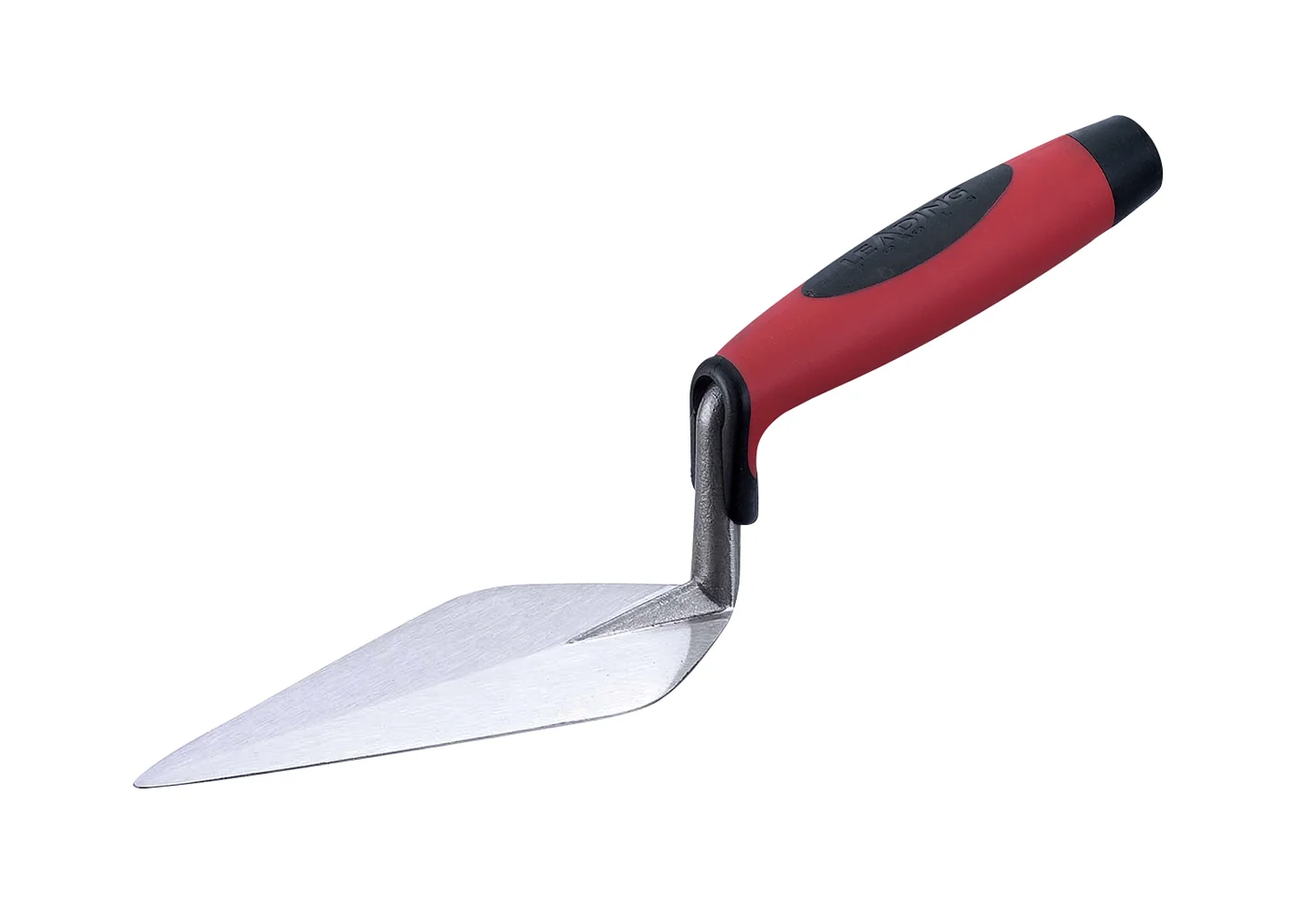
Pointing Trowel — Forged High Carbon Steel
Product Description
Product name: Pointing Trowel
Construction line: Forged in One-piece High Carbon Steel
Product family: Brick Trowel
Art. Nr (four sizes):
| ART. NR | Size | Metric equivalent |
|---|---|---|
| 024721 | 4" | 102 mm |
| 025721 | 5" | 127 mm |
| 026721 | 6" | 152 mm |
| 027721 | 7" | 178 mm |
Product type. Pointing trowel / precision masonry trowel, listed in the Brick Trowel family.
One-piece construction. Because the blade, shank, and tang come out of one piece of steel, there is no joint between blade and neck.
Direct feedback at the tip. With no joint between blade and shank, pressure applied at the handle arrives at the tip as one continuous section, which gives the operator direct feel at the point of contact.
Access instead of volume. A full-size laying trowel is the wrong shape for small mortar jobs. The narrow blade lets the operator pick up a small amount of mortar, see where it is going, and carry it to the edge of the joint, placing it only where it is wanted, which reduces cleanup on the brick face.
Four sizes covering the whole repair range. 4" for fine and confined work up to 7" for broader detail work means one product family covers both restoration work and general site patching, with no need to source from two suppliers.
Primary use. Picking up small amounts of mortar, patching and small rebuilds, repairs, detail rendering/plastering, and carrying mortar to the edge of the joint. Pressing mortar into the joint and compacting it is done with a Tuck Pointing Trowel or a Brick Jointer.
| Job situation | Why this tool | Size to reach for |
|---|---|---|
| Repointing raked-out joints on an existing wall | Picks up small amounts of mortar and carries it to the edge of the joint without disturbing brick arrises; packing is done with a Tuck Pointing Trowel or Brick Jointer | 4"–6" |
| Carrying mortar to perpends (vertical joints) | Pointed toe places the mortar accurately at the edge of the joint; packing is done with a Tuck Pointing Trowel or Brick Jointer | 4"–6" |
| Small patch repair on brick or block | Places mortar only where needed, keeping the surrounding face clean | 5"–7" |
| Corners, returns, reveals, narrow gaps | Small blade footprint where a laying trowel will not fit | 4"–5" |
| Stone veneer and decorative bands | Small controlled deposits with less squeeze-out | 4"–6" |
| Trimming mortar squeezed out of a joint | Sharp carbon steel edge slices mortar cleanly | any size |
| Spreading a full bed joint for laying | Wrong tool, use a full-size Philadelphia or London trowel | ; |
| Step | Action | Detail |
|---|---|---|
| 1 | Prepare mortar to a stiff, workable consistency | Correctly mixed mortar should hold its shape when cut, like marzipan; too wet and it slumps, too dry and it crumbles |
| 2 | Load the hawk, then cut a sausage of mortar off it with the trowel | Working from a hawk rather than the board keeps the mortar within reach of the joint |
| 3 | Carry the mortar to the edge of the joint from the face of the brick and place it | Deliver the mortar accurately so little spills onto the brick face; pressing and compacting it in the joint is done with a Tuck Pointing Trowel or Brick Jointer |
| 4 | Place mortar at the perpends (vertical joints) first, then the bed (horizontal) joints | This is the normal sequence and it stops finished horizontal joints being disturbed while the verticals are worked |
| 5 | Trim the excess flush before it sets | Use the blade edge to cut off proud mortar |
| 6 | Wait roughly 20–30 minutes, until a thumb press leaves a mark without sticking | This is the point at which the joint is ready to be tooled or ironed |
| 7 | Tool the joint to the required profile with a Brick Jointer | Bucket handle, weather struck, flush: profile depends on the specification |
| 8 | After the joint is tooled and the surface has dried slightly, brush the brick face lightly with a soft brush or wipe it with a wrung-out sponge | Cement film left on the face is very hard to remove later |
Because the blade is narrow, the operator keeps sight of the work throughout, which a full-size brick trowel obstructs.
| Job requirement | Advantage |
|---|---|
| Narrow access | Slim blade reaches confined spaces easily |
| Corner patching | Pointed toe reaches into corners cleanly |
| Small repair areas | Better control without overloading with mortar |
| Vertical joint work | Easier to place mortar accurately at the edge of the joint |
| Delicate masonry surfaces | Reduces accidental smearing on adjacent faces |
Best suited to:
On restoration work the mortar has to be delivered to a prepared joint without damaging the arrises of the surrounding brick, which is the whole reason a narrow blade is used instead of a laying trowel.
The joint is raked out and dampened; the pointing trowel picks up small amounts of mortar and carries them to the joint, and each pass is then pressed solid with a Tuck Pointing Trowel or a Brick Jointer. Waiting for the thumb-press stage before tooling is what separates a joint that survives a freeze-thaw cycle from one that does not.
When an isolated brick is being replaced or a chipped edge made good, a full brick trowel is oversized for the amount of mortar involved. The pointing trowel lets mortar be placed only where it is needed, which keeps the surrounding face clean and reduces the sponging afterwards.
Thin stone veneer, decorative brick bands, and edge details need small, controlled mortar deposits. The pointed toe places mortar behind or between pieces without excessive squeeze-out that then has to be cleaned off a textured face.
Around corners, wall returns, window reveals, and narrow gaps, the smaller blade footprint is the practical advantage over a full-size trowel. This is the scenario in which buyers move down to a 4".
On most jobs the pointing trowel is the second tool, not the only one. It supports a larger laying trowel by handling detail filling, edge cleanup, small corrections, and small-batch mortar delivery. It is therefore an add-on to Leading Tools' full-size brick trowels rather than a substitute for them.
Q: What is a pointing trowel for, and can I use it instead of a brick trowel?
A: It is a scaled-down brick trowel for small mortar work: picking up small amounts of mortar, patching and small rebuilds, repairs, detail rendering/plastering, and carrying mortar to the edge of the joint.
Its mortar capacity is deliberately low, so use a full-size Philadelphia or London trowel for laying bed joints and keep the pointing trowel as the precision tool. To press mortar into the joint, use a Tuck Pointing Trowel or a Brick Jointer.
Q: Which size should I order?
A: 6" (026721) is a general-purpose size, with 4"–5" for detail work and confined spaces. If the repair area is larger than a pointing job, move up to 7" (027721) or switch to a full-size brick trowel.
Q: Why carbon steel rather than stainless?
A: This line is made in carbon steel, which must be dried and thinly oiled after use or it rusts. Stainless steel has high corrosion resistance and low maintenance; chlorinated water, coastal air or prolonged soaking can still cause rust spots, so rinse with clean water and dry after use. Contact Leading Tools sales for stainless pointing trowels.
Q: How do I keep it clean and prevent rust?
A: If mortar sticks heavily, clean the blade thoroughly, dry it and apply a light film of oil. If it has started to rust, dry it fully, remove the rust with a fine abrasive pad and re-oil it, and do not store the tool in a water bucket or a damp bag.
Q: When is it time to change the size or replace the tool?
A: If you cannot place mortar accurately in narrow spots, either the blade is too large for the work or the point is worn, so move down to 4" or 5" or replace a worn tool.
A point that has rounded off or bent can have light burrs dressed, but significant deformation means replacement; gradual rounding from abrasive use is normal wear. If the handle feels loose, take the tool out of service until it is refitted or replaced.
The blade is a narrow, elongated triangle with a pointed toe. Two geometric properties do the work:
One practical consequence of the narrow blade is visibility: with a small blade footprint the operator can see the area being worked, which a full-size trowel blocks.
| Attribute | Specification |
|---|---|
| Handle type | Soft grip handle BF21 |
| Other handles | Can be fitted on request: contact Leading Tools sales. |
A pointing trowel is a scaled-down brick trowel, made in either the Philadelphia (square heel) or London (rounded heel) pattern, rather than an independent pattern name. The meaningful distinction for a buyer is therefore role and size class, not pattern name.
| Feature | Pointing trowel (this product) | Full-size Philadelphia pattern | Full-size London pattern |
|---|---|---|---|
| Blade length range | 4"–7" | Standard bricklaying lengths, typically 9"–12" | Standard bricklaying lengths, typically 9"–12" |
| Blade width | Very narrow | Broad, high-capacity heel | Narrower than Philadelphia, but still a laying blade |
| Heel form | Rounded heel (a scaled-down London pattern) | Square heel | Rounded heel |
| Toe | Narrow taper to a point | Pointed toe on a broader body | Long tapered laying profile |
| Main role | Picking up small amounts of mortar, detail placement, patching and repair | Carrying and spreading mortar beds | Bricklaying with cleaner control |
| Mortar capacity | Low | High | Medium to high |
| Control in tight spaces | Excellent | Moderate | Better than Philadelphia, still not a joint tool |
| Buying logic | Bought as a second, precision tool alongside a laying trowel | Primary laying tool | Primary laying tool |
In practical terms: a full-size Philadelphia trowel is bought to move mortar volume and lay courses quickly; a full-size London trowel is bought for a cleaner, more controlled laying profile; a pointing trowel is bought for precision, access, and finish control, and is not a substitute for either as a laying tool.
Because blade, shank, and tang are forged from one piece of steel, the tool has no joint between blade and neck. This suits a pointing trowel, because detail work concentrates load in a small area: repeated wrist rotation and pressure applied close to the tip.
Benefits of one-piece forged construction:
| Attribute | Specification |
|---|---|
| Blade material | High carbon steel |
| Blade finish | Polished |
| Construction | Forged in one piece |
| Corrosion behaviour | Rusts if stored wet; managed by drying and oiling |
| Size | Art. Nr | Typical use |
|---|---|---|
| 4" (102 mm) | 024721 | Fine repair work, tight spots, detail work, small cavities |
| 5" (127 mm) | 025721 | General-purpose and touch-up work |
| 6" (152 mm) | 026721 | Balanced choice for regular site repair and patching |
| 7" (178 mm) | 027721 | Greater reach and slightly higher mortar pickup for broader detail work |
Choose a smaller size (4"–5") when:
Choose a larger size (6"–7") when:
Size the trowel against the work: the narrower the joint it has to be carried to and the smaller the repair, the smaller the trowel should be. Pressing mortar into the joint itself is done with a Tuck Pointing Trowel or a Brick Jointer.
Specify a pointing trowel when:
Do not specify it as a replacement for a laying trowel. In normal practice a mason carries both: a full-size trowel for the mortar bed and a pointing trowel as the precision tool.
All four art numbers in this line, listed individually.
| ART. NR | Size | Metric | Blade material | Construction | Handle |
|---|---|---|---|---|---|
| 024721 | 4" | 102 mm | High carbon steel, polished | Forged in one piece | Soft grip, BF21 |
| 025721 | 5" | 127 mm | High carbon steel, polished | Forged in one piece | Soft grip, BF21 |
| 026721 | 6" | 152 mm | High carbon steel, polished | Forged in one piece | Soft grip, BF21 |
| 027721 | 7" | 178 mm | High carbon steel, polished | Forged in one piece | Soft grip, BF21 |
Attributes shared across all four art numbers:
| Attribute | Specification |
|---|---|
| Product name | Pointing Trowel |
| Product family | Brick Trowel |
| Construction line | Forged in One-piece High Carbon Steel |
| Blade geometry | Narrow elongated triangular blade, pointed toe |
| Blade finish | Polished carbon steel |
| Shank form | Forged neck and tang integrated with the blade |
| Handle type | Soft grip, BF21 |
| Primary work style | Precision placement rather than heavy mortar loading |
Carbon steel rusts if it is left wet, so corrosion control is part of owning the tool:
The point is the functionally important part of this blade. If it is nicked, bent, or heavily rounded, precision drops and the tool stops doing the job it was bought for. Minor burrs can be dressed lightly, but a cracked or deformed blade should be replaced. Gradual rounding of the point through abrasive contact is normal wear rather than a defect.
The soft grip handle needs less maintenance than wood, but it should still be kept clean of hardened mortar, which makes the grip surface slick, and inspected for splitting or for any movement between handle and tang. If the handle becomes loose, both accuracy and safety are affected and the tool should be taken out of service.
For seasonal or long-term storage, clean the blade fully, oil it, and store it dry and separate from other steel tools so the point is not knocked out of shape.

In compliance with EU personal data protection laws, we are committed to protecting and providing you with control over your personal data. By clicking "Accept All", you allow us to place cookies to enhance your experience on this site, help us analyze site performance and usage, and enable us to deliver relevant marketing content. You can manage your cookie settings below. By clicking "Agree" you agree to the current settings. For more information, please visit the Privacy Statement.
This website uses cookies
In compliance with EU personal data protection laws, we are committed to protecting your personal data and providing you with control over it. By clicking "Agree", you allow us to place cookies to improve your experience on this site, help us analyze site performance and usage, and allow us to deliver relevant marketing content.
By clicking "Only necessary" you allow us to place only necessary cookies. The website cannot function without these cookies and you cannot switch them off on your system. These cookies are typically set only in response to an action you perform (i.e. a service request), such as setting privacy preferences, logging in, or filling in a form. You can set your browser to block or prompt you for these cookies, but this may prevent some site features from working.