
Copyright 2026 © Leading Tools Industrial Co., Ltd.
All Rights Reserved. Website Design by Awakening Design
CATALOG TYPE
Product Categories
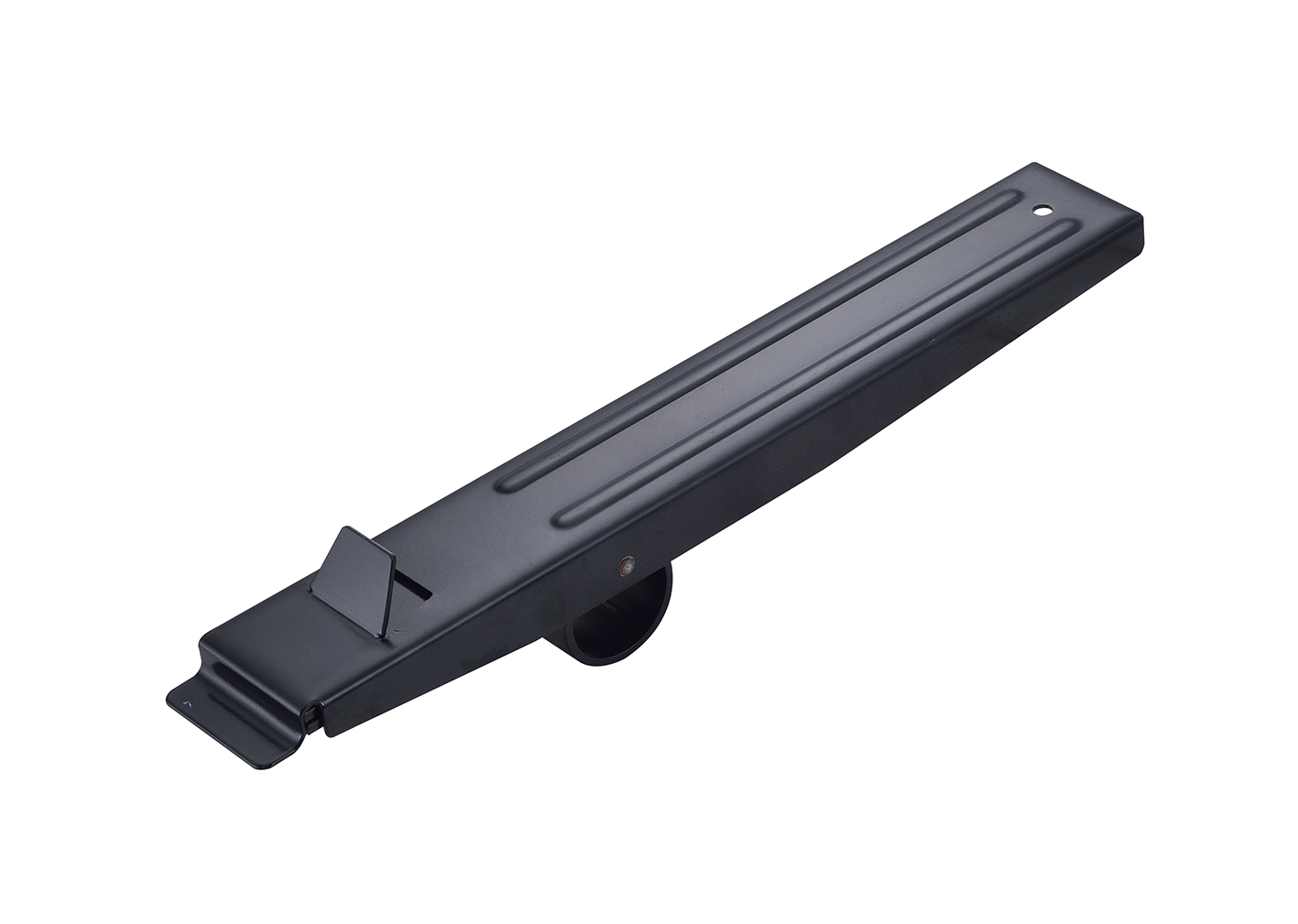
Roll Lifter
Product Description
Roll Lifter — Art. Nr 301015, Size 15" (381 mm)
The product name is Roll Lifter. It belongs to the Leading Tools Builder Tools range. One article number covers the product: 301015, 15".
It is a single black-finished flat bar. At the front end the bar is stepped down and bent into a thin lifting lip that slides into the gap under a board; a single roller is mounted underneath, just behind that lip; the remainder of the bar is a long, ribbed flat treadle that the installer stands on. There is no chassis and no clamp.
This is a standard drywall roll lifter / panel lifter: the lip goes under the bottom edge of a wallboard sheet, the roller becomes a fixed fulcrum against the floor, and foot pressure on the tail of the bar levers the sheet up so it can be closed tight to the sheet above.
It replaces the third hand on the bottom row of board. The one job that stops a solo installer is holding the lower sheet tight against the sheet above while driving the first screws. Lift the board without help and fasten with both hands free.
Foot power instead of back power, which matters for a known injury risk. Drywall installation is a high back- and shoulder-strain trade: bend at the knees rather than the waist, and have heavier sheets handled by two people. A foot lever transfers the lifting load to the leg and the floor instead of the lower back, which reduces fatigue and injury risk.
A fixed fulcrum, so the lift is controlled rather than a pry. The roller is a fixed pivot. Practically, the sheet rises along a predictable arc, so it can be nudged to a line instead of jumped into place.
The roller keeps the tool mobile without lifting it. Because the pivot is a wheel rather than a fixed heel, the tool can be slid along the wall to the next sheet; once the sheet is fixed, release the foot and roll the tool out.
Few moving parts. The only moving part is the roller; there is no clamp, screw or spring to loosen under load. Compare that with a clamp- or screw-based lifter, where a grip failure under a raised sheet is a genuine injury hazard.
Who buys this tool
| Buyer | What they use it for |
|---|---|
| Drywall / wallboard installers | Closing the joint on the bottom course of board, working alone |
| Interior fit-out contractors | Repeat single-operator board hanging across many rooms |
| Renovation and repair trades | Lifting a replacement panel back to line in an existing wall |
| Carpenters and joiners fitting sheet material | Timber panelling, fibreboard and similar sheets |
| Door and panel fitters | Raising a leaf or panel a few millimetres to align hinges or a threshold |
| Tool distributors and hire fleets | Hand tool for repeat use |
| Situation | Use the Roll Lifter? | Why |
|---|---|---|
| Hanging the bottom course of drywall alone | Yes, primary case | Lifts the sheet tight to the course above so both hands are free to fasten |
| Closing a gap at a board joint after the top course is fixed | Yes | Small, controlled lift against a fixed fulcrum |
| Aligning a cut sheet to a marked line at the floor | Yes | The lever holds the edge clear while the sheet is aligned |
| Fitting panelling or fibreboard | Yes | Also works for non-gypsum sheet material |
| Board on a ceiling | No | Use a panel hoist |
| Carrying a sheet from the stack to the wall | No | Not a transport tool; use a board carrier |
| Very large or heavy sheets, or overhead-height work | Two people | Recommended for heavy boards |
| Step | Action | Watch for |
|---|---|---|
| 1 | Set the board against the wall in position and rest its lower edge on the floor | Clear the floor first: grit under the roller stops it rolling and marks the floor |
| 2 | Slide the lip under the lower edge of the board so the bar points away from the wall and the roller sits flat on the floor | The lip must be fully under the board edge, not under the paper face only |
| 3 | Place your foot on the tail of the bar | Stand square; do not put your foot on the lip end |
| 4 | Press down. The roller is the pivot; the board edge rises, up to about 3" on tools of this class | Lift only as far as the joint needs: extra lift only loads the board edge |
| 5 | With the foot holding the lift, use both hands to align the board and drive the first fasteners | Keep the foot down until enough screws are in to hold the sheet |
| 6 | Release the foot slowly, then roll the tool out from under the board and move to the next sheet | Do not jerk the tool out, let the roller carry it |
The lower sheet has to be pushed up hard against the upper sheet before it is fixed, or the joint opens and shows through the finish. Working alone, that lift and the first screws happen at the same time, which is exactly the situation that calls for a third hand. Set the sheet, slide the lip under, stand on the tail, and drive the top row of screws first; the joint stays closed while you work down the sheet.
The same foot-lever tool can be used to fit timber board and fibreboard, not only plasterboard. The technique is unchanged; the only thing to check is that the lip clears the floor covering and does not mark a finished board edge.
Site crews without a lifter improvise with a pry bar and a timber wedge as the fulcrum. This works on the same lever principle, and it shows why the purpose-made tool exists: an improvised fulcrum slips, has no lip to spread the load along the board edge, has no roller, and is harder to pull out from under a loaded sheet.
| Job | Right tool |
|---|---|
| Ceiling board | Panel hoist / drywall lift, explicitly not this tool |
| Moving sheets from the stack | Board carrier or panel cart |
| Large or heavy sheets | Two-person handling |
| Very confined spaces | Contact sales for options |
Q1. How high does it lift, and can I use it for ceiling board?
Tools in this class lift up to about 3" (75 mm); that is a class figure. It is not for ceiling work, because a ceiling sheet has to be supported over its whole area, which is a panel hoist job. For heavy sheets use two people.
Q2. Does it work on materials other than plasterboard?
Yes. The same foot-lever tool can be used for timber board and fibreboard. Check that the lip suits the board edge and the floor covering.
Q3. The lip will not go under the board, or the board edge is getting crushed. What is wrong?
If the lip will not go under, the board is probably sitting flat on the floor with no gap, so tip the sheet a few millimetres with your foot or a scrap of board, then slide the lip in. If the edge is crushed or torn, you are lifting too far or loading the lip on a corner: lift only as far as the joint requires, and centre the lip under the sheet.
Q4. The roller will not turn, or the tool skids instead of lifting.
A roller that will not turn is almost always packed with gypsum dust or dried compound around the axle; clean it out, oil the axle lightly, and replace the roller if it still binds. Skidding means the roller is not seated flat or there is grit under it, so clear the floor and reseat the tool so the roller, not the lip, carries the pivot load.
| Model | Size |
|---|---|
| 301015 | 15" (381 mm) |
| Item | Value |
|---|---|
| Product name | Roll Lifter |
| Article number | 301015 |
| Nominal size | 15" (381 mm) |
| Tool type | Single-lever foot-operated board lifter |
| Fulcrum | One roller under the bar |
| Handle | None, bar is the foot treadle |
| Base material | Black finish (contact sales for base material) |
| Model | Size | Best For |
|---|---|---|
| 301015 | 15" (381 mm) | Standard-room drywall hanging, bottom course, single operator; general sheet-material lifting where there is clear floor to stand on |
| Application | Suitability | Notes |
|---|---|---|
| Bottom-course drywall / wallboard, single operator | Primary use | The application the tool class is designed and sold for |
| Standard 1/2" and 5/8" gypsum board | Suitable | The mainstream board thicknesses |
| Timber panelling, fibreboard and similar sheet material | Suitable | The same tool can be used for non-gypsum boards |
| Door leaves and fitted panels needing a few mm of lift | Supporting use | Same lever principle; confirm the lip fits the gap available |
| Ceiling board | Not suitable | Not for this tool, use a panel hoist |
| Moving a sheet across a room | Not suitable | Not for this tool, use a board carrier or panel cart |
| Oversized or very heavy sheets | Verify first | Two-person handling is recommended for larger, heavier boards regardless of the lifting aid |
| Soft or finished floor coverings | Verify first | The roller and lip concentrate load on a small area; protect the floor |
Complete article-number and size reference below.
| Art. Nr | Size | Material | Handle |
|---|---|---|---|
| 301015 | 15" (381 mm) | Black finish (contact sales for base material) | None, the bar itself is the foot treadle; foot-operated, not hand-held |
There is exactly one article number for Roll Lifter.

In compliance with EU personal data protection laws, we are committed to protecting and providing you with control over your personal data. By clicking "Accept All", you allow us to place cookies to enhance your experience on this site, help us analyze site performance and usage, and enable us to deliver relevant marketing content. You can manage your cookie settings below. By clicking "Agree" you agree to the current settings. For more information, please visit the Privacy Statement.
This website uses cookies
In compliance with EU personal data protection laws, we are committed to protecting your personal data and providing you with control over it. By clicking "Agree", you allow us to place cookies to improve your experience on this site, help us analyze site performance and usage, and allow us to deliver relevant marketing content.
By clicking "Only necessary" you allow us to place only necessary cookies. The website cannot function without these cookies and you cannot switch them off on your system. These cookies are typically set only in response to an action you perform (i.e. a service request), such as setting privacy preferences, logging in, or filling in a form. You can set your browser to block or prompt you for these cookies, but this may prevent some site features from working.