
Copyright 2026 © Leading Tools Industrial Co., Ltd.
All Rights Reserved. Website Design by Awakening Design
CATALOG TYPE
Product Categories
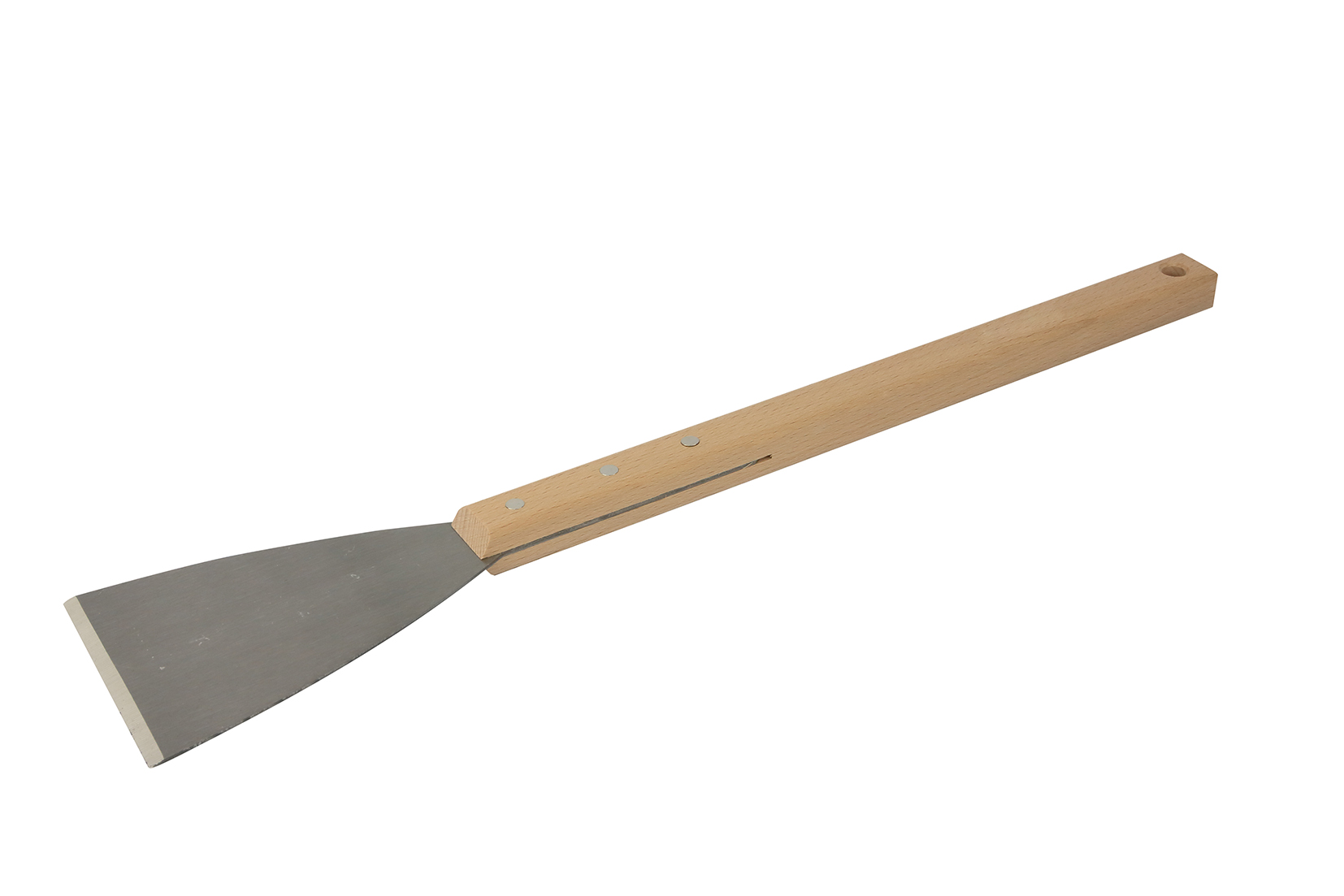
Scraper — Carbon Steel
Product Description
| Item | Detail |
|---|---|
| Product name | Scraper |
| Material line | Carbon Steel |
| Art. Nr | 314124 |
| Size | 100mm (blade width; 100 mm = 3-15/16", also called the 4" trade size) |
| Art numbers in this product line | 1: 314124 is the only art number in the "Scraper / Carbon Steel" line |
| Product family | Scraper, one of five distinct tool types in the Leading Tools Scraper range |
| Blade form | Flat trapezoidal blade widening to a single straight cutting edge, bright ground bevel visible on one face |
| Handle | Straight, square-section one-piece wooden handle, long relative to the blade, with a hanging hole through the butt end |
| Blade-to-handle attachment | Flat tang laid along the handle and fixed with three rivets |
Purpose. The 314124 is a rigid, long-handled hand scraper: a stiff carbon steel blade whose job is to remove material: wallpaper and wallpaper paste, old paint and varnish, adhesive, mortar smears, sealant and silicone residue, from a flat or gently shaped surface. It is deliberately not a putty knife.
A putty knife has a thin, springy blade so that it can flex against a surface and apply filler; a scraper has a thick, unyielding blade so that the operator's push or pull goes straight into the edge instead of being absorbed by blade flex. The distinction is simple: scrapers take things off, putty knives put things on, and using one for the other's job gives poor results and damages the tool.
Where it sits in the range. The Leading Tools "Scraper" range contains five distinct tool types.
The 314124 is the only full-width flat scraper among them: the range also carries the double-ended forged Leaf and Square Small Tool (300611–300614, 13–25mm), the Combination Shave Hook with a triangular head (300501/300502), the Shave Hook — Straight Blade (300504), and the 180mm stainless Broad Knife 300495. See Which tool in the Leading Tools Scraper range below for when to reach for each.
A removal tool that is actually stiff enough to remove. A common problem with scraping is that the tool flexes and skates instead of cutting; that happens when a putty knife is pressed into scraper duty. A putty knife is too soft to scrape and a scraper is too hard to spread, so the buyer needs both rather than one doing double duty. The 314124 is on the rigid side of that line by design.
Long handle, two-handed control, less fatigue. With a handle several times the blade length, the operator can grip near the blade for control and further back for reach, and can push from the shoulder on long wall or floor runs rather than from the wrist.
One tool for four common site jobs. The job list is: stripping wallpaper, removing paint and varnish, removing adhesive and silicone residue, and cleaning back oxidation and mortar smears before filling or repainting.
No consumables, no chemicals, no heat. Unlike a replaceable-blade scraper it needs no cartridges; unlike a chemical stripper it produces no solvent waste and needs no dwell time; unlike a hot-air gun it cannot scorch a substrate or ignite dust in a cavity. The cost is physical effort and dust; see Scraper vs hot-air gun vs chemical stripper below.
Re-sharpenable rather than disposable. A carbon steel edge can be brought back with a mill file and a stone many times over the life of the handle, which is the argument for this construction over a throw-away scraper in a fleet or rental context.
| Situation | Suitable? | Notes |
|---|---|---|
| Stripping wallpaper and softened wallpaper paste | Yes, the primary job for this tool | Soak or steam the paper first; the blade lifts, it does not dissolve |
| Removing old paint and varnish from flat wood | Yes | Work with the grain and keep the angle shallow so the edge does not score the timber |
| Removing glue, silicone and sealant residue | Yes | A standard job for this tool |
| Cleaning surface oxidation and light rust off metal | Yes | Prime immediately afterwards |
| Removing mortar and adhesive residue from walls | Yes | A standard job for this tool |
| Preparing a wall before filling and repainting | Yes | Knock off loose material, then switch to a putty or broad knife to fill |
| Old paint on a boat hull | Yes, with substrate care | Check the hull material first |
| Spreading filler, plaster or adhesive | No | Blade is rigid by design; use a putty knife or the 300495 broad knife |
| Stripping moldings, rebates and curved profiles | No | 100mm cannot follow the profile; use the shave hooks in the same range |
| Lifting floor adhesive over large floor areas | No | Use a long-handled floor scraper |
| Chopping, prying or demolition | No | The tang is riveted, not forged in one piece; prying loads work the rivets loose |
| Step | Action | Why |
|---|---|---|
| 1 | Survey the surface first and remove or mark every nail, screw, staple and metal bead. Run a magnet over old joinery if in doubt. | Metal is what chips a carbon edge; one hidden nail costs a re-grind. |
| 2 | Wet, steam or soften the coating where the job allows it (wallpaper, water-based paste, some coatings). | Softening turns a scraping job into a lifting job and cuts both effort and dust. |
| 3 | Present the blade at roughly 30–45° to the surface. | Steeper digs into the substrate and leaves gouges; flatter skates over the film without cutting. |
| 4 | Take the stroke: push for coverage on open flat runs, pull for control at edges and detail. Both are used; operators settle on a preference. | The pull stroke gives a slicing feel and easier angle control; the push stroke covers ground faster. |
| 5 | On wood, work along the grain rather than across it. | Cross-grain strokes tear fibers and raise the surface. |
| 6 | Keep pressure even and overlap each stroke. | Uneven pressure leaves ridges that show through the new finish. |
| 7 | Clear material off the blade face every few strokes. | Build-up on the face drags material against the blade instead of ahead of the edge. |
| 8 | Stop and re-sharpen as soon as the blade starts tearing rather than cutting. | A dull edge means more force, less control, and more substrate damage. |
The 100mm wooden-handled scraper strips wallpaper, paint, and glue or silicone from walls and windows, and cuts out cracks before filling. Soak or steam the paper until the paste releases, then work the blade in flat at a shallow angle and lift whole sheets rather than picking at fragments.
Come back over the wall a second time for the paste film itself, which is what shows through a new paper or a new paint film if it is left. Keep the blade at the flatter end of the 30–45° range on plasterboard: the paper face of the board is soft and a steep blade will cut into it.
A sharp edge slices the film rather than pushing it. Work along the grain. Take the bulk of the film off with moderate pressure at 30–45°, then reduce the angle for the last pass so the edge cleans the surface without digging. Sand afterwards regardless: scraping is a preparation stage, not a finishing stage. On veneers, heirloom pieces and anything with a fragile finish, test on a hidden area first.
This tool type also handles paint, glue, wood, varnish and rust, including old paint on boat hulls. On steel, the scraper takes off loose scale, blistered paint and light surface oxidation; it is not a substitute for abrasive blasting or a chemical rust remover on heavy corrosion.
Prime or coat cleaned steel the same day: bare steel flash-rusts. On a hull, check the substrate before you start: the technique for a steel hull, a GRP hull and a timber hull are not the same, and gel coat in particular will not tolerate a rigid carbon edge.
The wooden-handled scraper handles wall and surface scraping and the removal of adhesive and mortar residue directly, along with wallpaper and adhesive residue, old paint and surface oxidation. For cured silicone, cut the bulk away with a knife first and use the scraper for the residual film; for tile mastic and flooring adhesive on a small area the 314124 works, but past a few square meters a long-handled floor scraper is the correct tool.
Paint in older buildings may contain lead, and the cut-off year differs by country. Dry-scraping old paint may release lead dust. Lead paint must not be heated or dry-scraped; follow local regulations. Confirm the requirements that apply in your own market before starting work.
Q1. What is it for, and can I use it as a putty knife?
It is a rigid scraper that takes material off; the stiff blade puts the force into the edge. It is not a putty knife, which has to flex to press filler in, so fill with a putty or taping knife, or with the 300495 broad knife on wide areas. Work at roughly 30–45°, pushing or pulling as you prefer.
Q2. Is the 100mm the blade width or the tool length?
The blade width. Every size figure in the Scraper range is a working width, and 314124 is the only size under this heading.
Q3. Why carbon steel rather than stainless? I would rather not oil a tool.
Carbon steel blades cost less, but they must be wiped dry and given a thin coat of tool oil after use, otherwise they rust. If nobody in your operation will dry and oil a blade after use, ask us about a stainless alternative; note that the stainless 300495 is a broad knife for spreading and light scraping, not a like-for-like replacement.
Q4. The blade is rusting even though I use it every week. What am I doing wrong?
Almost always the cleaning, oiling or storage. Wash it, dry it fully, not air-dry, and oil it after every use, and keep it out of unheated or coastal storage. Light surface rust comes off with fine abrasive paper or fine steel wool; deep pitting means the tool should be replaced.
Q5. Where should I not use it?
Do not use it to chop, pry or demolish, or as a lever, because that works the handle loose.
| Property | Detail |
|---|---|
| Material | Carbon steel |
| Working width | 100mm = 3-15/16"; also called the 4" size |
| Blade shape | Flat trapezoid, widening from the tang to the full-width straight cutting edge |
| Edge | Single straight edge, ground on one face; bright bevel |
| Blade flex | Rigid, this is a removal tool, not a spreading tool |
| Property | Detail |
|---|---|
| Handle material | Wood, light-toned, unfinished or clear-finished |
| Handle form | Straight, square/rectangular cross-section, constant section along its length, no palm swell and no contoured grip |
| Handle length | Long relative to the blade, several times the blade length |
| Attachment | Flat tang laid along the handle face and fixed with three rivets |
| Attachment type | Mechanical riveted joint |
| Hanging hole | Yes, through the butt end of the handle |
The 314124 carries a fixed, sharpenable edge rather than a replaceable blade head. When it dulls it is re-ground; there is no cartridge to buy. The practical consequence for the buyer is the need to keep a file or stone in the kit.
All five product lines below belong to the same Leading Tools Scraper range. They are separate tools, not sizes of one tool.
| Product line | Art. Nr | Size | Material / handle | What it is for |
|---|---|---|---|---|
| Leaf and Square Small Tool, Forged in One piece | 300611 / 300612 / 300613 / 300614 | 13mm / 16mm / 19mm / 25mm | Forged in one piece, no handle fitted | Double-ended detail tool: one square flat end, one leaf-shaped pointed end, for filling and dressing small repairs in tight spaces |
| Combination Shave Hook, Carbon Steel | 300501 / 300502 | 60mm / 80mm | Carbon steel, wooden handle with hanging hole | Triangular combination head for stripping paint out of moldings, rebates, corners and curved profiles |
| Shave Hook — Straight Blade, Carbon Steel | 300504 | 60mm | Carbon steel, wooden handle with hanging hole | Flat trapezoidal head on a shave-hook shank, narrow-width stripping where a full 100mm blade will not fit |
| Scraper, Carbon Steel | 314124 | 100mm | Carbon steel, long wooden handle with hanging hole | General flat-surface removal: wallpaper, paste, paint, varnish, adhesive, mortar smears, the workhorse width |
| Broad Knife, Stainless Steel, Aluminum Handle | 300495 | 180mm | Stainless steel blade, aluminum tube handle with a ball end | Wide-blade spreading and skimming, and light wide-area scraping where the surface must not be marked |
Read that table as a progression of width against control. At 80mm and below you are working detail: moldings, glazing bars, window rebates, and there the shave hooks and the Leaf and Square Small Tool win because the 100mm blade physically cannot reach.
At 100mm the 314124 covers ground fast enough to strip a wall or a door but is still narrow enough to steer around architraves and skirting. At 180mm the 300495 is a different job again: it is a stainless broad knife for spreading material and light scraping, not for aggressive removal.
This is the selection error that costs most site time. A scraper is rigid and is used to take material off; a putty knife is flexible and is used to put material on; using either for the other's job is inefficient and shortens the tool's life. A broad knife such as the 300495 has a wide blade for spreading and wiping material; see its own page.
| If the job is… | Use | Why |
|---|---|---|
| Getting wallpaper, paste, paint, adhesive or mortar off | Scraper 314124 | Rigid blade transmits force straight to the edge |
| Pressing filler into a crack or hole | Putty knife / taping knife | A flexible blade follows the surface and leaves filler in the void |
| Skimming a wide area flat | Broad Knife 300495 | Wide blade bridges hollows; stainless is corrosion resistant, though chlorinated water, coastal air or prolonged soaking can still cause rust spots |
| Stripping paint from a molding or corner | Combination Shave Hook 300501/300502, or Shave Hook — Straight Blade 300504 on flatter sections | Shaped head follows the profile |
| Detail filling in a confined repair | Leaf and Square Small Tool 300611–300614 | 13–25mm double-ended forged blade |
| Material | Behavior | Best for |
|---|---|---|
| Carbon steel, the 314124 | Blade cost is lower. Must be wiped dry and given a thin coat of tool oil after use, otherwise it rusts | Trades that will actually maintain the tool |
| Stainless steel | High corrosion resistance and low upkeep; chlorinated water, coastal air or prolonged soaking can still cause rust spots, so rinse with clean water and dry after use | Damp environments, shared tool stores, users who will not oil a blade. For a stainless alternative to this scraper, contact us; the stainless 300495 is a broad knife for spreading and light scraping, not a like-for-like replacement |
The word "scraper" spans two very different tonnages. The 314124 is a hand tool: one 100mm blade, a wooden handle, worked at arm's length. The other family, the floor scraper, carries a wide blade on a long handle, and is worked standing up, with body weight behind it, for lifting floor adhesive, tile mastic and frozen deposits.
Choose by posture and area: if the operator is standing over a floor and clearing square meters, the long-handled tool is the right buy and the 314124 will exhaust them; if the operator is working a wall, a door, a window reveal or a bench-top piece, the long-handled tool cannot be steered and the 314124 is the right buy.
| Method | Speed | Hazards | Waste | Best for |
|---|---|---|---|---|
| Scraper (314124) | Fastest on thin to medium coatings and on wallpaper | Physical effort; dust: control with a HEPA vacuum or by wetting the surface | Dry debris only | Wallpaper and paste, single or few paint coats, adhesive residue, mortar smears |
| Hot-air gun | Slower per pass but gets through thick multi-coat paint | Scorching the substrate; igniting dust or material in a cavity; fumes from heated paint | Softened paint scrapings | Thick built-up paint on joinery, doors, furniture |
| Chemical stripper | Slowest; usually multiple applications | Chemical handling, ventilation and controlled disposal | Solvent-contaminated waste | Carved and ornate work, interiors where heat is a fire risk |
In practice the three are used together: strip the bulk with the 314124, take the stubborn build-up with heat, and finish detail and carving chemically.
Complete art number and size reference for the "Scraper / Carbon Steel" product line:
| Art. Nr | Size | Size (inch equivalent) | Blade material | Handle |
|---|---|---|---|---|
| 314124 | 100mm | 3-15/16" (nominal 4") | Carbon steel | Wooden handle with hanging hole, riveted flat tang |
One art number only. No other size is offered under this heading, so there is no 60mm or 150mm version of this scraper to order. The neighboring art numbers that a buyer may expect to find here, 300611–300614, 300501/300502, 300504 and 300495, belong to four different tools in the same Leading Tools Scraper range and are listed under Which tool in the Leading Tools Scraper range above, not here.
The size column follows the convention used throughout the Scraper range: the figure is the working blade width, not the overall tool length.
A 100mm blade presents a large area of bare steel. In a coastal, humid or unheated store, an unoiled carbon blade will show flash rust quickly. Where nobody owns the oiling routine, such as a shared tool store, ask us about a stainless alternative.
Sharpen when the tool needs noticeably more force for the same result, when it tears material instead of cutting it, when the edge shows a continuous bright reflective line (a rolled edge), or immediately after the blade has run over a nail or a metal bead.
Procedure: clamp the blade or hold it in a jig; take out serious damage with a flat mill or bastard file; refine on a fine file or an oilstone; keep to the original bevel; and work the edge evenly rather than turning it into a chisel point.
| Situation | Recommendation |
|---|---|
| Workshop or garage | Hang from the hanging hole, blade oiled |
| Tool bag or pouch | Fit an edge guard so the blade cannot cut the bag or a hand; blade oiled |
| Vehicle | Secure it so it cannot slide; bring it indoors in wet or humid weather |
| Long-term | Clean, dry, oiled, hung or laid flat |

In compliance with EU personal data protection laws, we are committed to protecting and providing you with control over your personal data. By clicking "Accept All", you allow us to place cookies to enhance your experience on this site, help us analyze site performance and usage, and enable us to deliver relevant marketing content. You can manage your cookie settings below. By clicking "Agree" you agree to the current settings. For more information, please visit the Privacy Statement.
This website uses cookies
In compliance with EU personal data protection laws, we are committed to protecting your personal data and providing you with control over it. By clicking "Agree", you allow us to place cookies to improve your experience on this site, help us analyze site performance and usage, and allow us to deliver relevant marketing content.
By clicking "Only necessary" you allow us to place only necessary cookies. The website cannot function without these cookies and you cannot switch them off on your system. These cookies are typically set only in response to an action you perform (i.e. a service request), such as setting privacy preferences, logging in, or filling in a form. You can set your browser to block or prompt you for these cookies, but this may prevent some site features from working.