
Copyright 2026 © Leading Tools Industrial Co., Ltd.
All Rights Reserved. Website Design by Awakening Design
CATALOG TYPE
Product Categories
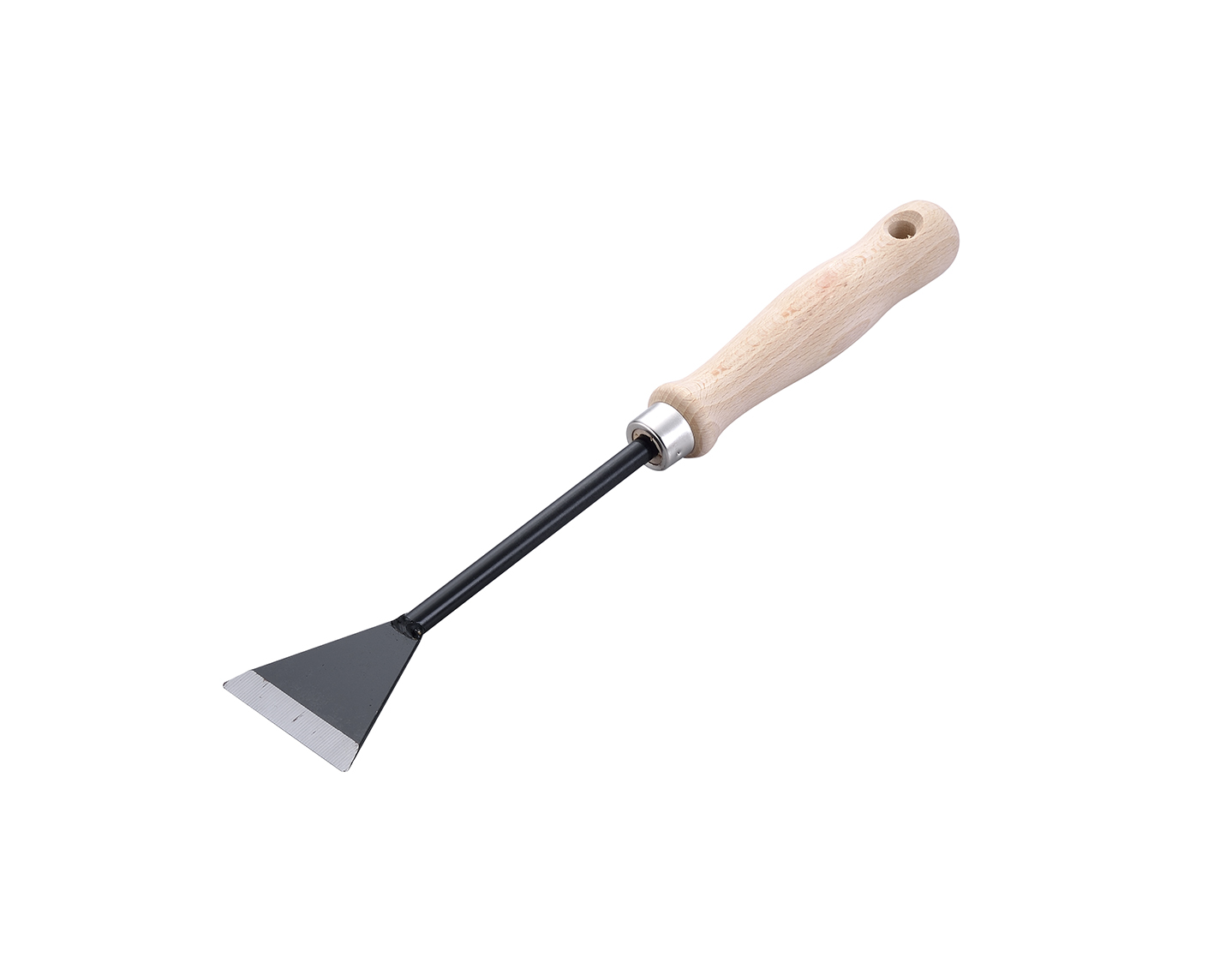
Shave Hook — Straight Blade
Product Description
Product name: Shave Hook — Straight Blade
Material line: Carbon Steel
Product family: Scraper
Art. Nr: 300504
Size: 60 mm (2-3/8")
| ART. NR | Size | Product line | Product family |
|---|---|---|---|
| 300504 | 60 mm (2-3/8") | Shave Hook — Straight Blade / Carbon Steel | Scraper |
The head is a plain trapezoidal head, flared slightly towards the working end, carrying one straight beveled edge across the full width. There is no concave sweep, no convex sweep and no point.
The Combination Shave Hook in the same series (Art. Nr 300501 / 300502) has a triangular multi-edge head instead. Choose between the two by head shape: the straight blade for flat runs, the triangular head for profiles and corners.
It is specified for paint and varnish, not for open wall areas. Its job is stripping old paint and varnish from window frames, architraves and door casings, skirting boards, stair banisters, furniture, and recessed corners, the places where a 100 mm flat stripping knife simply does not fit. A painter does not buy a shave hook to cover area; they buy it to get into the profiles that the wide scraper leaves behind.
Full-width straight edge does the long runs faster. A single straight edge carried across the whole 60 mm gives more cutting length per stroke on a flat run, a skirting face, a door stile, a flat architrave band, than the shorter edges of a triangular multi-edge head.
Carbon steel can be brought back on site. When the edge dulls, it is refiled with a hand file rather than replaced; the edge shape is restored in a minute at the bench and the tool goes back into service. That matters on a repaint contract, where a stripping edge dulls quickly against old paint films.
A wooden handle suits hot-air gun stripping. Softening the film with hot air and following it immediately with the scraper is a common method for painted joinery; an open-flame torch is not recommended. A wooden handle is comfortable to hold through that cycle.
Hanging hole is a real maintenance feature, not decoration. The recommended storage for a shave hook is hanging with the edge protected, precisely because loose storage in a bag is what rolls and nicks the edge.
| Surface / job | Use 300504? | Notes |
|---|---|---|
| Old paint or varnish on flat joinery: door stiles and rails, skirting faces, flat architrave bands | Yes, primary application | This is the job the tool class is specified for |
| Window frames and glazing bars | Yes | Classic shave hook application; work carefully against the glass |
| Stair banisters, handrails, newel posts | Yes, on the flat sections | Turned spindles need a multi-edge head such as 300501 / 300502 |
| Furniture and panelled doors, flat panels and flat framing | Yes | Go slowly to avoid gouging the timber |
| Rounded ovolo / torus moldings, coves | No; use 300501 / 300502 | A single straight edge cannot follow a rounded molding; 300501 / 300502 can work short profile sections with its edges and point |
| Internal 90° corners, mitres, rebates | No; use 300501 / 300502 | A point is what reaches a square internal corner |
| Opening and widening cracks in walls or ceilings before filling | Yes, as a secondary use | Opening cracks before filling is a standard preparation use for a shave hook |
| Large flat wall and ceiling areas | No | Use a wide flat stripping knife; a 60 mm head is not an area tool |
| Step | Action | Why it matters |
|---|---|---|
| 1 | Check the substrate and the film. Identify the timber, the number of coats, and whether the coating may contain lead (any older building; the lead-paint cut-off year varies by country). | Lead paint changes the method entirely: it must not be heated or dry-scraped; follow local regulations |
| 2 | Match the edge to the shape in front of you: straight edge for a flat surface, the point of 300501 / 300502 for a square internal corner. On 300504 you have the straight edge only. | Working the wrong edge into a profile is what gouges timber |
| 3 | Soften the film if it is sound and well adhered: hot air from a hot-air gun (an open-flame torch is not recommended), or a chemical stripper left to work for the stated dwell time. | A softened film lifts in sheets; a hard film has to be cut off, which is slower and rougher |
| 4 | Hold the wooden handle in the palm, thumb along the shank, and set the edge on the surface at a low angle, closer to flat than upright. | A high angle digs into the timber; a low angle slices under the film |
| 5 | Pull the tool towards you with a smooth, even stroke, using light to moderate pressure. Do not lever, and do not try to take the whole film in one pass. | Even pressure and repeated light passes are the correct technique; forcing the tool is the main cause of both gouging and edge damage |
| 6 | Work along the grain wherever the substrate is timber, not across it. | Cross-grain scraping tears the fibers and shows through the new finish |
| 7 | Slow down at corners, edges, mitres and around glass, taking short strokes. | The main risk point for this tool is the edge skidding off a detail and gouging the substrate |
| 8 | Clear softened paint off the edge frequently, and check the edge for dullness or a rolled corner. Re-file with a hand file when it stops cutting. | A dull edge needs more force, and more force is what damages the substrate |
| 9 | When the section is stripped, fill, sand and prime. The scraper removes the film; it does not produce the finished surface. |
Frames are the classic shave hook job: narrow rebates, small flats, and glass right next to the work. Strip the flats and the frame faces with the straight edge, keeping the tool low and pulling towards yourself.
Approach the glass line with short strokes and reduced pressure: the risk is the edge riding up onto the glass or skidding into the putty line.
If the frame has molded glazing bars rather than flat ones, the flat edge of 300504 will not follow the profile; that section is work for the triangular multi-edge head of 300501 / 300502. Where a hot-air gun is used, keep the hot air moving and never let it dwell on the glass.
These are the long flat runs where the full 60 mm edge pays for itself. Work in sections of roughly an arm's length, soften if needed, and pull along the run with the blade flat to the surface.
Keep the leading corner of the blade off the wall plaster above the skirting: a corner dug into plaster leaves a mark that has to be filled. Where the architrave has a molded outer edge, strip the flat band with 300504 and change to the triangular head of 300501 / 300502 for the molding.
Hot-air stripping and a shave hook are a common combination for painted joinery. Heat a section of about 150–200 mm until the film blisters, then move the gun on and take the softened film immediately with the scraper; the wooden handle conducts much less heat into the hand than a metal handle would. Keep the gun moving so the timber does not scorch, keep a metal container for hot scrapings, and never use heat on a coating that may contain lead; follow local regulations.
A further use for the shave hook is raking out, widening and opening cracks in walls and ceilings so that filler can key properly before the surface is made good. A corner of the blade is drawn along the crack to remove loose material and open the crack into a V, then the surface is dusted off and filled. This is a preparation operation on plaster and render, not a paint operation, and it is a genuine secondary use for the tool on refurbishment work.
Q1. What is this tool actually for?
A. Stripping old paint and varnish from woodwork: window frames, architraves and door casings, skirting boards, stair banisters, furniture and recessed corners: the detail areas a wide flat stripping knife cannot reach. A secondary use is raking out and opening cracks in walls and ceilings before filling.
Q2. Should I choose 300504 or 300501 / 300502?
A. 300504 has a flat head with one straight bevel and suits flatter surfaces. For profiled work and corners, the Combination Shave Hook 300501 / 300502, with its triangular head, is the better choice.
Q3. I keep gouging the timber. Is the tool wrong?
A. Usually it is angle or pressure. Hold the blade at a low angle rather than upright, use light to moderate pressure with repeated passes instead of one heavy pass, and slow down at corners and details.
Q4. How do I sharpen it and stop it rusting?
A. Sharpen with a hand file along the existing bevel, keeping the edge straight across its width; do not use a bench grinder, which removes too much metal and changes the bevel. Carbon steel needs the head cleaned, dried completely and lightly oiled after every use, and stored dry: chemical stripper residue left on the steel is the worst offender.
Q5. Can I use it with a hot-air gun?
A. Yes, hot air is a common method for painted joinery, and the wooden handle transfers much less heat to the hand than a metal one; an open-flame torch is not recommended. Keep the gun moving, keep a metal container for hot scrapings, and do not heat any coating that may contain lead.
| Attribute | Value |
|---|---|
| Article Number | 300504 |
| Product name | Shave Hook — Straight Blade |
| Product family | Scraper |
| Size (blade width) | 60 mm (2-3/8") |
| Blade material | Carbon steel |
| Head profile | Flat trapezoidal head, single straight bevel across the full width |
| Shank | Round steel shank, dark finish |
| Handle material | Wood, turned, with metal ferrule |
| Handle feature | Hanging hole through the butt |
The head is a flat plate, wider across the working end than where it meets the shank, finished with one straight bevel across the full 60 mm. The working edge is therefore a single continuous straight line. On a flat run, the face of a skirting board, the flat band of an architrave, a door stile, a straight edge of that length removes a wider ribbon of film per stroke than a segmented head does.
The trade-off is the one every single-profile scraper carries: it cannot follow a curved molding. A sharp point is what reaches into a 90° internal corner or a rebate. If the job in front of the buyer is mostly molded joinery rather than flat joinery, the Combination Shave Hook 300501 / 300502, with its triangular multi-edge head, is the correct article in the same series.
Carbon steel is the specified blade material. It is easy to re-file, and it must be wiped dry and given a thin coat of tool oil after use, otherwise it rusts.
A turned wooden handle is fitted, with a metal ferrule at the blade end and a hanging hole drilled through the butt. Three things follow from that construction:
| Art. Nr | Product line | Size | Head | Handle |
|---|---|---|---|---|
| 300501 | Combination Shave Hook / Carbon Steel | 60 mm | Triangular multi-edge head, fixed to the shank by a center screw | Wood with ferrule and hanging hole |
| 300502 | Combination Shave Hook / Carbon Steel | 80 mm | Triangular multi-edge head, fixed to the shank by a center screw | Wood with ferrule and hanging hole |
| 300504 | Shave Hook — Straight Blade / Carbon Steel | 60 mm | Flat trapezoidal head, single straight bevel | Wood with ferrule and hanging hole |
The heads differ: a triangular multi-edge head on 300501 / 300502, a single straight bevel on 300504.
Choose between 300504 and the Combination Shave Hook 300501 / 300502 by head shape, not by width. The straight blade of 300504 is for flat runs; the triangular head of 300501 / 300502 is for moldings, rebates and corners. At 60 mm, 300504 is wide enough to strip a skirting face or a door stile at a reasonable rate and narrow enough to stay under control on a glazing bar.
| Buyer situation | Recommended article | Why |
|---|---|---|
| Mostly flat joinery: skirting faces, door stiles and rails, flat architrave bands, flush doors, flat furniture panels | 300504 (straight blade) | One long straight edge clears more film per stroke on a flat run |
| Molded joinery: ovolo and torus moldings, coved architraves, panel moldings, turned banister spindles | 300501 (60 mm) or 300502 (80 mm) | Several edges and a point follow a profiled section; one straight edge cannot |
| Internal 90° corners, rebates, mitre joints, glazing rebates | 300501 / 300502 | The point of a triangular head is what reaches into a square internal corner |
| Wide runs, high volume, mostly flat | 300502 at 80 mm, or a wide flat stripping knife | Width is throughput on flat work |
| One tool that has to cover everything on a mixed refurbishment | 300501 / 300502 | The triangular multi-edge head is the more versatile choice |
300504 is carbon steel: it is easy to re-file, and it must be dried and oiled after use (see Care & Maintenance below).
Wood is the traditional fitting and suits use with a hot-air gun. Other handle options can be supplied on request; contact us.
All article numbers in this product line. This line contains a single article number.
| ART. NR | Size | Blade material | Handle | Product line |
|---|---|---|---|---|
| 300504 | 60 mm (2-3/8") | Carbon steel | Wood, turned, metal ferrule, hanging hole through the butt | Shave Hook — Straight Blade / Carbon Steel |
Adjacent articles in the same series (Combination Shave Hook, triangular multi-edge head):
| ART. NR | Size | Blade material | Handle | Product line |
|---|---|---|---|---|
| 300501 | 60 mm | Carbon steel | Wood, ferrule, hanging hole | Combination Shave Hook / Carbon Steel |
| 300502 | 80 mm | Carbon steel | Wood, ferrule, hanging hole | Combination Shave Hook / Carbon Steel |
Carbon steel is the specified blade material, and carbon steel rusts. The routine is short and non-negotiable:
Chemical strippers are the specific hazard here, not just water: residue left on the blade attacks the steel continuously and will pit the edge.
The working edge is meant to be maintained with a hand file, not a grinder. File along the existing bevel, keep the edge straight across its width, and take off no more metal than is needed to restore a clean cutting line.
Do not take the edge to a bench grinder: it removes far more metal than intended and changes the bevel angle. Check the edge every time the tool starts to need more pressure than usual: needing more force is the first symptom of a dull edge, and force is what damages both the substrate and the tool.
Hang the tool by the hole in the butt of the handle, on a hook or a pegboard, with the edge protected. Loose storage in a tool bag among other steel tools is what rolls and nicks a stripping edge. A card sleeve or a purpose-made blade guard over the head is worth the trouble if the tool travels between sites.
Keep the wooden handle clean and dry; wipe off stripper immediately, since chemical strippers attack varnish and can raise the grain. Check periodically that the shank has not started to work loose in the ferrule: blade wobble is the warning sign, and a loose head should be taken out of service rather than worked around. If the wood dries out and the grain becomes rough, a light sanding and a wipe of boiled linseed oil restores it.
A rolled or dented edge on a straight-bevel head can usually be filed back. A head that has been bent out of plane, or a bent shank, is a replacement.

In compliance with EU personal data protection laws, we are committed to protecting and providing you with control over your personal data. By clicking "Accept All", you allow us to place cookies to enhance your experience on this site, help us analyze site performance and usage, and enable us to deliver relevant marketing content. You can manage your cookie settings below. By clicking "Agree" you agree to the current settings. For more information, please visit the Privacy Statement.
This website uses cookies
In compliance with EU personal data protection laws, we are committed to protecting your personal data and providing you with control over it. By clicking "Agree", you allow us to place cookies to improve your experience on this site, help us analyze site performance and usage, and allow us to deliver relevant marketing content.
By clicking "Only necessary" you allow us to place only necessary cookies. The website cannot function without these cookies and you cannot switch them off on your system. These cookies are typically set only in response to an action you perform (i.e. a service request), such as setting privacy preferences, logging in, or filling in a form. You can set your browser to block or prompt you for these cookies, but this may prevent some site features from working.