
Copyright 2026 © Leading Tools Industrial Co., Ltd.
All Rights Reserved. Website Design by Awakening Design
CATALOG TYPE
Product Categories
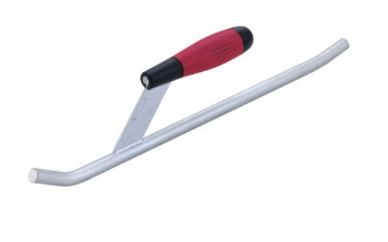
Sled Runner
Product Description
Sled Runner — Art. Nr 301045, 301046, 301047 — sizes 3/8"×17", 1/2"×17", 5/8"×17".
Three art numbers, three joint widths, one length. All three share the same 17" (approx. 432mm) working bar; the only difference is the diameter of the round bar: 3/8" (approx. 9.5mm), 1/2" (approx. 12.7mm) and 5/8" (approx. 15.9mm). That diameter is the width class of the mortar joint the tool strikes: buyers choose by the joint width on their wall, not by the size of the tool itself.
What it does. A sled runner is a long jointer: a round steel bar turned up at both ends, with a flat steel post that carries a handle above it. The mason sets it into the horizontal bed joint of a block or brick wall and draws it along the joint in one pass; the convex face of the round bar compacts the mortar into a concave joint. Its specialty is the long, straight horizontal joint: the short vertical head joints are left to an ordinary hand jointer, the bed joints go to the sled runner.
It solves the job a hand jointer does badly: long joints. A hand jointer of around 10" has to strike the bed joint of a 400mm block in several overlapping strokes, and the overlaps tend to leave marks of uneven depth.
The sled runner's 17" bar spans a full block length at once, so the whole run is formed under one face at one depth and one curvature. That is why it is the tool for finishing horizontal joints: once the mortar is thumbprint hard, tool the head joints with a hand jointer and finish the horizontal joints with the sled runner, then flick off any burrs with the blade of the trowel. Many masons do the head joints first; that is a common practice, not a rule.
A concave joint is a weather detail, not just a look. Concave, "V" and grapevine joints are the profiles that best resist water penetration in exterior brickwork: tooling presses the mortar against the brick and consolidates it into a dense, weather-tight surface.
Unless otherwise required, joints should be tooled with a rounded jointer, producing a concave joint. The sled runner makes exactly that joint, on the longest joint on the wall and the one most exposed to water running down the face.
Saves time on long walls. On a block wall the total length of bed joint far exceeds the total length of head joint, so the efficiency of the bed-joint tool shows up directly in labour hours.
A clear division of labour with the Leading Tools jointer range. The Grapevine Jointer, Heavy Duty Convex Jointer, Heavy Duty Tempered Convex Jointer and Brick Jointer are all double-ended hand jointers for head joints and short touch-ups; the sled runner adds the long bed joint. A distributor stocking both covers the complete jointing sequence for block and brick.
| Stage | Use the sled runner? | Notes |
|---|---|---|
| Mortar just spread, units just laid | Not yet | Tooling too early smears mortar onto the brick and leaves a rough joint surface |
| Mortar "thumbprint hard" | Yes, finish the bed joints with it; the head joints are tooled with a hand jointer (many masons do them first, a common practice) | A thumb pressed in leaves an indentation but no mortar transfers to the thumb; sequence per Basic Technique below |
| Mortar too hard to press | No | Tooling too late cannot consolidate the joint surface or bond it to the brick |
| Wall built in several lifts | Tool each lift when it reaches thumbprint hardness | Consistent timing gives a consistent mortar shade: early tooling is lighter, late tooling darker |
| Step | Action | Check before moving on |
|---|---|---|
| 1 | Press a thumb into the joint: an indentation that holds, with no mortar on the thumb, means the joint is ready to tool | The time to reach this state varies through the day with weather and mortar mix |
| 2 | Tool the head joints with a hand jointer | Many masons finish the head joints before the bed joints (a common practice) so the horizontal groove runs unbroken |
| 3 | Set the upturned end of the sled runner into one end of the bed joint with the bar bearing on the arrises of the units above and below | The bar must be supported on both edges so the depth is governed by the bar diameter |
| 4 | Hold the grip firmly, press firmly without digging into the joint, and draw the tool along the joint to the end | Keep the pressure even and the bar on both arrises for the whole stroke |
| 5 | Where the joint is longer than the bar, restart a short way back over the end of the previous stroke | Keep the same pressure over the overlap so the seam does not show |
| 6 | Flick off the burrs of mortar squeezed out along the joint edges with the blade of the trowel | Flick along the joint, not across the brick face |
| 7 | Once the wall is tooled and the mortar has stiffened further, brush loose crumbs off the face with a soft brush | Brushing too soon smears wet mortar into the pores of the brick |
The test is simple: pressing the thumb into the mortar leaves an indentation, but no mortar is transferred to the thumb. There is no fixed number of minutes; the time varies through the day with temperature, wind and mortar mix.
Too early and the mortar smears onto the brick and the joint surface is rough; too late and the surface cannot be consolidated or bonded to the brick. Where a wall is built in sections, each section must be allowed to reach this state before tooling, otherwise early- and late-tooled sections show a visible difference in colour.
A bed joint is never perfectly straight: the arrises of the units carry tolerances and the mortar bed varies in thickness.
A short hand jointer follows those variations; a long bar bears on several high points at once, fills the low spots and presses down the high ones, and the joint is "straightened" over the length of the bar. The longer the bar, the more variation it bridges; Leading Tools' 17" has the advantage here.
The sled runner is the standard tool for finishing horizontal joints on concrete block walls. Brick walls are equally suitable; the difference is that brick courses are lower, so bed joints are closer together and the tool is restarted and overlapped more often than on block. On either wall the result is a concave joint, one of the profiles that best resists water penetration on an exterior wall.
Q1. How is a sled runner different from an ordinary jointer?
A. Length and role. An ordinary hand jointer is around 10" long and double-ended, for head joints and short touch-ups, while the sled runner is a 17" bar for long bed joints. Head joints are tooled with the hand jointer and bed joints with the sled runner; many masons do the head joints first, which is a common practice.
Q2. What do 3/8", 1/2" and 5/8" refer to, and which should I choose?
A. They are the diameter of the round bar, which is the width of the concave joint it strikes. Choose by the joint width on the wall; contact sales if unsure which size suits it. Each art number makes one joint width, so stock one tool per joint width in use on site.
Q3. When can tooling start, and what happens if I tool too early or too late?
A. When the mortar is "thumbprint hard": a thumb pressed in leaves an indentation but picks up no mortar. Too early smears mortar onto the brick and leaves a rough joint; too late means the joint surface cannot be consolidated or bonded to the brick, and water resistance suffers.
Q4. Can I use it on brick as well as block, and what if the joint is longer than the bar?
A. Both. Block walls are its main use, while on brick the courses are lower and the bed joints closer together, so the tool is restarted more often. For a joint longer than the bar, work in overlapping strokes, restarting each a short way back over the end of the last one with the same pressure over the overlap.
Q5. Can it make a raked joint, and how do I look after it?
A. No, a round bar cannot form a square recess; use a raker such as Leading Tools' Skate Wheel Mortar Raker (Art. Nr 301110). The bar is steel; dry it after use and do not grind or file it.
| Field | Value |
|---|---|
| Product name | Sled Runner |
| Art. Nr | 301045, 301046, 301047 |
| Size | 3/8"×17", 1/2"×17", 5/8"×17" |
| Bar length | 17" (approx. 432mm), same on all three |
| Joint width class | 3/8" (approx. 9.5mm), 1/2" (approx. 12.7mm), 5/8" (approx. 15.9mm) |
| Material | Steel bar and post, silver-grey finish |
| Handle | Rubberwood handle |
| Product line | Builder Tools |
| Variants | 3 (three joint widths, one bar length) |
| Feature | Description | What it means on site |
|---|---|---|
| Bar | One long round steel bar of uniform diameter | The convex face of the bar is the working face; it strikes a concave joint |
| Ends | Both ends turned up, one with a distinct bend, the other a gentle curve | Enters the joint without catching; can be pulled in either direction |
| Post | A flat steel plate rising at an angle from the bar to the handle | Lifts the hand off the wall face; knuckles do not scrape the brick on the pull |
| Handle | Rubberwood handle | Pulling force in line with the stroke; less fatigue over long runs |
| Finish | Silver-grey finish on bar and post | Dry the tool after use |
| Construction | Bar, post and handle as one unit | No adjustable parts to work loose on site |
| Situation | Suitable? | Why |
|---|---|---|
| Finishing bed joints on a concrete block (CMU) wall | Yes, block walls are its main use | The sled runner is the tool for horizontal joints |
| Finishing bed joints on a brick wall | Yes | Works on bed joints in both brick and block walls |
| Head (vertical) joints | Use a double-ended hand jointer instead | Head joints are short and a long bar cannot work in them; tool the head joints with a hand jointer and the bed joints with the sled runner (many masons do the head joints first, a common practice) |
| A concave joint is wanted | Yes | The convex round bar strikes exactly that profile |
| A V, flush or raked joint is wanted | No | The face is round; it cannot form a V or a flat. For raked joints use a raker (Leading Tools Skate Wheel Mortar Raker 301110) |
| Re-working joints where the mortar has already set hard | No | Tooling must be done when the mortar is thumbprint hard; set mortar can only be raked out and repointed |
The size is the diameter of the round bar, and each art number makes one width of concave joint. Choose by the joint width on the wall; contact sales if unsure which size suits it.
| Item | Reason |
|---|---|
| Double-ended hand jointers (Leading Tools 300033–300037, 300043–300047, 300053–300055) | Head joints need the short hand tool and bed joints the sled runner (many masons do the head joints first, a common practice), so the two types ship together as a complete jointing kit |
| Brick trowel | Burrs are flicked off with the trowel blade, part of the same operation |
| Skate Wheel Mortar Raker, Art. Nr 301110 | The alternative tool when a raked joint rather than a concave joint is specified |
Three art numbers are listed under "Sled Runner".
| Art. Nr | Joint width | Bar length | Construction | Handle |
|---|---|---|---|---|
| 301045 | 3/8" (approx. 9.5mm) | 17" (approx. 432mm) | Steel round bar, both ends turned up, flat steel post | Rubberwood handle |
| 301046 | 1/2" (approx. 12.7mm) | 17" (approx. 432mm) | As above | As above |
| 301047 | 5/8" (approx. 15.9mm) | 17" (approx. 432mm) | As above | As above |

In compliance with EU personal data protection laws, we are committed to protecting and providing you with control over your personal data. By clicking "Accept All", you allow us to place cookies to enhance your experience on this site, help us analyze site performance and usage, and enable us to deliver relevant marketing content. You can manage your cookie settings below. By clicking "Agree" you agree to the current settings. For more information, please visit the Privacy Statement.
This website uses cookies
In compliance with EU personal data protection laws, we are committed to protecting your personal data and providing you with control over it. By clicking "Agree", you allow us to place cookies to improve your experience on this site, help us analyze site performance and usage, and allow us to deliver relevant marketing content.
By clicking "Only necessary" you allow us to place only necessary cookies. The website cannot function without these cookies and you cannot switch them off on your system. These cookies are typically set only in response to an action you perform (i.e. a service request), such as setting privacy preferences, logging in, or filling in a form. You can set your browser to block or prompt you for these cookies, but this may prevent some site features from working.