
Copyright 2026 © Leading Tools Industrial Co., Ltd.
All Rights Reserved. Website Design by Awakening Design
CATALOG TYPE
Product Categories
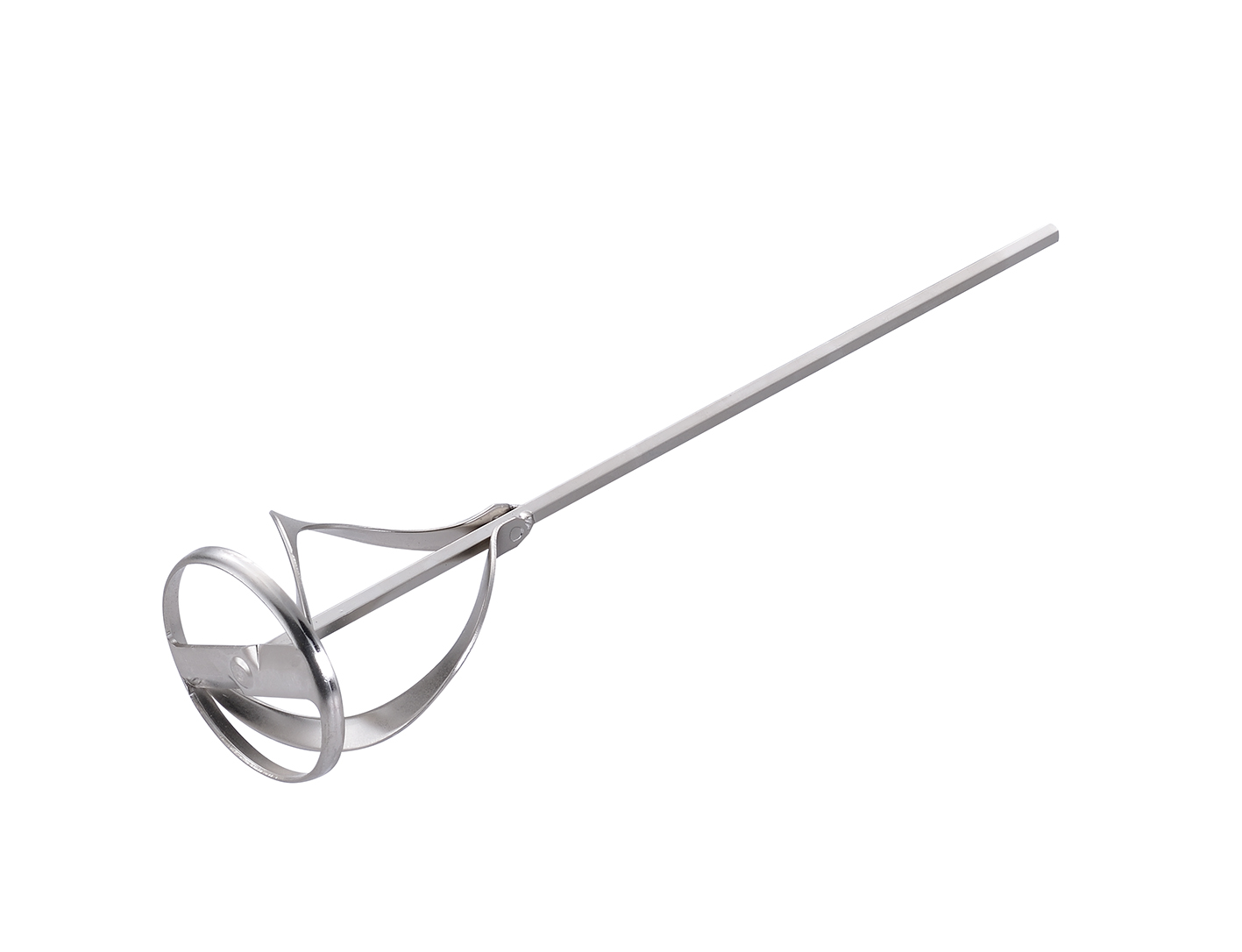
Spiral Mixing Paddle — 60–140 mm
Product Description
Spiral Mixing Paddle, 60–140mm
Art. Nr: 390601, 390602, 390603, 390604, 390605
The Spiral Mixing Paddle is the widest size ladder of Leading Tools' four mixing heads. Five art numbers step the blade diameter 60mm, 80mm, 100mm, 120mm and 140mm, the shank 8mm, 10mm and 12mm, and the overall length 400mm, 600mm and 760mm, against rated batch capacities from 1kg to 35kg. It is the only family in the range that reaches down to a 1–5kg batch, and the only one that reaches 760mm of length.
The head itself is a single helical blade: one continuous ribbon spirals down the shaft and is closed at the bottom by an outer ring, so the blade drives material along the axis of the shaft as well as around the bucket. The shafts are 8mm, 10mm or 12mm in diameter with no M14 thread at the drive end. Every model in the family is therefore a drill-chuck tool.
There is no M14 option in 390601–390605 (M14 is the most common professional connection for dedicated mixing machines). This range is specified for drills with a chuck that takes the shaft, not for M14 mixing machines.
Five diameters on one blade form. 60 / 80 / 100 / 120 / 140mm in even 20mm steps, all sharing the same single-helix-plus-ring head, so the selection decision is diameter and length rather than geometry.
Shank diameter scales with the blade. 8mm on the 60mm and 80mm heads, 10mm on the 100mm and 120mm heads, and 12mm on the 140mm head. The shank is sized to the torque the blade can develop, which is why the small heads cannot simply be run harder; the drive end is the limit, not the blade.
Three working lengths, including a 760mm. 400mm on the 60mm and 80mm heads for micro-batches and small buckets, 600mm on both 100mm and 120mm heads, and 760mm on the 140mm head. The 760mm on 390605 is the longest shaft in the Leading Tools mixing range, and it is what lets the head reach the bottom of a tall drum while the machine stays clear of the rim.
Rated by batch weight on every art number. 1–5, 5–10, 10–20, 15–25 and 25–35kgs respectively. You buy against the weight you actually mix rather than against a vague size class.
Helix geometry. A helical head lifts and folds the batch axially instead of only spinning it, which suits thicker materials such as plaster, mortar and cement-based products. For tile adhesive, self-levelling compound, epoxy resin, paint and other special materials, follow the material manufacturer's mixer recommendation.
Drill-chuck mounting throughout. Every model clamps in a standard drill chuck; nothing in the family threads onto a mixing machine. It lets a buyer use machines already on site, at the price of the chuck being a wear item under sustained heavy mixing.
The small end of the range is sized for micro-batches. 390601 at 60mm and 400mm on an 8mm shank is a micro-batch tool for patch repairs and small quantities of material. No other Leading Tools mixing family goes below 5kg rated capacity.
You can standardize a whole crew on one blade form. Because all five art numbers share the same helical head geometry, a mixer who learns the technique on the 100mm head does not relearn it on the 140mm; only diameter, length and shank change. Your spares holding becomes five sizes of one tool rather than five different tools.
The size ladder covers a jobsite end to end. A contractor can carry 390601 for small patch batches, 390602 for medium batches and 390604 for larger repair mortar batches out of the same product family, matched by weight rather than guessed. The selection rule is exactly this: choose paddle diameter by the volume being mixed, because larger diameters demand more power from the machine.
The 8mm shafts fit small-capacity chucks that a 10mm or 12mm shaft will not. The two small models suit lighter machines with smaller chucks, so a small batch does not need a larger drill.
760mm of reach on the 140mm head solves the deep-drum problem. 390605 combines the largest blade in the family with the longest shaft in the family, which is the combination you need for a deep drum.
Rated where drills are still the sensible driver. Four of the five Spiral Mixing Paddle models are rated at 25kg or below. Only 390605, at 25–35kgs, asks for a genuinely high-torque machine.
| Material | Recommended model | Rated capacity |
|---|---|---|
| Plaster or mortar, 1–5kg batches | 390601 | 1-5kgs |
| Plaster or mortar, 5–10kg batches | 390602 | 5-10kgs |
| Repair mortar, 10–20kg batches | 390603 | 10-20kgs |
| Plaster, render, mortar, screed, 15–25kg batches | 390604 | 15-25kgs |
| Heavy cement mortar, render, scratch coat, deep drums | 390605 | 25-35kgs |
| Tile adhesive, self-levelling compound, epoxy resin, paint, other special materials | Follow the material manufacturer's mixer recommendation | — |
Concrete with coarse aggregate is not a duty for a chuck-mounted paddle.
| Step | Action | Why |
|---|---|---|
| 1 | Measure the liquid into the container first, then add powder gradually, never the reverse. Follow the material manufacturer's water ratio | Adding water onto powder leaves dry pockets under the batch that the paddle then has to break up |
| 2 | Seat the shank fully and tighten the chuck completely; verify the chuck actually closes on the shank diameter | A partly seated shank is the starting condition for chuck slip and shank wear |
| 3 | Place the head in the container before starting the machine | Starting in air throws dry powder out of the container and loads the shank off-axis |
| 4 | Start at low speed until the powder is wetted out | Full speed on dry powder entrains air and makes dust |
| 5 | Once the powder is taken up, follow the material manufacturer's speed | Too slow and the batch does not circulate; too fast and air is whipped into the mix |
| 6 | Move the head through the batch in a figure-eight and up-and-down pattern rather than holding it still | Holding one position leaves unmixed material at the wall and under the blade |
| 7 | Mix for the material manufacturer's stated time | Over-mixing entrains air and heats the batch |
| 8 | Stop with the head still submerged, then lift | Lifting under power throws material off the blade |
| 9 | Rinse right after the batch | Set material changes the blade profile and the balance of the head |
Follow the material manufacturer's speed rather than a per-model figure. A helical head is meant to drive material from the bottom of the container upward, so it needs enough speed to establish that circulation and no more. The behavior to watch: if the batch splashes or foams, reduce speed; if material clings to the wall and will not turn over, raise it slightly; and as blade diameter and material viscosity increase, expect to work at lower speed.
Use a 3–8L pail, keep the head near the bottom, and mix in short passes. A light drill with an 8mm chuck is adequate at this batch size. Rinse immediately: cementitious material sets in the helix and on an 8mm shank there is little metal to lose before the shank is out of true.
Water first, powder gradually, low speed for wet-out, then the material manufacturer's speed. Let the batch slake if the bag calls for it, then remix briefly at low speed rather than at working speed.
Keep the head off the container wall: dragging the blade on the bucket contaminates the mix with abraded plastic and is a common mixing error. For 10–20kg batches move up to 390603, whose 600mm length reaches the bottom of a 15–25L bucket without the chuck going below the rim.
At 15–25kgs the material is dense and the machine matters more than the paddle. Use a high-torque drill. Use a container large enough that the paddle does not touch the wall while it turns; a paddle working close to the wall causes poor circulation and abraded container material.
Hold the machine with both hands: the reaction if a large head jams is enough to injure a wrist. Keep to the manufacturer's mixing time even though the batch is large.
390605 is the only model in the family at 25–35kgs, and its 760mm shaft is what makes a deep drum workable without tipping the drum. Three things change at this size. First, machine class: use a high-torque machine, since an ordinary drill gearbox may overheat under sustained load.
Second, speed: run at low speed and let the helix do the lifting rather than driving it faster. Third, straightness: a 760mm shaft has far more free length than a 400mm one, so start and stop with the head submerged and keep it off the drum wall. If the batch is genuinely above 35kg or you are mixing all day, the answer in the Leading Tools range is not a longer Spiral Mixing Paddle but the M14 Plaster Mixer 390212 at 25–40kgs.
Wet cement and gypsum irritate skin, so wear gloves and eye protection; wear a dust mask while pouring dry powder. Use both hands on the machine for any batch at the top of a model's rating.
Q1. Which model do I order if I mix one 20kg batch at a time?
A: 390603 (100mm x 600mm, rated 10–20kgs), or 390604 (120mm x 600mm, rated 15–25kgs) if your batches often run over 20kg. The family runs from 390601 to 390605, covering 60–140mm. Check the drill too: it needs a 10mm chuck and enough torque for the batch.
Q2. What drill do I need?
A: For 390601 and 390602 a light drill works within limits, as long as its chuck takes the shaft. From 390603 upward, use a drill with enough torque for the batch size.
Q3. How should I mix?
A: Put the liquid in first, then add the powder gradually, and keep the head submerged and off the container wall. Follow the material manufacturer's speed, using a lower speed as the blade gets larger or the material gets thicker; splashing or foaming means too fast. Mix for the manufacturer's stated time.
Q4. What is it not suited to, and is there an M14 version?
A: Helical heads are made for thicker materials such as plaster, mortar and cement; for paint, resin and other special materials, follow the material manufacturer's mixer recommendation. There is no M14 (threaded connection) version, since the shafts are 8mm, 10mm or 12mm only, for an M14 mixing machine use Plaster Mixer 390211 (120mm) or 390212 (140mm).
Q5. What should I check if the paddle slips or vibrates?
A: If it slips in the chuck, check that the chuck is fully tightened, that its capacity covers the shank diameter and that the jaws are not worn. If it vibrates, roll the shaft on a flat surface: a wobble means it is bent and must be replaced. 390605 has the longest shaft in the range (760mm), so it flexes most; drop to the low end of the speed band and keep the head submerged.
| ART. Nr | Dia. | Shaft | Length | Capacity |
|---|---|---|---|---|
| 390601 | 60mm | 8mm | 400mm | 1-5kgs |
| 390602 | 80mm | 8mm | 400mm | 5-10kgs |
| 390603 | 100mm | 10mm | 600mm | 10-20kgs |
| 390604 | 120mm | 10mm | 600mm | 15-25kgs |
| 390605 | 140mm | 12mm | 760mm | 25-35kgs |
The head is a single helical ribbon wound down the lower part of the shaft, closed at the bottom by one outer ring that carries the blade tip. There is no second crossing helix and no wire cage.
What the geometry does: helical heads suit thicker materials such as plaster, mortar and cement, and move material from the bottom of the container upward, so the batch turns over rather than simply spinning.
The shafts are 8mm, 10mm and 12mm in diameter with no threaded end. Two consequences follow for a buyer.
First, chuck capacity is the compatibility check, not thread size. The 10mm-shank models (390603 / 390604) need a chuck that genuinely closes on 10mm, and the 12mm-shank model (390605) needs a chuck that takes 12mm (in practice a 13mm / 1/2in chuck). Light drills are often fitted with 6.5mm, 8mm or 3/8in (9.5mm) chucks, which will not take a 10mm or 12mm shank. Check the number stamped on the chuck body before ordering.
Second, the load path is friction. A drill chuck transmits torque by clamping the shank, so grip degrades as the jaws wear, and sustained heavy mixing is what wears them. This is not a defect of the tool; it is the behavior of the connection type, and it is why M14 threaded connections are the professional standard for heavy continuous mixing. No model in this family offers M14.
The five models are not five arbitrary sizes. Reading across the size table, three variables move together:
| Step | Blade | Shank | Length | Capacity | What changed |
|---|---|---|---|---|---|
| 1 | 60mm | 8mm | 400mm | 1-5kgs | Baseline: smallest blade on an 8mm shank, short enough for a 3–8L pail |
| 2 | 80mm | 8mm | 400mm | 5-10kgs | Blade steps up; shank and length stay the same |
| 3 | 100mm | 10mm | 600mm | 10-20kgs | Shank steps up to 10mm; length jumps 200mm for bucket-depth work |
| 4 | 120mm | 10mm | 600mm | 15-25kgs | Blade grows on an unchanged shank and length, torque demand rises, drive does not |
| 5 | 140mm | 12mm | 760mm | 25-35kgs | Largest blade plus the longest shaft in the range |
The step that matters most for a buyer is step 4 to 5: from 390603 onward the shank grows only from 10mm to 12mm (390605) while blade diameter and batch weight keep climbing, so the machine and the operator's technique, not the tool, become the limiting factor.
Every model in this family is chuck-mounted, so machine capability is the first gate, not an afterthought.
| If your batch is… | And your container is… | Choose… | Rated capacity |
|---|---|---|---|
| 1–5kg, small patch or repair batch | 3–8L pail | 390601 (60mm x 400mm) | 1-5kgs |
| 5–10kg, standard batch | 8–15L bucket | 390602 (80mm x 400mm) | 5-10kgs |
| 10–20kg, repair mortar | 15–25L bucket | 390603 (100mm x 600mm) | 10-20kgs |
| 15–25kg, cement repair mortar | 20–30L bucket | 390604 (120mm x 600mm) | 15-25kgs |
| 25–35kg, heavy cement or render, deep drum | 30L+ deep drum | 390605 (140mm x 760mm) | 25-35kgs |
The rule behind this table: choose paddle diameter to suit the volume you are mixing, remembering that larger diameters need more power. Container volumes above are a working guide. One cross-check on container sizing is worth keeping: choose a container large enough that the paddle does not touch the wall while it turns, because a paddle working close to the wall drags on the container.
Helical heads suit thicker materials such as plaster, mortar and cement; all five Spiral Mixing Paddle models are helical. Soft, creamy materials such as grout and filler: see the Wire Mixer (390401 / 390402). For tile adhesive, self-levelling compound, epoxy resin, paint and other special materials, follow the material manufacturer's mixer recommendation.
| Product | Art. Nr | Dia. | Shaft | Length | Capacity | What it is for |
|---|---|---|---|---|---|---|
| Spiral Mixing Paddle | 390601–390605 | 60 / 80 / 100 / 120 / 140mm | 8 / 10 / 12mm | 400 / 600 / 760mm | 1-35kgs | The full size ladder, and the only family reaching down to 1–5kgs; longest shaft in the range at 760mm; no M14 anywhere |
| Plaster Mixer | 390201 / 390202 / 390211 / 390212 | 120 / 135 / 140mm | 12mm or M14 | 600 / 750mm | 5-40kgs | Highest rated capacity in the range; M14 is available here and on the Wire Mixer 390402; choose when the batch exceeds 35kg or the machine is an M14 mixing station |
| Wire Mixer | 390401 / 390402 | 85 / 105mm | 8mm or M14 | 400 / 600mm | 5-10kgs | Smallest head (105mm) among the M14-capable heads; both connections carry the same 5–10kgs rating, so the choice is machine-driven |
| Mixing Paddle | 390501 | 85mm | 8mm | 500mm | 5-15kgs | Single art number, drill shank only; a 500mm middle length between the 400mm heads and the 600mm heads |
Running 390601 at 10kg because "it still turns." The 60mm blade on an 8mm shank is rated 1–5kgs. For anything over 10kg, start at 390603.
Putting the 760mm 390605 into a shallow bucket. A 760mm shaft in a 300mm-deep bucket leaves most of the shaft above the rim, which turns the machine into a lever and makes the whole assembly unstable. Match paddle length to container depth, then check the diameter.
Assuming any "10mm chuck" takes a 10mm shank. Chucks are commonly marked 6.5mm, 8mm, 3/8in (9.5mm) or 13mm (1/2in), and only a 13mm (1/2in) chuck, or a chuck marked 10mm, reliably closes on a 10mm shank. Forcing a 10mm shank into a 9.5mm chuck damages both.
Choosing 390603 for 15–25kg cement work. At that weight the rated capacity puts you on 390604 (15-25kgs), not on 390603 (10-20kgs). Using an undersized blade in a heavy batch means the paddle pushes the mass instead of shearing it, and the machine takes the load.
Specifying this family for an M14 mixing machine. Nothing in 390601–390605 threads. If the customer's machine is an M14 station, the Plaster Mixer 390211 / 390212, or the Wire Mixer 390402 for lighter batches, are the M14 options in the Leading Tools range.
Complete art-number reference for the Spiral Mixing Paddle family.
| ART. Nr | Dia. | Shaft | Length | Capacity |
|---|---|---|---|---|
| 390601 | 60mm | 8mm | 400mm | 1-5kgs |
| 390602 | 80mm | 8mm | 400mm | 5-10kgs |
| 390603 | 100mm | 10mm | 600mm | 10-20kgs |
| 390604 | 120mm | 10mm | 600mm | 15-25kgs |
| 390605 | 140mm | 12mm | 760mm | 25-35kgs |
Five art numbers, and no others in this family. Units are mm and kgs. At 1in = 25.4mm, the blade diameters are 2.4in, 3.1in, 3.9in, 4.7in and 5.5in, and the lengths are 15.7in, 23.6in and 29.9in.
Attribute view of the same five models:
| Attribute | 390601 | 390602 | 390603 | 390604 | 390605 |
|---|---|---|---|---|---|
| Blade diameter | 60mm | 80mm | 100mm | 120mm | 140mm |
| Shank diameter | 8mm | 8mm | 10mm | 10mm | 12mm |
| Overall length | 400mm | 400mm | 600mm | 600mm | 760mm |
| Rated capacity | 1-5kgs | 5-10kgs | 10-20kgs | 15-25kgs | 25-35kgs |
| Connection | Drill chuck | Drill chuck | Drill chuck | Drill chuck | Drill chuck |
| Minimum chuck capacity | 8mm | 8mm | 10mm | 10mm | 12mm |
| Blade geometry | Single helix with outer ring | Single helix with outer ring | Single helix with outer ring | Single helix with outer ring | Single helix with outer ring |
| M14 thread option | None | None | None | None | None |
There is no handle on this product family. The drive end is the shank itself, and the operator's grip is on the machine, not on the tool.
Rinse right after the batch. Cementitious material sets inside the helix and around the ring, and once cured it changes the profile of the blade and the balance of the head. Practical routine: run the head in a bucket of clean water at low speed to flush the loose material, then rinse under running water. Soak dried residue in warm water, then remove it with a plastic scraper or nylon brush; do not use a steel brush or abrasive pads, which scratch the surface.
Clean the shank as well as the blade. Cement residue left on the shank transfers into the chuck jaws, where it accelerates the wear that eventually causes slip. On 390605 the mid-shaft is easy to miss because it never enters the material on shallow batches but does on deep ones.
Roll the shank on a flat surface before each session. Any wobble means the shaft is bent, and a bent shaft must not be run at working speed. Inspect the full length for corrosion, pitting and damage, and inspect the drive end for wear where the chuck jaws grip. The two models most worth checking are the extremes, 390601 and 390605; on 390605, 760mm of free length amplifies any bend into visible whip.
Dry completely before storage. Store 390604 and 390605 either hanging vertically or horizontally with support along the shaft, so the shaft carries no bending load. Do not stack weight on stored paddles, and store 390601 where it cannot be leaned on. A light oil film on the shank limits surface oxidation over a long storage period.
Service life depends far more on material abrasiveness and cleaning discipline than on calendar age. The factors that shorten it are sand-loaded materials, which abrade the blade edge, and material left to set on the head, which changes the profile. Replace when the helix is visibly bent, when the ring is deformed, when the shank no longer runs true, or when the drive end is worn enough that the chuck no longer grips it.

In compliance with EU personal data protection laws, we are committed to protecting and providing you with control over your personal data. By clicking "Accept All", you allow us to place cookies to enhance your experience on this site, help us analyze site performance and usage, and enable us to deliver relevant marketing content. You can manage your cookie settings below. By clicking "Agree" you agree to the current settings. For more information, please visit the Privacy Statement.
This website uses cookies
In compliance with EU personal data protection laws, we are committed to protecting your personal data and providing you with control over it. By clicking "Agree", you allow us to place cookies to improve your experience on this site, help us analyze site performance and usage, and allow us to deliver relevant marketing content.
By clicking "Only necessary" you allow us to place only necessary cookies. The website cannot function without these cookies and you cannot switch them off on your system. These cookies are typically set only in response to an action you perform (i.e. a service request), such as setting privacy preferences, logging in, or filling in a form. You can set your browser to block or prompt you for these cookies, but this may prevent some site features from working.