
Copyright 2026 © Leading Tools Industrial Co., Ltd.
All Rights Reserved. Website Design by Awakening Design
CATALOG TYPE
Product Categories
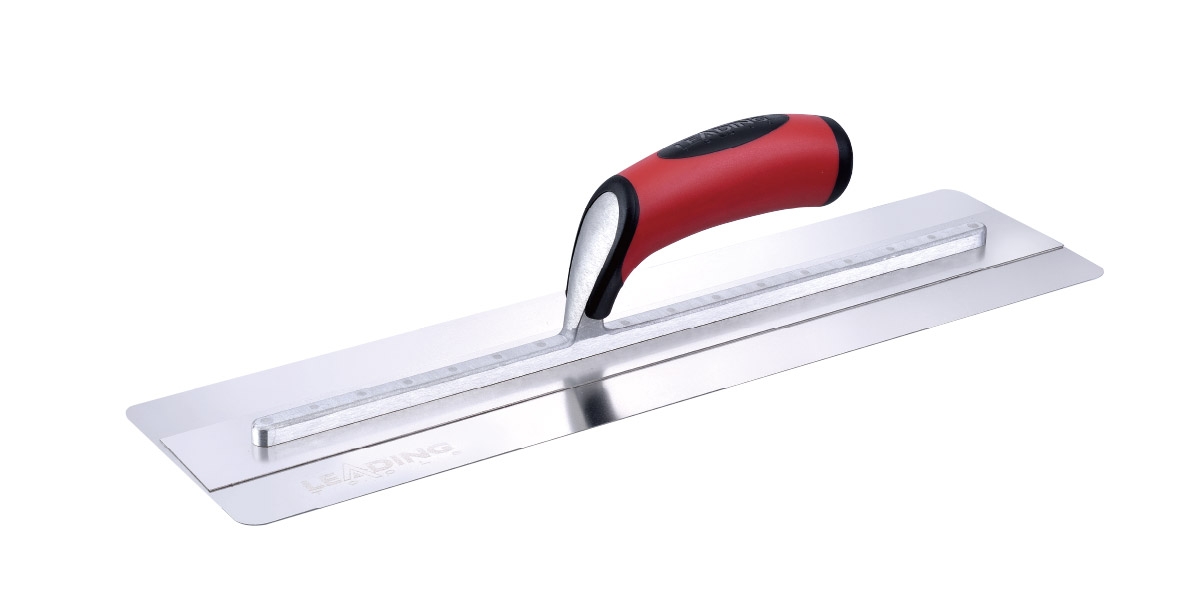
Ultra Flex Trowel — Stainless Steel
Product Description
Ultra Flex Trowel — Stainless Steel (Art. Nr 561821 to 578821)
| Item | Value |
|---|---|
| Product name | Ultra Flex Trowel — Stainless Steel |
| Designation | "Stainless Steel — Great Flexibility" |
| Art. Nr | 561821, 564821, 566821, 568821, 570821, 574821, 576821, 578821 (8 art numbers) |
| Blade widths | 4-1/2" (114 mm) and 4-3/4" (121 mm) |
| Blade lengths | 11" (279 mm), 14" (356 mm), 16" (406 mm), 18" (457 mm) |
| Product family | Plaster Trowel range |
| Series positioning | "PROFESSIONAL TOOLS — Ultra Flex Trowel" |
| Blade material | Stainless steel |
| Blade character | Great flexibility, a flexible blade built for thin finishing coats |
| Handle | Soft-grip handle |
The Ultra Flex Trowel is the finishing member of the Leading Tools plaster trowel range.
Where a general plastering trowel carries material onto the wall and then closes the surface, the Ultra Flex is built for the last stage only: thin coats, skim coats and the final closing and burnishing passes, where a blade that gives slightly under the hand follows the wall instead of fighting it. This tool is also called a flex finishing trowel, a flexible skimming trowel or simply a flex trowel.
A blade that follows the wall instead of ridging it. A rigid blade carries every bow in its own plane onto the surface, and a thin finishing coat shows each one. A flexible blade gives a little under hand pressure, so the pressure spreads across the blade and the coat is pulled out evenly. This is what the Ultra Flex is built for: full-surface skim coats and final plaster coats.
Light pressure does the work. The Ultra Flex is meant to be steered with fingertip pressure at a shallow angle. Because the blade flexes, the operator does not have to lean on the handle to bring the blade down onto the wall.
Stainless steel for finishing work. The stainless blade has high corrosion resistance and low maintenance, and is less likely to leave rust marks on white gypsum, pale lime or pigmented decorative coats; hard burnishing on pale microcement can still leave metal marks; reduce pressure or shorten the burnishing pass. It needs no oiling; chlorinated water, coastal air or prolonged soaking can still cause rust spots, so rinse with clean water and dry after use.
Rounded corners. Sharp square corners on a thin blade are the usual cause of tram lines in a closing pass. The rounded corners of this blade keep the corner from scoring the surface when the blade is tilted slightly, which is the normal way to work a flex trowel.
Two widths and four lengths on one design. A crew can keep a short 4-1/2" x 11" blade for ceilings, reveals and detail, and a 4-3/4" x 18" blade for long open walls, with the same blade style, the same grip style and the same way of working across the whole set.
Eight sizes share one size ladder (art. nr 561821–578821).
A finishing tool. The Ultra Flex is not meant for scraping hardened material, for lifting heavy loads of render off a hawk or for pushing a thick coat into a hollow. For those jobs the Premium Plaster Trowel and the Spot Riveted Plaster Trowel are the better match; see Where the Ultra Flex Sits in the Range below.
| Stage | What the trowel does | Working angle and pressure |
|---|---|---|
| Skim coat / thin coat | Draws a thin even coat of material over the whole surface | About 15–20°, light to medium pressure over the whole blade |
| First closing pass | Flattens ridges and closes surface porosity | About 10–15°, light pressure |
| Final closing and burnishing | Brings up the final smoothness or sheen | About 5–12°, minimal pressure, with a damp blade |
The angles above are reference angles for general finishing work: the closer the blade lies to the wall, the lighter the pressure and the finer the finish. With a flexible blade the pressure is as important as the angle. Let the blade give; do not force it.
| Step | Action | Detail |
|---|---|---|
| 1 | Prepare the surface | Substrate sound, dust-free and suitably dry; follow the material manufacturer's instructions for dampening or priming |
| 2 | Check the blade | Clean, flat, with no kink or crease and no dried residue on either face |
| 3 | Load the blade | Pick up a thin ribbon of material along the blade edge; do not overload a flexible blade |
| 4 | Draw the coat | About 15–20°, long continuous strokes, overlapping each pass by a third |
| 5 | Level the ridges | Cross the first strokes lightly to remove ridges and fill hollows |
| 6 | Wait for the surface to tighten | Press a thumb into an unimportant spot: it should take a light damp mark without material coming away on the skin |
| 7 | Close the surface | 10–15° then 5–12°, with a damp blade and minimal pressure, in sets of roughly three passes |
| 8 | Stop in time | Do not keep polishing after the surface has closed; an over-burnished face is glassy and will not take paint properly |
Two habits separate a flat finish from a streaky one. Use the entire blade face rather than one corner, because pressure at a single point makes the coat uneven. And keep the stroke continuous: lifting the blade mid-pass leaves a start mark that a thin coat will show.
The highest-grade drywall finish is a thin skim coat over the entire surface, joints and boards alike, so that the wall takes paint evenly.
The aim of the skim is an even, uniform surface for paint, not a mirror-flat wall, which is why a flexible blade does it well: it follows the board, lays material down in a thin film and leaves very little to sand.
Work in sections you can finish before the compound tightens, draw the coat in long overlapping strokes, then close it with light, shallow passes. Use the 4-1/2" x 14" (564821) for walls and the 4-1/2" x 11" (561821) for ceilings and edges.
After the base coat has been laid on and flattened with a general plastering trowel, let it stiffen to the thumb test and close it with the Ultra Flex. Use the 4-3/4" width on open walls for more coverage per pass. Keep the blade damp and the pressure minimal on the last passes. In hot or windy conditions, work smaller areas so that each section can be closed while it is still workable.
Decorative thin-coat systems are built up in several very thin coats and burnished rather than floated. Apply each coat thinly, allow it to dry or set as the material instructions say, and burnish with the blade held almost flat until a sheen appears.
A flexible stainless blade is the usual tool for this work because it follows the wall as it burnishes and, being stainless, it is less likely to leave rust marks in a pale or pigmented finish; if burnishing leaves metal marks on pale microcement, reduce pressure or shorten the burnishing pass. Clean and dry the blade between coats.
Over a cured base coat on an exterior insulation finish system, a final thin coat is drawn out with the blade nearly flat and very light pressure. The blade should "float" over the surface rather than dig into it. Clean the blade often; dried particles caught under a flexible blade leave scratches in the thin coat.
To blend a patch into an existing surface, build the patch slightly proud, then draw the Ultra Flex from the center of the patch outward at a shallow angle with decreasing pressure so that the edge of the coat tapers away to nothing. Repeat in thin passes, each one reaching slightly wider than the last.
Do not use the Ultra Flex to scrape hardened plaster or paint, to pry or lever, as a putty chisel, or to mix material. A flexible blade bends under that load and a bend or crease in the blade shows up in every coat that follows. Use a scraper for removal and a gauging trowel for mixing.
Q: What is the Ultra Flex Trowel used for, and how is it different from the Premium Plaster Trowel?
A: It is the finishing trowel of the Leading Tools plaster range, used for skim coats, thin final coats and the closing and burnishing passes, and its flexible stainless steel blade follows the wall under light pressure.
The Premium Plaster Trowel is a general plastering trowel that lays on, flattens and finishes with a less flexible blade, and many crews carry both. Do not use the Ultra Flex to lay on a thick coat, because a flexible blade gives under the load; lay the coat on with a Premium or Spot Riveted Plaster Trowel, then finish with the Ultra Flex.
Q: What sizes are available, and which should a first-time buyer choose?
A: There are eight art numbers: 4-1/2" wide in 11", 14", 16" and 18" lengths (561821, 564821, 566821, 568821), and 4-3/4" wide in the same four lengths (570821, 574821, 576821, 578821).
Start with 4-1/2" x 14" (564821) for walls, or 4-1/2" x 11" (561821) for ceilings, patches and learning the tool, since a shorter blade is easier to control.
Q: What angle and pressure should I use?
A: About 15–20° to draw a thin coat, 10–15° for the first closing pass, and 5–12° with minimal pressure and a damp blade for the final passes. Let the blade flex; do not press it down hard.
Q: My finish shows lines or waves, or the wall has come out glassy and the paint will not take. What is wrong?
A: Lines usually mean a dirty blade, a nicked edge or corner, or too much pressure at one point, so clean and dry the blade, check the corners with a fingertip, and use the whole blade face with even pressure.
A wavy finish means pressure is going through one corner or the blade has a permanent bend; check the blade on glass for rocking. A glassy wall is over-polishing, so stop once the surface has closed.
Q: Will the blade rust, and what if it gets a crease?
A: Stainless steel has high corrosion resistance and low maintenance, but chlorinated water, coastal air or prolonged soaking can still cause rust spots, so rinse the blade with clean water and wipe it dry after each wet job. A crease in a flexible blade is permanent and will show in every coat, so retire the blade from finishing work or replace it, and avoid scraping, prying or stacking heavy items on the blade.
| Property | Detail |
|---|---|
| Blade shape | Long flat rectangle with rounded corners |
| Blade material | Stainless steel |
| Blade widths | 4-1/2" (114 mm); 4-3/4" (121 mm) |
| Blade lengths | 11" (279 mm); 14" (356 mm); 16" (406 mm); 18" (457 mm) |
| Flexibility | "Great Flexibility": the flexible-blade member of the Leading Tools plaster trowel range |
| Intended use | Skim coats, thin final coats, closing and burnishing passes |
| Metric sizes | Converted from the inch sizes and rounded to the nearest millimeter |
The flexibility of the blade is what separates this product from the rest of the range. Use it for the last passes of a finish.
| Property | Detail |
|---|---|
| Handle | Soft-grip handle |
| Construction | Flexible blade with a fitted handle |
| Marking | Leading Tools name on the blade |
| Blade Width | Primary Use |
|---|---|
| 4-1/2" (114 mm) | General finishing; ceilings, reveals, columns and returns; the width that gives the most control and feel for feathering edges |
| 4-3/4" (121 mm) | Open wall areas where coverage per pass matters; slightly more material under the blade on each stroke |
| Blade Length | Primary Use |
|---|---|
| 11" (279 mm) | Ceilings, small rooms, patches, detail and corners; also the length recommended to anyone learning to work a flex blade, because a short blade is easier to keep under control |
| 14" (356 mm) | The working default for walls; a balance of control and coverage |
| 16" (406 mm) | Long continuous passes on open walls; needs a practiced, even stroke |
| 18" (457 mm) | Large flat areas only; the longer the blade, the more care it takes to keep it flat and avoid flexing it more than the job needs |
A distributor stocking a single size for finishing work should stock 564821 (4-1/2" x 14"). For ceilings and detail add 561821 (4-1/2" x 11"), and for large open walls add 576821 (4-3/4" x 16") or 578821 (4-3/4" x 18"). This product line has no width below 4-1/2"; for narrower blades see the Premium Plaster Trowel.
| Job | Why the Ultra Flex suits it |
|---|---|
| Full-surface skim coat over plasterboard | A thin, even coat over the whole surface; the flexible blade follows joint areas and field alike |
| Final coat over gypsum or cement-based plaster | Closes the surface and removes trowel ridges with light pressure |
| Decorative thin coats: Venetian-style plaster, lime finishes, microcement | The blade follows the wall as the coat is burnished; stainless is less likely to leave rust marks in pale or pigmented finishes; if burnishing leaves metal marks on pale microcement, reduce pressure or shorten the burnishing pass |
| Thin finishing coats over a cured base coat on exterior insulation finish systems (EIFS) | Light-pressure, nearly flat passes pull out a thin even coat |
| Feathering a repair into an existing surface | The edge of a flexible blade tapers a patch out smoothly |
| Scraping, prying, lifting hardened material | Not suited, use a scraper; see below |
| Property | Stainless Steel Blade (this product) |
|---|---|
| Art. Nr | 561821 to 578821 |
| Sizes | 4-1/2" and 4-3/4" wide; 11", 14", 16", 18" long |
| Designation | Stainless Steel — Great Flexibility |
| Blade material | Stainless steel |
| Rust | High corrosion resistance and low maintenance; chlorinated water, coastal air or prolonged soaking can still cause rust spots, so rinse with clean water and dry after use |
| Choose it when | You want a metal blade and the familiar steel feel |
| Leading Tools Product | Role |
|---|---|
| Ultra Flex Trowel — Stainless Steel | Thin finishing coats, skim coats, closing and burnishing; the flexible blade |
| Golden Plaster Trowel and Premium Plaster Trowel | General plastering: laying on, flattening and finishing with a firmer blade; widths from 3" to 4-3/4" |
| Spot Riveted Plaster Trowel | Rectangular plastering trowel with square corners for laying on and floating, stainless steel blade (carbon steel: contact sales) |
| Taping Knife range | Plasterboard joint bedding and filling |
A common pairing is a Premium or Spot Riveted Plaster Trowel for laying on and flattening, then an Ultra Flex for the closing passes. One crew can carry both and move between them as the coat sets.
| Tool | Difference |
|---|---|
| Standard plastering trowel | A firmer blade for laying on and flattening; it does not give the flexible follow-the-wall action of the Ultra Flex |
| Taping knife | Narrower tool for pressing tape into plasterboard joints; not a wall-finishing trowel |
All eight art numbers of the Ultra Flex Trowel — Stainless Steel. Blade material is stainless steel on every row.
| Art. Nr | Blade Size (W x L) | Blade Size (mm) | Blade Material |
|---|---|---|---|
| 561821 | 4-1/2" x 11" | 114 x 279 | Stainless steel |
| 564821 | 4-1/2" x 14" | 114 x 356 | Stainless steel |
| 566821 | 4-1/2" x 16" | 114 x 406 | Stainless steel |
| 568821 | 4-1/2" x 18" | 114 x 457 | Stainless steel |
| 570821 | 4-3/4" x 11" | 121 x 279 | Stainless steel |
| 574821 | 4-3/4" x 14" | 121 x 356 | Stainless steel |
| 576821 | 4-3/4" x 16" | 121 x 406 | Stainless steel |
| 578821 | 4-3/4" x 18" | 121 x 457 | Stainless steel |
Note: both widths are offered in the same four lengths (11", 14", 16", 18"). This product has no width below 4-1/2". Metric sizes are converted from the inch sizes and rounded to the nearest millimeter.

In compliance with EU personal data protection laws, we are committed to protecting and providing you with control over your personal data. By clicking "Accept All", you allow us to place cookies to enhance your experience on this site, help us analyze site performance and usage, and enable us to deliver relevant marketing content. You can manage your cookie settings below. By clicking "Agree" you agree to the current settings. For more information, please visit the Privacy Statement.
This website uses cookies
In compliance with EU personal data protection laws, we are committed to protecting your personal data and providing you with control over it. By clicking "Agree", you allow us to place cookies to improve your experience on this site, help us analyze site performance and usage, and allow us to deliver relevant marketing content.
By clicking "Only necessary" you allow us to place only necessary cookies. The website cannot function without these cookies and you cannot switch them off on your system. These cookies are typically set only in response to an action you perform (i.e. a service request), such as setting privacy preferences, logging in, or filling in a form. You can set your browser to block or prompt you for these cookies, but this may prevent some site features from working.