
Copyright 2026 © Leading Tools Industrial Co., Ltd.
All Rights Reserved. Website Design by Awakening Design
CATALOG TYPE
Product Categories
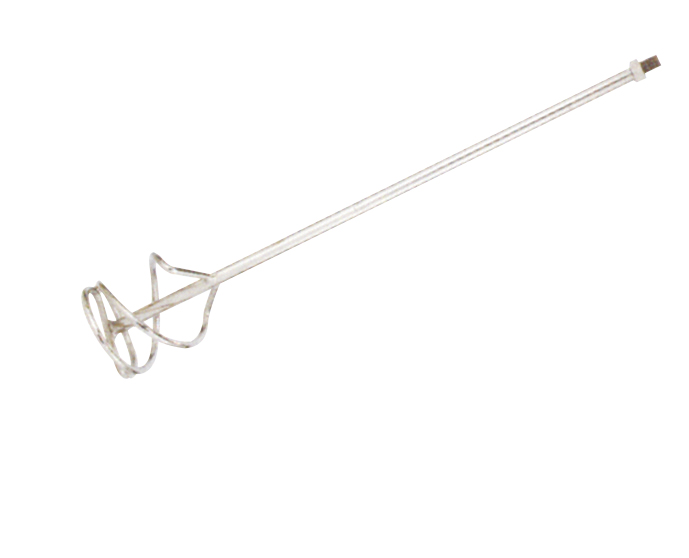
Wire Mixer — Cage-Type Mixing Paddle
Product Description
Wire Mixer — Cage-Type Mixing Paddle, 8mm Shaft & M14 Thread
Art. Nr: 390401, 390402
The Wire Mixer is the cage-type head in Leading Tools' mixing range. Instead of a solid or helical blade, the head is a framework of wire loops that form an open basket around a central shaft: open at the bottom, closed and looped at the top. The batch passes through the cage rather than being pushed around by a blade face, which keeps air out of materials that are damaged by air.
Two art numbers make up the family, and they differ in exactly three things: head diameter, connection and shaft length:
Read the capacity column before you read anything else, because it is the same on both: 5–10kgs. Unlike the Plaster Mixer and Spiral Mixing Paddle families in the Leading Tools range, where a bigger head buys a bigger batch, the Wire Mixer's two models are rated identically. The choice between 390401 and 390402 is therefore driven by the machine you own, not by the batch you mix.
Open wire-cage head on a central shaft. A framework of wire loops forms a basket that is open at the bottom and closed or looped at the top, carried on a single central shaft. Material enters at the bottom and passes up through the cage, so the head circulates the batch instead of shearing it against a blade face.
Two head diameters: 85mm and 105mm. 390401 is 85mm, 390402 is 105mm. Both are small heads for pail-scale work.
Two shaft lengths: 400mm and 600mm. 390401 is 400mm long and 390402 is 600mm long. The 400mm length is matched to pail-scale work rather than to tall drums; the 600mm length of 390402 reaches deeper into a container.
Two connection types on the same head family. 390401 takes an 8mm shaft that clamps in a standard drill chuck; 390402 takes an M14 thread that connects to a dedicated mixing machine. M14 is the connection professional mixing equipment is built around.
Identical rated capacity on both models: 5–10kgs. Neither model is the "big batch" version of the other.
The 8mm shaft fits a standard drill chuck. The chuck capacity must cover 8mm; ordinary 10mm and 13mm drill chucks do.
It is the head for thin materials that should not be aerated. Cage-type paddles suit soft, creamy materials such as grout and filler, while the twin-helix and spiral types suit thicker materials such as mortar and plaster.
Air whipped into grout or filler becomes pinholes and weak spots after cure, and the working practice that avoids it is low speed with a cage head. For tile adhesive, self-levelling compound, epoxy resin, paint and other special materials, follow the material manufacturer's mixer recommendation.
It buys the batch size that actually matches a bag and a pail. 5–10kgs is a real working unit: one to two bags of grout or filler mixed in a builder's pail.
Both connections are covered at the same rating, so you can standardize. A crew running cordless and corded drills takes 390401; a crew running a dedicated M14 mixing machine takes 390402; both get the same mixing behavior and the same 5–10kgs window. You are not forced to change head geometry because you changed machines.
400mm (390401) is the right reach for pail work, and short is an advantage here. A 400mm shaft keeps the chuck or machine connection well clear of a standard pail rim while the cage still reaches the bottom, and it puts less overhang, and therefore less wobble, on a light drill than a 600mm shaft would. The 600mm shaft of 390402 gives the same head more reach for deeper containers; the other 600mm and 760mm shafts in the Leading Tools range belong to drum-scale mixing, not pail-scale mixing.
M14 is available at a small head size. Of Leading Tools' four mixing head families, the Wire Mixer and the Plaster Mixer are the only ones offering M14 at all; the Mixing Paddle and the Spiral Mixing Paddle are drill-shaft only. 390402 is therefore the option for running a dedicated mixing machine on small, air-sensitive batches without stepping up to a 120mm helical head.
The cage is an easy head shape to inspect. Wear on a wire cage is visible as loop deformation or spread from a metre away, whereas blade-edge wear on a solid paddle has to be inspected. That makes pre-use inspection realistic on a working site rather than theoretical.
| Material | Suitability | Recommended model | Why |
|---|---|---|---|
| Tile grout, unsanded | Primary use | 390401 / 390402 | Cage type is the right head for grouting compounds; also called a grout whisk |
| Tile grout, sanded | Suitable within 5–10kgs | 390401 / 390402 | Same class; keep the batch inside the rating |
| Fillers and patching compounds | Suitable | 390401 / 390402 | Cage type assigned to fillers |
| Ready-mixed joint compound / drywall mud | Suitable | 390401 | Low-speed homogenizing without aeration |
| Cement mortar, masonry cement, render | Use the spiral family instead | Plaster Mixer 390201–390212 | The twin-helix head is the assigned head for thick cementitious material |
| Any batch above 10kg | Outside the rating | See the Selection Guide on the Specification tab |
For tile adhesive, self-levelling compound, epoxy resin, paint and other special materials, follow the material manufacturer's mixer recommendation.
| Step | Action | Why |
|---|---|---|
| 1 | Start clean: a clean cage and a clean pail | Residue from a previous batch can discolor or contaminate the new mix |
| 2 | Seat the connection: tighten the chuck fully on 390401, or make the M14 joint up solidly on 390402 | A partially seated shank is the starting condition for chuck slip |
| 3 | Put the liquid in the pail first, then add powder | Adding water to powder leaves dry pockets at the bottom that the cage then has to break up |
| 4 | Place the head in the pail before starting the machine, then start at low speed | Starting in air throws dry powder out of the pail |
| 5 | Add the powder gradually at low speed | Dumping the bag at once is the most common cause of clumping |
| 6 | Once the powder is wetted out, follow the material manufacturer's speed; if the mix splashes or foams, slow down | Higher speed entrains air; low speed is the general recommendation from material manufacturers |
| 7 | Mix for the material manufacturer's stated time, until the mix is smooth and homogeneous | Stop when it is uniform rather than running to a clock |
| 8 | Slake (rest) if the material manufacturer specifies it, then re-mix briefly | Slaking is a material instruction, not a tool instruction, follow the bag |
| 9 | Keep the cage submerged while it is turning | Lifting a spinning cage out of the material is a direct way to whip in air |
| 10 | Wash the cage immediately after the batch | Grout, adhesive and joint compound set hard on wire and are very hard to remove once cured |
The speed rule. There is no single number; follow the material manufacturer's recommendation. A low-speed machine suits cage paddles because it has more torque and stalls less, and low speed also reduces entrained air and gives a more even mix. The operating rule: start low, raise only after the powder is wetted, and reduce speed the moment the mix starts to splash or foam.
This is the core application. Water or latex additive into the pail first, powder in gradually at the lowest speed that keeps the cage turning, then hold at low-to-medium speed until the mix is smooth. Grout is one of the materials most punished by aeration: air pulled into the mix becomes pinholes in the cured joint.
Keep the head fully submerged, move it slowly around the pail rather than holding it in one spot, and stop as soon as the mix is uniform. Follow the manufacturer's slake instruction and re-mix briefly before use; do not add water afterwards to loosen a batch that has begun to stiffen, because that dilutes the additive rather than restoring the mix.
This material does not need mixing so much as homogenizing: settled solids at the bottom of a pail have to be redistributed without turning the material into foam. Low speed and a submerged cage do that.
Q1. What is the difference between 390401 and 390402?
A: Connection, head diameter and shaft length, and nothing else. 390401 is 85mm on an 8mm shaft, 400mm long; 390402 is 105mm on an M14 thread (a screw-on connection used on mixing machines), 600mm long. Both are rated 5–10kgs, so choose by the machine you will drive it with.
Q2. What can I mix with it, and what is it not for?
A: A cage paddle suits thin, creamy materials such as grout and filler, in batches up to 10kg. Mortar and other dense materials are normally past that rating, so use the Plaster Mixer (390201 / 390202 / 390211 / 390212) instead. For tile adhesive, self-levelling compound, epoxy resin, paint and other special materials, follow the material manufacturer's mixer recommendation.
Q3. How should I mix, and why is my grout full of bubbles?
A: Put the liquid in first, add the powder gradually at low speed, and mix until smooth. Bubbles almost always mean the speed is too high, so reduce it first, and do not lift the cage out of the material while it is still turning. Splashing or foaming means slow down; extra mixing after the batch is uniform only adds air.
Q4. How do I look after the cage?
A: Wash it, dry it fully after washing and hang it in a dry place. Light surface rust can be brushed off with a nylon or brass brush and the tool kept in service; pitting or visible thinning of the wire means replace it.
Q5. How is this different from the Mixing Paddle 390501?
A: 390501 has the same 85mm head and 8mm shaft, but a 500mm shaft rather than 400mm and a 5–15kgs rating rather than 5–10kgs. If you need the extra reach or the extra 5kg on a drill shaft, order 390501.
| ART. Nr | Dia. | Shaft | Length | Capacity |
|---|---|---|---|---|
| 390401 | 85mm | 8mm | 400mm | 5-10kgs |
| 390402 | 105mm | M14 | 600mm | 5-10kgs |
Units are mm and kgs; at 1in = 25.4mm, 85mm is 3.35in, 105mm is 4.1in, 400mm is 15.7in, and 600mm is 23.6in.
The head is a cage: wire loops arranged around a central shaft to form an open basket, open at the bottom and closed at the top. The functional difference from a helical paddle is what the head does with the material.
A helix drives material along the shaft axis and shears it between blade and bucket; a cage lets material pass through the loops, which produces circulation with far less air entrainment. The same split applies across paddle designs: the cage family suits thin, creamy materials such as grout and filler, and the twin-helix and spiral families suit thicker materials such as mortar, plaster and render.
8mm shaft (390401). The 8mm shaft clamps in a standard drill chuck. What governs use is the load path: a drill chuck transmits torque by clamping friction on the shank, so grip degrades as the jaws wear. Practical consequences: the 8mm shaft fits a chuck of 8mm capacity or more (such as 10mm or 13mm), there is no minimum engagement beyond seating the shank fully, and chuck condition becomes part of routine maintenance rather than an optional check.
M14 thread (390402). M14 is the standard professional connection for mixing equipment. The M14 thread connects to the machine, so torque is carried mechanically by the thread and chuck wear stops being a variable.
| Factor | 8mm shaft (390401) | M14 thread (390402) |
|---|---|---|
| Head diameter | 85mm | 105mm |
| Rated capacity | 5-10kgs | 5-10kgs, identical |
| Overall length | 400mm | 600mm |
| Torque path | Friction: chuck jaws clamp the shank | Mechanical: thread engagement carries the load |
| Machine required | Any drill with a standard chuck; 8mm / 3/8in fits | Dedicated mixing machine with an M14 thread connection |
| Fitting and removal | Drop in, tighten the chuck | Make up and break the joint with two open-end wrenches |
| Effect of machine wear | Grip falls as chuck jaws wear | No friction step in the load path |
| Typical buyer | Occasional and mixed-duty work on machines already owned | Daily professional grout and filler work on a mixing machine |
The row that decides most orders is the capacity row. Because both models are rated 5–10kgs, buying 390402 does not give you a bigger batch; it gives you the connection, and with it the 105mm head that comes with that connection.
Do you have, or will you buy, a dedicated mixing machine with an M14 thread connection?
Both models are rated 5–10kgs. That is one to two standard bags of grout or filler mixed in a builder's pail. If your routine batch is heavier than 10kg, you are outside this family:
Cage heads and twin-helix or spiral heads are not interchangeable, and the thickness of the material decides which one you need:
| Material class | Head type | Leading Tools family |
|---|---|---|
| Grout, filler and other thin, creamy materials | Cage | Wire Mixer 390401 / 390402 |
| Mortar, plaster, render and other thick materials, including heavy cementitious mixes above 10kg | Twin-helix / spiral | Plaster Mixer 390201 / 390202 / 390211 / 390212, Spiral Mixing Paddle |
What is binding on 390401/390402 is the rated 5–10kgs and the head size, not a blanket material prohibition. Treat sand-loaded cementitious mixes as out of scope on capacity grounds, and use the Plaster Mixer for them because the twin-helix head is the right one for that class. For tile adhesive, self-levelling compound, epoxy resin, paint and other special materials, follow the material manufacturer's mixer recommendation.
| Scenario | Recommended model | Why |
|---|---|---|
| Tile grout, 5–10kg batch, standard drill | 390401 | 8mm shaft in a drill chuck; rated 5-10kgs |
| Tile grout, 5–10kg batch, M14 mixing machine | 390402 | Same rating, threaded connection |
| Ready-mixed joint compound, homogenizing before use | 390401 | Breaks down settled solids at low speed without aerating |
| Professional tile setter with a dedicated mixing machine, daily work | 390402 | The threaded joint removes chuck slip from daily duty |
| Occasional DIY grout work | 390401 | Runs on a drill already owned |
| Sand-cement mortar, render, batches above 10kg | Neither, Plaster Mixer 390201–390212 | Outside the 5-10kgs rating; helical head is the assigned type |
| Product | Art. Nr | Dia. | Shaft | Length | Capacity | What it is for |
|---|---|---|---|---|---|---|
| Wire Mixer | 390401 / 390402 | 85mm / 105mm | 8mm or M14 | 400mm / 600mm | 5-10kgs | Pail-scale heads; both connections carry the same 5-10kgs rating, so the choice is machine-driven, not batch-driven |
| Mixing Paddle | 390501 | 85mm | 8mm | 500mm | 5-15kgs | Single art number, drill shaft only, no M14; same head diameter as 390401 but 100mm more reach and 5kg more rating |
| Plaster Mixer | 390201 / 390202 / 390211 / 390212 | 120mm / 135mm / 140mm | 12mm or M14 | 600mm / 750mm | 5-40kgs | Highest rated capacity in the range; the only family offering M14 at 140mm blade diameter |
| Spiral Mixing Paddle | 390601–390605 | 60mm / 80mm / 100mm / 120mm / 140mm | 8mm / 10mm / 12mm | 400mm / 600mm / 760mm | 1-35kgs | Widest size ladder and the only family reaching down to 1–5kgs, but no M14 anywhere in the family |
Assuming 390402 is the "bigger batch" model. It is the bigger head, not the bigger batch; both are rated 5–10kgs. Order it because you have an M14 machine, not because you mix more.
Buying a cage head for sand-loaded mortar. Not because the wire will fail immediately, but because the batch weight for mortar work is normally well past 10kg and the helical head is the right one for dense cementitious material. Use the Plaster Mixer 390201/390202 series for those.
Sizing the head to the bucket by eye. The cage must have clearance to circulate material and must not contact the wall in use.
Raising the speed to mix faster. For grout-class materials, higher speed does not mean faster mixing; it means entrained air, which shows up as pinholes and weak cure. Use a low-speed machine; low speed is the general recommendation from material manufacturers.
Running a worn cage. Wire loops fatigue and spread over time. A spread cage loses the circulation pattern that makes the head work and will not mix to the same consistency. Because the deformation is visible, this is the cheapest failure mode to catch.
Specifying by picture rather than by art number. The Wire Mixer and the Mixing Paddle share the same 85mm head diameter and the same 8mm shaft; they differ in shaft length (400mm vs 500mm) and rating (5-10kgs vs 5-15kgs). Put the art number on the purchase order.
Complete art-number reference for the Wire Mixer family.
| ART. Nr | Dia. | Shaft | Length | Capacity |
|---|---|---|---|---|
| 390401 | 85mm | 8mm | 400mm | 5-10kgs |
| 390402 | 105mm | M14 | 600mm | 5-10kgs |
Two art numbers, and no others in this family. Units are mm and kgs; at 1in = 25.4mm, 85mm = 3.35in, 105mm = 4.1in, 400mm = 15.7in, 600mm = 23.6in.
Attribute view of the same two models:
| Attribute | 390401 | 390402 |
|---|---|---|
| Head diameter | 85mm | 105mm |
| Connection | 8mm shaft | M14 thread |
| Length | 400mm | 600mm |
| Rated capacity | 5-10kgs | 5-10kgs |
| Head geometry | Open wire cage, closed at top | Open wire cage, closed at top |
There is no handle on this product family: the drive end is the connection itself (8mm shaft or M14 thread), and the operator's grip is on the machine, not on the tool.
Grout, tile adhesive and joint compound set hard on wire and become very difficult to remove once cured; a cage is worse than a solid blade in this respect because residue collects at every wire intersection and at the base of the basket.
Working routine: while the material is still fluid, run the head in a pail of clean water at low speed, rinse under running water, then finish with a soft nylon brush at the loop intersections. Remove dried residue with a plastic scraper or nylon brush; do not use a steel brush or abrasive pads, which scratch the surface.
On 390402, clean the M14 thread specifically. Dried material in the thread roots is what causes a cross-threaded make-up next time, and a cross-threaded joint can damage the machine's thread connection.
Because the head is open, inspection is visual and takes seconds:
Store dry. A cage has a large surface-area-to-mass ratio and a lot of crevices, so it holds water longer than a solid paddle and is correspondingly more prone to surface rust in a humid store. Dry the head fully before it goes away, hang it rather than dropping it in a bucket of tools so the loops carry no load, and do not seal it in a plastic bag while damp. A light film of rust-preventive oil is worthwhile for long storage.
Cement- and gypsum-based materials are alkaline, which is the normal working environment for this tool.
Acidic cleaners, including the acid washes sometimes used to remove grout haze, and strongly caustic cleaners will attack the wire far faster than the material being mixed does; rinse the cage immediately after any contact with them. Solvent-based sealers and some resin systems can damage the tool; check the material manufacturer's guidance before using the tool with them.
The reliable guide to service life is the failure mode: the wire loops are the wear point, they fail by fatigue and spreading rather than by sudden breakage, and abrasive material shortens life faster than calendar time does. Replace when the cage is visibly out of shape, when a wire has broken, or when the mix quality drops at the same speed and time settings you have always used.

In compliance with EU personal data protection laws, we are committed to protecting and providing you with control over your personal data. By clicking "Accept All", you allow us to place cookies to enhance your experience on this site, help us analyze site performance and usage, and enable us to deliver relevant marketing content. You can manage your cookie settings below. By clicking "Agree" you agree to the current settings. For more information, please visit the Privacy Statement.
This website uses cookies
In compliance with EU personal data protection laws, we are committed to protecting your personal data and providing you with control over it. By clicking "Agree", you allow us to place cookies to improve your experience on this site, help us analyze site performance and usage, and allow us to deliver relevant marketing content.
By clicking "Only necessary" you allow us to place only necessary cookies. The website cannot function without these cookies and you cannot switch them off on your system. These cookies are typically set only in response to an action you perform (i.e. a service request), such as setting privacy preferences, logging in, or filling in a form. You can set your browser to block or prompt you for these cookies, but this may prevent some site features from working.