
Copyright 2026 © Leading Tools Industrial Co., Ltd.
All Rights Reserved. Website Design by Awakening Design
CATALOG TYPE
Product Categories
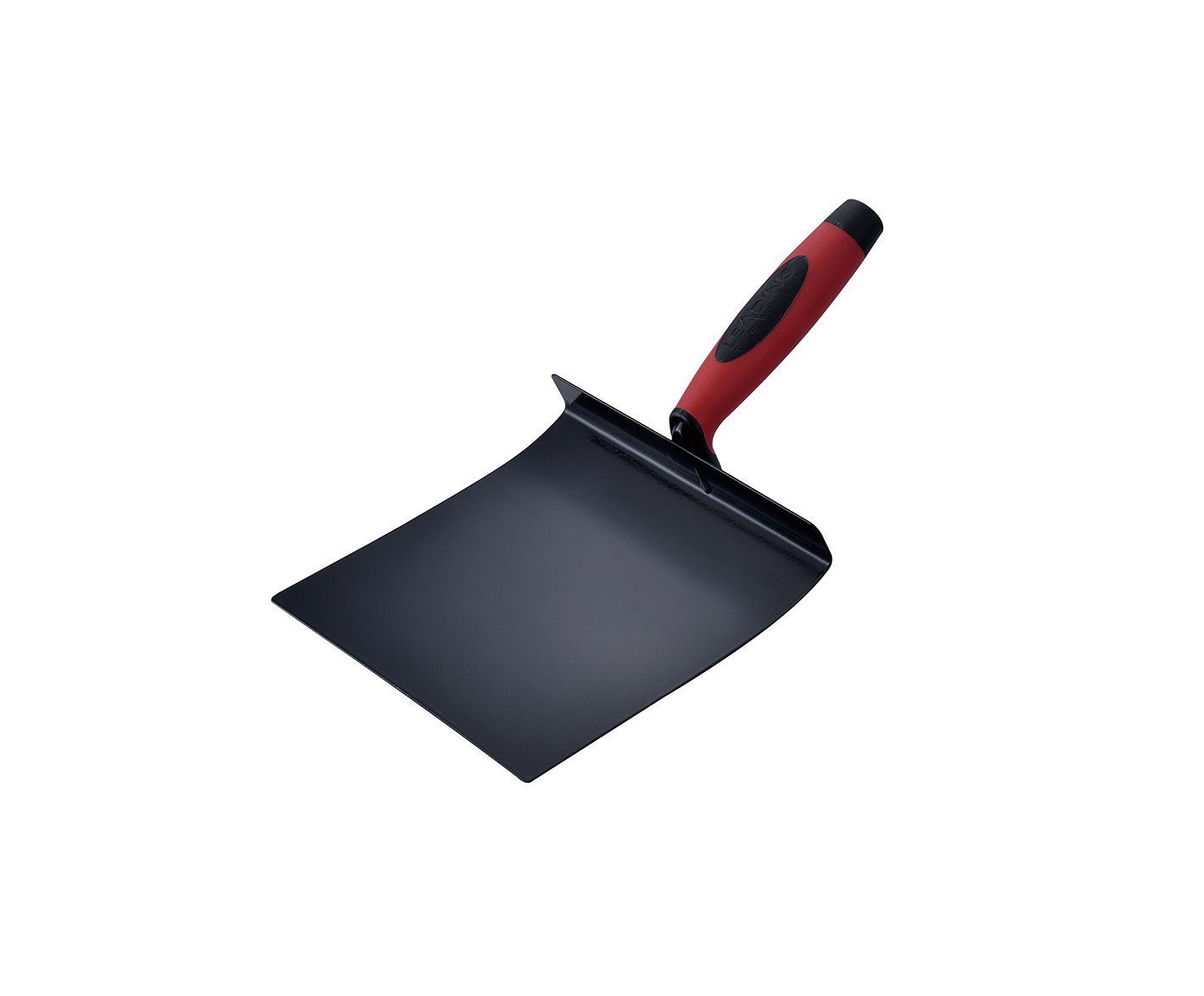
Harling Trowel
Product Description
Harling Trowel — Art. Nr 301055, size 6" (≈152mm; 1" = 25.4mm)
Also known as a Dash Trowel or a Roughcast Trowel. It belongs to the Leading Tools Float line, alongside the Aluminum Hawk (300369–300374) and the Plastic Hawk (300301–300303).
A harling trowel is a scoop: a square, deep-troughed steel blade whose face is curved or slightly angled so that coarse-aggregate mortar gathers in the trough and leaves cleanly when the wrist casts it at the wall. When a specification or a conservation report calls for render to be cast on rather than floated, this is the tool that method assumes.
These four words describe one family of finish, not four products. Mortar carrying a coarse aggregate is thrown onto the wall to give a rough, weather-shedding external face. This finish is called harling, roughcast or wet dash. The difference inside the family is when the aggregate arrives: in wet dash the aggregate is mixed into the mortar and cast in one action: the traditional method; in dry dash the pebbles are thrown onto a freshly laid wet coat afterwards and pressed in; pebble dash names the pebbled face that results. Tyrolean render sits outside this family: it is a machine finish, applied with a flicker gun, not a hand-cast one.
| Situation | Use the harling trowel? | Why |
|---|---|---|
| Harling / roughcast / wet dash on an external wall | Yes | Coarse-aggregate mortar is cast, not spread; this is the defining tool for that method |
| Pebble dash / dry dash finish | Yes | The blade scoops the pebbles and casts them at the wet coat to be pressed in |
| Thrown base coat under further coats | Yes | A wrist-thrown rough coat forms the key for the coats above |
| Lime harling on historic fabric | Yes | Cast on rather than floated |
| Tyrolean honeycomb render | No: use a flicker gun | Tyrolean texture is applied by machine |
| Flattening, ruling and finishing the cast face | No: use a straight edge and float | The cast surface is brought to line with a straight edge after casting |
| Step | Action | Detail |
|---|---|---|
| 1 | Load the blade | Take material off a hawk, a mixing board or a bucket |
| 2 | Set your stance | Stand at an angle to the wall, not square to it. Working practice varies: casting straight off the hawk, walking the elevation with a bucket under the left arm (scudding), or standing between the handles of a loaded barrow and throwing from it |
| 3 | Cast, don't spread | Hold the blade at a slight angle and throw the material with the wrist; the gentle scooping motion is what meters how much leaves the blade on each throw |
| 4 | Cover, don't smooth | The target is even coverage and consistent grain, not a flat face; a thrown base coat is rough and discontinuous |
| 5 | Build in thin coats | Several thin coats are better than one thick one. On lime work each coat must be weaker than the coat and the background beneath it, and background suction must be controlled for the cast material to bond |
| 6 | Rule off | Bring the cast surface to line with a straight edge |
| 7 | Wash out immediately | Rinse with water before the mortar sets and brush the blade face and the blade-to-handle joint with a stiff brush |
Common errors
Lime mortar with coarse aggregate, traditionally slaked lime, in modern work also cement-based roughcast, is cast onto the wall to build a rough, weather-resistant external face; it suits wet climates. On historic fabric, harling is cast on rather than floated, which is the reason a conservation specifier calls for hand casting.
The base coat is laid, then the trowel scoops the pebbles and casts them at the wet face, where they are pressed in. This is where the deep trough earns its keep, since loose stone will not stay on a flat blade through the swing.
A thrown base coat is cast with wrist action as a rough, discontinuous coat; the coarse grain forms the key for the coats above. A thrown coat is a key coat, and its roughness is the specification.
Q1. Is a harling trowel the same thing as a dash trowel or a roughcast trowel?
A. Yes. All three names describe the same tool and are used interchangeably.
Q2. Can I use an ordinary finishing trowel instead?
A. Not for cast-on work. A harling trowel is a square blade with a deep trough that scoops up the mix and releases it onto the wall, while a flat blade has no side walls to hold coarse aggregate through the swing, so the material is dragged onto the wall rather than cast at it. After casting, the surface is ruled to line with a straight edge; the harling trowel itself is not a smoothing tool.
Q3. What size should I order?
A. 6" (301055) is the general-purpose size and the only size of this model in the Leading Tools range.
Q4. Material is not releasing cleanly from the blade. What is wrong?
A. Check three things in order: hardened residue in the trough from the previous session, which changes how the material releases; the blade angle, since a gentle scooping angle is what meters the load; and the mix, since a coat that is meant to be cast is a different consistency from one meant to be floated. Do not roughen the blade face to fix it.
Deep-troughed blade: function. The 301055 blade is a deep-troughed scoop with the front edge open. That is the standard form of a harling trowel: a square, deep-troughed steel blade whose face is curved or slightly angled, as distinct from the flat plane of a finishing trowel. The form does three things:
| Attribute | Specification |
|---|---|
| Size | 6" (≈152mm) |
| Blade form | Square/tapered steel blade, deep trough, leading edge open |
| Blade finish | Dark coating over the steel |
| Blade material | Carbon steel |
| Attribute | Specification |
|---|---|
| Handle type | Red/black two-color soft-grip handle |
| End cap | Black end cap |
| Grip security | The throwing motion is a wrist flick with a loaded blade, so a non-slip grip is a working requirement rather than a comfort feature |
The defining feature of a harling trowel is the depth of the trough, not blade length and not shank length. A flat finishing trowel of the same 6" size cannot do this job: with no side walls, aggregate spills before the throw, and with no open release edge the material is dragged onto the wall instead of cast at it, which loses the mechanical key that cast-on work is specified for in the first place.
Do not treat this trowel and a Tyrolean flicker as substitutes: they produce different finishes by different means. A Tyrolean render (named after the Austrian Tyrol) is a machine-applied honeycomb texture, made with a flicker gun. The harling trowel is the hand-cast route to a thrown coarse-aggregate face. Use the machine when the specification says Tyrolean; use this trowel when the specification says harling, roughcast, wet dash or pebble dash.
Complete art-number reference for this model.
| Art. Nr | Size | Blade material | Handle |
|---|---|---|---|
| 301055 | 6" (≈152mm) | Dark-coated steel blade | Red/black soft-grip handle with black end cap |
The Harling Trowel is offered under one art number: 301055 at 6". There is no 8", 10" or 12" size in the Leading Tools range for this model. Stainless-steel version: please contact us.
Casting mortar by hand throws material back off the wall. Treat eye and hand protection as a site requirement.

In compliance with EU personal data protection laws, we are committed to protecting and providing you with control over your personal data. By clicking "Accept All", you allow us to place cookies to enhance your experience on this site, help us analyze site performance and usage, and enable us to deliver relevant marketing content. You can manage your cookie settings below. By clicking "Agree" you agree to the current settings. For more information, please visit the Privacy Statement.
This website uses cookies
In compliance with EU personal data protection laws, we are committed to protecting your personal data and providing you with control over it. By clicking "Agree", you allow us to place cookies to improve your experience on this site, help us analyze site performance and usage, and allow us to deliver relevant marketing content.
By clicking "Only necessary" you allow us to place only necessary cookies. The website cannot function without these cookies and you cannot switch them off on your system. These cookies are typically set only in response to an action you perform (i.e. a service request), such as setting privacy preferences, logging in, or filling in a form. You can set your browser to block or prompt you for these cookies, but this may prevent some site features from working.