
Copyright 2026 © Leading Tools Industrial Co., Ltd.
All Rights Reserved. Website Design by Awakening Design
CATALOG TYPE
Product Categories
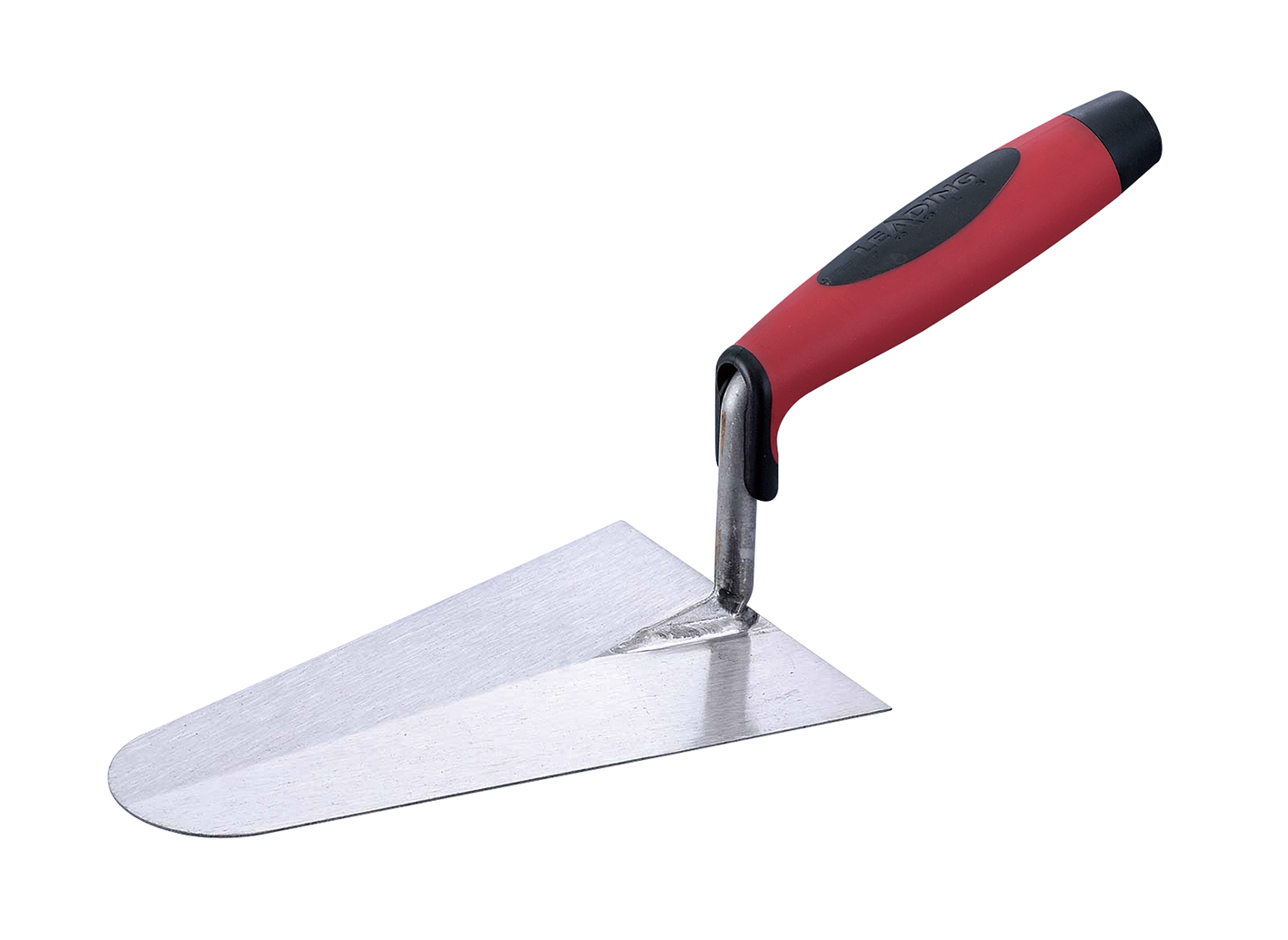
Italian Round Trowel — CO2 Welded Carbon Steel
Product Description
Italian Round Trowel — CO2 Welding Carbon Steel
Leading Tools article numbers: 222621, 223621, 224621, 225621, 226621, 227621, 228621: seven blade lengths from 140 mm to 260 mm (5.5" to 10.2"; 1" = 25.4 mm).
This is the carbon steel, CO2-welded member of the Italian Round family. Leading Tools also offers a Spot Welding Stainless Steel sibling under the identical name and the identical seven-size ladder; its art numbers are 222821–228821.
The two share blade pattern and sizing; they differ in blade material and in the welding process used to join blade and shank. Buyers cross-shopping the two should read the Selection Guide below before deciding.
The "Italian Round" name describes a blade pattern, not a certification or a grade.
| Task | Italian Round | Notes |
|---|---|---|
| Applying and spreading mortar on a bed | Yes, primary use | : |
| Renders, plaster and curved finishing passes | Yes | Renders and curved finishing |
| Working curved zones, arches and internal corners | Yes | The round tip suits rounded zones and angles |
| Working mortar into brick joints; filling gaps in stone walling | Yes | Joint mortar application and stone-wall gap filling |
| Fine masonry, pointing-material application, restoration | Yes | Fine work, pointing material and restoration, including monument work |
| Buttering head joints on standard brickwork at speed | No, use a pointed pattern | A radius cannot direct mortar into a tight head joint the way a point can |
| Scooping mortar out of a bucket | Use a Bucket Trowel | That is the tool for bucket pick-up and buttering |
| Gauging or mixing small plaster batches | Use a Gauging Trowel | Gauging trowels are the tool for gauging, mixing and patching; not for pointing |
| Prying, levering, chiseling, or tapping units down | No | Not designed for off-axis loading |
| Step | Action | Detail |
|---|---|---|
| 1 | Load the blade | Cut and lift mortar from the board with the blade held roughly flat. Load the middle of the blade, not the toe: a tapered blade carries its mass over the heel and mid-section. |
| 2 | Lay the bed | Use the standard bricklaying motion: a "cake-slicing" downward flip of the wrist runs the mortar off the blade onto the bed |
| 3 | Spread and level | Draw the blade along the bed. The rounded toe tracks continuously and does not catch a corner on surface irregularity |
| 4 | Butter the end | Invert the trowel and swipe sideways quickly so the mortar does not slide off the blade |
| 5 | Work the curve or the corner | Follow the arc of the work with the arc of the blade: this is the motion the pattern is made for; sweep rather than jab |
| 6 | Strike off surplus | Cut surplus mortar from the face with the side edge of the blade, then return it to the board |
| 7 | Clean before it sets | Rinse the blade, especially the blade-to-shank junction, before mortar hardens. Build-up there weakens the bond and can eventually cause the blade to break off |
This is the workhorse role. Load the blade from the board, place the bed with the wrist flip, then draw the blade along the run to level. Because the leading edge is a radius rather than a corner, the blade rides over minor irregularities in the previous course instead of snagging on them, which is what makes this pattern comfortable to draw for long distances.
The larger sizes (220–260 mm) carry more mortar per pick-up and cover ground faster; the trade-off is wrist load over a full shift.
The Italian round pattern suits renders and curved finishing, and the round shape suits rounded zones and angles. It handles a range of mortars, plasters and cement-based materials.
In practice this means arch soffits, curved returns, column surrounds, pool and pond detailing, and any place where a straight, cornered blade would leave a facet where the work should read as a curve. Work with a sweeping motion that follows the form, keeping the blade at a shallow angle to the surface.
The round-tipped trowel suits applying mortar into brick joints, plastering walls, and filling gaps in stone walling. Stone walling in particular presents irregular, variable-width voids that a narrow pointed trowel struggles to fill and finish in one pass; the round toe lets the mason push material in and then draw the same edge across to strike the joint.
Note the limit: a rounded profile cannot do what a point does in a tight, regular head joint on standard brickwork. For a running bond in facing brick at production speed, this is not the tool.
Restoration substrates are frequently soft, weathered, historically significant, and irreplaceable, and the working surfaces are rarely flat or square.
The rounded toe spreads contact pressure, so when mortar is applied on soft brick, terracotta or hand-made brick the face is less likely to be scratched or chipped.
This pattern suits fine and pointing work on historic masonry, and finishing and confined-space work rather than production bricklaying.
Q1. Can I use the Italian Round as my main bricklaying trowel?
For applying and spreading mortar, yes. For fast, repetitive head-joint buttering on standard facing brick, no: a rounded toe cannot direct mortar into a tight head joint the way a pointed London or Philadelphia pattern can. Most crews carry this alongside a pointed trowel rather than instead of one.
Q2. How is it different from the Bucket Trowel and from a gauging trowel?
The Bucket Trowel has a straight, square-cut front edge and is made for scooping mortar out of a bucket and buttering brick ends, while the Italian Round front edge is a continuous arc.
If the complaint is "I can't get mortar out of the bucket cleanly," the Bucket Trowel is the answer; if it is "I need to follow a curve," this is the one. It is also not a gauging trowel, which is a small, narrow round-nosed tool for mixing small quantities of plaster and patching; the catalog lists an Italian Gauging Trowel separately (857621 at 180 mm, 858621 at 200 mm); contact Leading Tools sales.
Q3. Which size should I order first, and should I take carbon steel or stainless?
Start with 180 mm (224621) and 200 mm (225621). Take carbon steel (222621–228621) if the tool is cleaned and dried daily, and stainless (222821–228821) for lime mortar, exterior and coastal work, or humid storage; the pattern, the seven sizes and the handle are the same.
Q4. The blade is rusting quickly. What is wrong?
Rust is almost always one of these: not dried after washing, stored in a damp bag or container, mortar left on the blade between uses, or repeated lime-mortar exposure without protection. Clean and dry after every use, oil the blade and clear the weld junction; for persistent rust problems, switch to the stainless version.
Q5. When should I stop using it or replace it?
If the blade goes loose at the shank, stop using the tool and replace it, because a blade-to-shank weld cannot be reliably repaired on site; also check whether mortar build-up at the junction contributed.
A dented rounded toe no longer follows a curve cleanly: minor deformation can sometimes be reshaped, but significant deformation means replacement. Never use the toe to pry or lever.
The defining feature of this trowel is what the front of the blade does not do: it does not converge to a point. Working back from the toe, the two blade sides taper inward but are joined by a continuous curve, so the leading edge presents an arc rather than a corner. The heel end is cut square, and the shank rises from a point set back from the heel.
This is a tapered blade with a rounded toe, not a broad, deep, scoop-shaped blade. The blade has a wedge profile of ordinary bricklaying proportion, finished with a radius instead of a point.
What the geometry buys you:
| Blade pattern | Toe shape | Typical use |
|---|---|---|
| Philadelphia | Square heel, wide blade, right-angle shoulder | Bricklaying with block and stone; high mortar load per pick-up |
| London (narrow / wide) | Tapered to a point, rounded heel | Precision brickwork and joint work |
| Italian Round | Continuous radius at the toe | Curved zones and corners, finishing passes, fine and restoration work, mortar spreading |
| Bucket Trowel | Straight, square-cut front edge | Scooping mortar out of a bucket; buttering brick ends |
| Gauging Trowel (incl. Italian Gauging) | Small, narrow, round-nosed | Gauging and mixing small quantities of plaster, patching; explicitly not a pointing tool |
The construction line for this version is CO2 Welding Carbon Steel. In practice that means:
Two-piece welded vs. one-piece forged. This model is a two-piece CO2 welded assembly; the one-piece forged construction is a different build.
With either construction, the blade-to-shank junction is the area that deserves attention in service: mortar allowed to build up where the handle meets the blade will weaken that bond and eventually cause the blade to break off. Care & Maintenance below turns that into a maintenance routine.
Leading Tools also offers a forged one-piece high carbon steel construction in its Bucket Trowel family (204721F 180 mm, 205721F 200 mm).
The handle is a two-tone ergonomic soft-grip handle (BF21), on a bent shank rising from the blade heel.
| Attribute | Specification |
|---|---|
| Product name | Italian Round Trowel |
| Construction line | CO2 Welding Carbon Steel |
| Blade pattern | Italian Round, tapered blade, radiused toe, no point |
| Blade material | Carbon steel |
| Blade-to-shank joint | CO2 weld (two-piece assembly) |
| Heel | Square-cut |
| Handle | Two-tone ergonomic soft-grip |
| Blade length range | 140 mm – 260 mm (5.5" – 10.2") |
| Number of sizes | 7 |
| Size increment | 20 mm |
| Article number range | 222621 – 228621 |
| Stainless sibling | Spot Welding Stainless Steel (222821–228821) |
Seven lengths, 140 mm to 260 mm, in 20 mm steps. Length drives three things at once: how much mortar you carry per pick-up, how much wrist load you accumulate over a shift, and how close you can work into a corner or a return.
| Size | ART. NR | Best suited to |
|---|---|---|
| 140 mm / 160 mm | 222621 / 223621 | Detail and finishing work, tight returns, repointing small areas, restoration where control matters more than volume |
| 180 mm / 200 mm | 224621 / 225621 | The mainstream working sizes |
| 220 mm / 240 mm / 260 mm | 226621 / 227621 / 228621 | Larger mortar load per pick-up, faster bedding over long runs, large-format units |
Both versions belong to the same Leading Tools product family and share the Italian Round pattern, the same seven sizes, and the same two-tone soft-grip handle.
| Attribute | CO2 Welding Carbon Steel (222621–228621) | Spot Welding Stainless Steel |
|---|---|---|
| Blade material | Carbon steel | Stainless steel |
| Joining process | CO2 weld | Spot weld |
| Size range | 140–260 mm, 7 sizes | 140–260 mm, 7 sizes |
| Handle | Two-tone ergonomic soft-grip | Two-tone ergonomic soft-grip |
| Corrosion behavior | Will rust if stored wet or left with mortar on the blade; requires the routine in Care & Maintenance below | High corrosion resistance and low maintenance; rinse with clean water and dry after use |
Choose the carbon steel CO2 version where the tool is cleaned and stored at the end of each day, or where the buyer already runs a carbon steel tool inventory.
Choose the stainless version for lime mortar work, exterior and coastal jobs, humid storage conditions, or any application where rust has been a problem.
| If the job is… | Reach for | Why |
|---|---|---|
| Spreading and working mortar with a curved leading edge; curved zones, corners and finishing passes | Italian Round 222621–228621 | The round tip is what the pattern is for |
| Scooping mortar out of a bucket and buttering brick ends | Bucket Trowel 202621–208621 (CO2 carbon steel), 202821–208821 (stainless), 204721F/205721F (forged) | Bucket trowel blades have a straight, square-cut front edge and are made for bucket pick-up and buttering |
| Gauging and mixing small quantities of plaster; patching | Italian Gauging Trowel (catalog 857621 / 858621; contact Leading Tools sales) | Gauging trowels are round-nosed but small and narrow; they are not pointing tools |
| Precision brick-by-brick laying, buttering head joints, working a line | A pointed London or Philadelphia pattern | A point directs mortar into a tight head joint; a radius cannot |
On the Bucket Trowel comparison specifically: the Bucket Trowel front edge is straight and square-cut; the Italian Round front edge is a continuous arc. They are different tools for different motions, and the two should not be substituted for one another.
All seven article numbers for Italian Round Trowel / CO2 Welding Carbon Steel.
| ART. NR | Blade length | Blade material | Construction | Handle |
|---|---|---|---|---|
| 222621 | 140 mm | Carbon steel | CO2 welding | Two-tone ergonomic soft-grip |
| 223621 | 160 mm | Carbon steel | CO2 welding | Two-tone ergonomic soft-grip |
| 224621 | 180 mm | Carbon steel | CO2 welding | Two-tone ergonomic soft-grip |
| 225621 | 200 mm | Carbon steel | CO2 welding | Two-tone ergonomic soft-grip |
| 226621 | 220 mm | Carbon steel | CO2 welding | Two-tone ergonomic soft-grip |
| 227621 | 240 mm | Carbon steel | CO2 welding | Two-tone ergonomic soft-grip |
| 228621 | 260 mm | Carbon steel | CO2 welding | Two-tone ergonomic soft-grip |
Carbon steel rusts when it stays wet or when wet mortar residue is left on the blade; the stainless sibling is the alternative.
The Italian Round has no honed cutting edge: the radius is a geometry feature, not a sharpened edge, so there is nothing to grind.

In compliance with EU personal data protection laws, we are committed to protecting and providing you with control over your personal data. By clicking "Accept All", you allow us to place cookies to enhance your experience on this site, help us analyze site performance and usage, and enable us to deliver relevant marketing content. You can manage your cookie settings below. By clicking "Agree" you agree to the current settings. For more information, please visit the Privacy Statement.
This website uses cookies
In compliance with EU personal data protection laws, we are committed to protecting your personal data and providing you with control over it. By clicking "Agree", you allow us to place cookies to improve your experience on this site, help us analyze site performance and usage, and allow us to deliver relevant marketing content.
By clicking "Only necessary" you allow us to place only necessary cookies. The website cannot function without these cookies and you cannot switch them off on your system. These cookies are typically set only in response to an action you perform (i.e. a service request), such as setting privacy preferences, logging in, or filling in a form. You can set your browser to block or prompt you for these cookies, but this may prevent some site features from working.