
Copyright 2026 © Leading Tools Industrial Co., Ltd.
All Rights Reserved. Website Design by Awakening Design
CATALOG TYPE
Product Categories
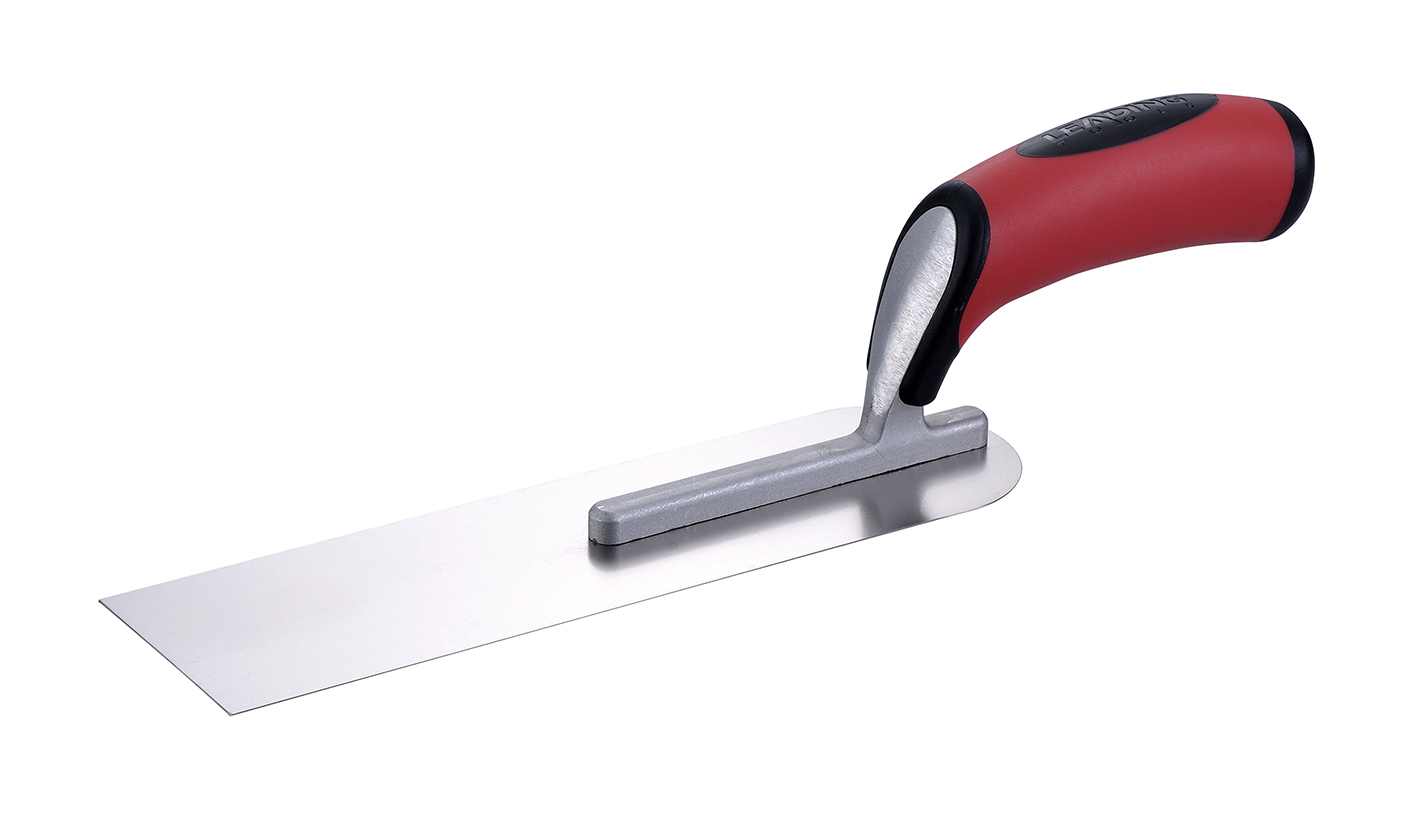
Pipe Trowel
Product Description
| Item | Detail |
|---|---|
| Product Name | Pipe Trowel |
| Article Number | 612821 |
| Blade Size | 3" × 10-1/2" (76 × 267 mm; 1" = 25.4 mm) |
| Product Family | Plaster Trowel range, Spot Riveted construction |
| Material | Stainless Steel (SS); for carbon steel, contact sales |
| Attachment | Spot Riveted |
| Handle | Soft-grip handle (F21) |
Single size. There is exactly one article number under Pipe Trowel: 612821 at 3" × 10-1/2". There is no small/medium/large ladder inside this model; the size choices sit in the neighboring families listed in the Selection Guide and Full Size Reference below.
Why the asymmetric blade matters. The rounded heel and the square tip are two different tools on one blade. The rounded heel lets the trowel be swept and pivoted across a curved or concave surface without a rear corner catching and scoring the fresh material.
The square tip lets the same trowel cut a clean straight line into a corner, along a reveal, or against a stop bead, something a fully rounded pool trowel cannot do. That combination is what separates 612821 from both the Round Corner Small Trowel family and the Pool Trowel family in the Leading Tools range.
| Situation | Use 612821? | Reason |
|---|---|---|
| Plastering around pipework, conduit and fixed obstructions | Yes, where the gap is wider than the 76 mm blade | The narrow blade and rounded heel work close to obstructions |
| Gap behind a radiator or between closely spaced pipes (under ~80 mm) | No | 612821 is 3" (76 mm) wide; use a narrower tool |
| Curved or cylindrical surfaces: columns, tank walls, pool returns | Yes | The rounded heel follows the contour without scoring |
| Work that must terminate in a straight line or square corner | Yes | The square tip cuts the line |
| Pool and spa plaster (marcite, quartz) | Yes (612821 is stainless steel) | Trowel-applied finish in a wet, chemically treated environment |
| Large open flat walls | No | A wider standard plaster trowel is faster |
| Scraping dried material off a substrate | Never | Use a scraper; prying can damage the blade and the mount |
| Step | Action | Detail |
|---|---|---|
| 1 | Break the trowel in | A new trowel is dressed before first use: rub the blade edges back with a wet stone or 400-grit aluminum oxide paper to take the sharp arris off, or wear it in on real work |
| 2 | Prepare the substrate | Clean, damp but not wet, with adequate suction; use a bonding agent on smooth or non-absorbent substrates |
| 3 | Load the blade | Load mortar or plaster from a hawk; the 10-1/2" blade length gives useful capacity per pass |
| 4 | Lay on | Apply in thin passes rather than one thick coat, working the blade at a shallow angle |
| 5 | Let it take up | Wait until the material is thumb-firm before the flattening pass |
| 6 | Flatten and close | Second pass at a flatter angle to close the surface; a light spray of water assists on a stiffening surface |
| 7 | Know when to stop | Over-troweling tears and burnishes the surface: the most important judgment in plastering is knowing when to stop |
| 8 | Clean immediately | Wash the blade before material sets; dry a carbon steel blade at once |
| Surface | Suggested Angle | Note |
|---|---|---|
| Laying on a fresh coat | 30–45° | Steep enough to control pressure, shallow enough to glide |
| Flattening pass | About 15–20° | Levels the applied coat |
| Closing / final pass | About 5–12° | Near flat with light pressure; the flatter angle closes the surface instead of cutting it |
| Convex curve (column, pipe exterior) | Slightly steeper than flat work | Maintains blade contact across the arc |
| Concave curve (tank interior, cove) | Slightly flatter than flat work | Lets the rounded heel ride the contour |
| Cutting a square termination | Tip end leading, blade near flat | Use the square tip, not the heel |
Context. A full-size plaster trowel cannot get into the space beside a service pipe, behind a bracket or into a duct reveal, and finishing those areas by hand leaves a poor surface.
Method. Work the obstructed area first, before the surrounding wall, so the narrow tool is not fighting fresh material on both sides. Lead with the square tip when cutting up to the pipe or bracket, and use the rounded heel for the sweeping pass that blends the patch into the main surface.
Limit. Measure the gap first. If the clear space is narrower than 76 mm the blade will not enter; use a narrower tool.
Context. Columns, curved retaining walls, arch soffits, tank and cistern interiors, and pool return surrounds all present a continuous radius where a square trailing corner scores the fresh material.
Method. Keep the heel end trailing through the sweep so the radiused end, not a corner, is the part following the contour. Rotate the tool with the surface rather than pushing it in a straight line. On a convex surface, carry slightly more angle to keep blade contact; on a concave surface, flatten out.
Related design logic. The Pool Trowel is built on the same principle. 612821 achieves part of that benefit through its rounded heel.
Context. Marcite and quartz pool interiors are hand-applied with a trowel onto the concrete shell and worked to a smooth, dense surface.
Method. 612821 is stainless steel, which this work requires: the environment is wet and chemically treated, and carbon steel will both rust and mark the finish. Apply and then compact the material with the trowel to drive out air and feather the edges. For the open shell surfaces, the larger Pool Trowel sizes cover ground faster; 612821 earns its place at returns, steps, fittings and the transitions where a straight edge is still needed.
Context. Water tanks, cisterns and similar structures are commonly rendered internally with cement-sand mortar as part of the waterproofing build-up.
Method. The 10-1/2" blade gives a useful straight-edge reference over short spans while the 3" width passes through restricted access openings. Build up in multiple thin passes rather than one heavy coat, which sags on vertical and curved faces. Use stainless for anything that will hold water.
Q: Does the blade have rounded corners on all four sides?
A: No. The heel at the handle end is fully rounded, and the tip end is square with defined corners.
Q: Carbon steel or stainless steel: which should I order?
A: 612821 is stainless steel; each art number corresponds to one blade material. Stainless is the choice for anything wet, for pool and spa work, and for gypsum-based finish plaster, where carbon steel can leave oxidation marks on a light-colored surface. Carbon steel is fine for dry interior cement-sand work if the crew will dry and oil the tool after every use; contact Leading Tools sales for a carbon steel blade.
Q: What is the difference between 612821 and 681821?
A: The sizes differ: 612821 is 3" × 10-1/2" and 681821 is 3-1/2" × 12". 681821 is the Pool Trowel with both ends fully rounded; 612821 is the Pipe Trowel with a rounded heel and a square tip. Order 612821 when the work also needs a straight, square termination.
Q: I still get marks on curved work. What am I doing wrong?
A: Check three things. First, the rounded heel should be the trailing end following the contour, not the square tip. Second, reduce the angle on the closing pass so the blade rides rather than cuts. Third, do not over-work the surface, because stopping in time is the core skill.
| Attribute | Detail |
|---|---|
| Blade Dimensions | 3" × 10-1/2" (76 mm × 267 mm) |
| Blade Shape | Rectangular, rounded heel end, square tip end |
| Corner Type | Heel end fully radiused; tip end square with defined corners |
| Blade Material | Stainless Steel (SS) |
| Blade Profile | Flat across the width, no camber |
| Attachment Method | Spot Riveted; contact us for mount material and joint details |
Read the geometry before you order. The end that sits under and behind the handle is a full semicircular radius, while the leading end is cut square.
| Attribute | Detail |
|---|---|
| Handle Type | Soft-grip handle (F21) |
Spot Riveted construction. The blade is joined to the mount by spot-riveting; for mount material and joint details, contact us.
| Specification | Value |
|---|---|
| Article Number | 612821 |
| Blade Size | 3" × 10-1/2" (76 × 267 mm) |
| Blade Shape | Rectangular, rounded heel / square tip |
| Material | Stainless Steel; for carbon steel, contact sales |
| Construction | Spot Riveted |
| Handle | Soft Grip |
| Primary Use | Plastering around pipework and obstructions; curved and confined-access surfaces |
612821 is stainless steel. Each art number corresponds to one blade material; for a carbon steel blade, contact Leading Tools sales. The comparison below is for reference.
| Criteria | Carbon Steel (CS) | Stainless Steel (SS) |
|---|---|---|
| Wet environments | Rusts if left wet; needs same-day drying and oiling | The standard choice for pools, spas and tanks |
| Gypsum-based plaster | Can leave oxidation marks on a light finish coat | Preferred for gypsum plaster |
| Corrosion resistance | Low: flash rust develops overnight on a damp blade | High; still requires rinsing and drying |
| Maintenance load | High: dry, then oil or a water-displacing spray after each wet use | Low: rinse and dry |
| Typical specification | Cement-sand mortar, interior dry work, abrasive fills | Pool plaster, lime plaster, exterior and wet-area work |
Recommendation. If the job involves water, pool chemistry, gypsum-based finish plaster, or outdoor exposure, the stainless 612821 is the right blade. It also avoids rust marking on light-colored finishes.
| Article No. | Model | Blade Size | End Geometry | Best Suited For |
|---|---|---|---|---|
| 601808R | Round Corner Small Trowel | 3" × 7-1/2" (76 × 191 mm) | Round corners | Tight, awkward and small-radius work; the most maneuverable option |
| 602808R | Round Corner Small Trowel | 3" × 8" (76 × 203 mm) | Round corners | Small patch and repair work |
| 603808R | Round Corner Small Trowel | 3" × 10" (76 × 254 mm) | Round corners | The longest Round Corner size; same 3" width as 612821, with fully rounded corners |
| 612821 | Pipe Trowel | 3" × 10-1/2" (76 × 267 mm) | Rounded heel, square tip | Reach plus a defined edge; work around obstructions and on curves that still needs a straight terminated line |
| 680821 | Pool Trowel | 3" × 10" (76 × 254 mm) | Both ends fully rounded | Pool and curved work with no straight edge requirement |
| 681821 | Pool Trowel | 3-1/2" × 12" (89 × 305 mm) | Both ends fully rounded | Larger than 612821, with the square tip removed |
| 682821 | Pool Trowel | 4" × 14" (102 × 356 mm) | Both ends fully rounded | Larger pool shells; more coverage per pass |
| 683821 | Pool Trowel | 4-1/2" × 16" (114 × 406 mm) | Both ends fully rounded | Open pool floors and large radii |
| 684821 | Pool Trowel | 5" × 18" (127 × 457 mm) | Both ends fully rounded | Largest coverage; least control on tight curves |
612821 or 681821? 612821 is 3" × 10-1/2"; 681821 is larger at 3-1/2" × 12". Choose 612821 when the work includes a straight terminated edge, an internal corner, or a stop that has to be cut square. Choose 681821 when every edge of the work is curved and a square corner would be a liability.
| Article No. | Blade Size | Material | Construction | Handle |
|---|---|---|---|---|
| 612821 | 3" × 10-1/2" (76 × 267 mm) | Stainless Steel | Spot Riveted | Soft Grip |
The Pipe Trowel model is offered as a single article number in a single size.
| Article No. | Model | Blade Size | Material | Construction | Handle |
|---|---|---|---|---|---|
| 601808R | Round Corner Small Trowel | 3" × 7-1/2" (76 × 191 mm) | Stainless Steel | Spot Riveted | Soft Grip |
| 602808R | Round Corner Small Trowel | 3" × 8" (76 × 203 mm) | Stainless Steel | Spot Riveted | Soft Grip |
| 603808R | Round Corner Small Trowel | 3" × 10" (76 × 254 mm) | Stainless Steel | Spot Riveted | Soft Grip |
| 680821 | Pool Trowel | 3" × 10" (76 × 254 mm) | Stainless Steel | Spot Riveted | Soft Grip |
| 681821 | Pool Trowel | 3-1/2" × 12" (89 × 305 mm) | Stainless Steel | Spot Riveted | Soft Grip |
| 682821 | Pool Trowel | 4" × 14" (102 × 356 mm) | Stainless Steel | Spot Riveted | Soft Grip |
| 683821 | Pool Trowel | 4-1/2" × 16" (114 × 406 mm) | Stainless Steel | Spot Riveted | Soft Grip |
| 684821 | Pool Trowel | 5" × 18" (127 × 457 mm) | Stainless Steel | Spot Riveted | Soft Grip |
Cleaning
Handling and Storage
| Item | Frequency | Method |
|---|---|---|
| Rust removal (carbon steel) | As needed | Fine abrasive paper (400–600 grit) or a rust eraser, then wipe clean and re-oil; replace the blade if pitting has started |
| Edge inspection | Weekly | Run a fingertip along the edge: no burrs or nicks |
| Mount inspection | Monthly | Check for movement between blade and mount; a loose mount is a repair or replacement decision, not something to work through |
| Handle inspection | Monthly | Check for cracking, loosening on the mount, or worn grip surface |
| Flatness check | Monthly | Lay the blade on flat glass: no rocking |
| Protective oiling (carbon steel, storage) | Before any extended storage | Thin coat of machine oil or camellia oil |
| Care Aspect | Carbon Steel | Stainless Steel |
|---|---|---|
| Drying after use | Immediate and non-negotiable | Prompt |
| Rust prevention | Oil or a water-displacing spray after drying | Rinse and wipe dry; chlorinated water, coastal air or prolonged soaking can still cause rust spots |
| Chemical resistance | Poor | Good, but not unlimited against prolonged acid exposure |
| Cleaning agent | Clean water | Water with mild detergent |
| Long-term storage | Dry and oiled | Dry is sufficient |
| Effect of neglect | Rust, then pitting, then replacement | Surface staining, generally recoverable |

In compliance with EU personal data protection laws, we are committed to protecting and providing you with control over your personal data. By clicking "Accept All", you allow us to place cookies to enhance your experience on this site, help us analyze site performance and usage, and enable us to deliver relevant marketing content. You can manage your cookie settings below. By clicking "Agree" you agree to the current settings. For more information, please visit the Privacy Statement.
This website uses cookies
In compliance with EU personal data protection laws, we are committed to protecting your personal data and providing you with control over it. By clicking "Agree", you allow us to place cookies to improve your experience on this site, help us analyze site performance and usage, and allow us to deliver relevant marketing content.
By clicking "Only necessary" you allow us to place only necessary cookies. The website cannot function without these cookies and you cannot switch them off on your system. These cookies are typically set only in response to an action you perform (i.e. a service request), such as setting privacy preferences, logging in, or filling in a form. You can set your browser to block or prompt you for these cookies, but this may prevent some site features from working.