
Copyright 2026 © Leading Tools Industrial Co., Ltd.
All Rights Reserved. Website Design by Awakening Design
CATALOG TYPE
Product Categories
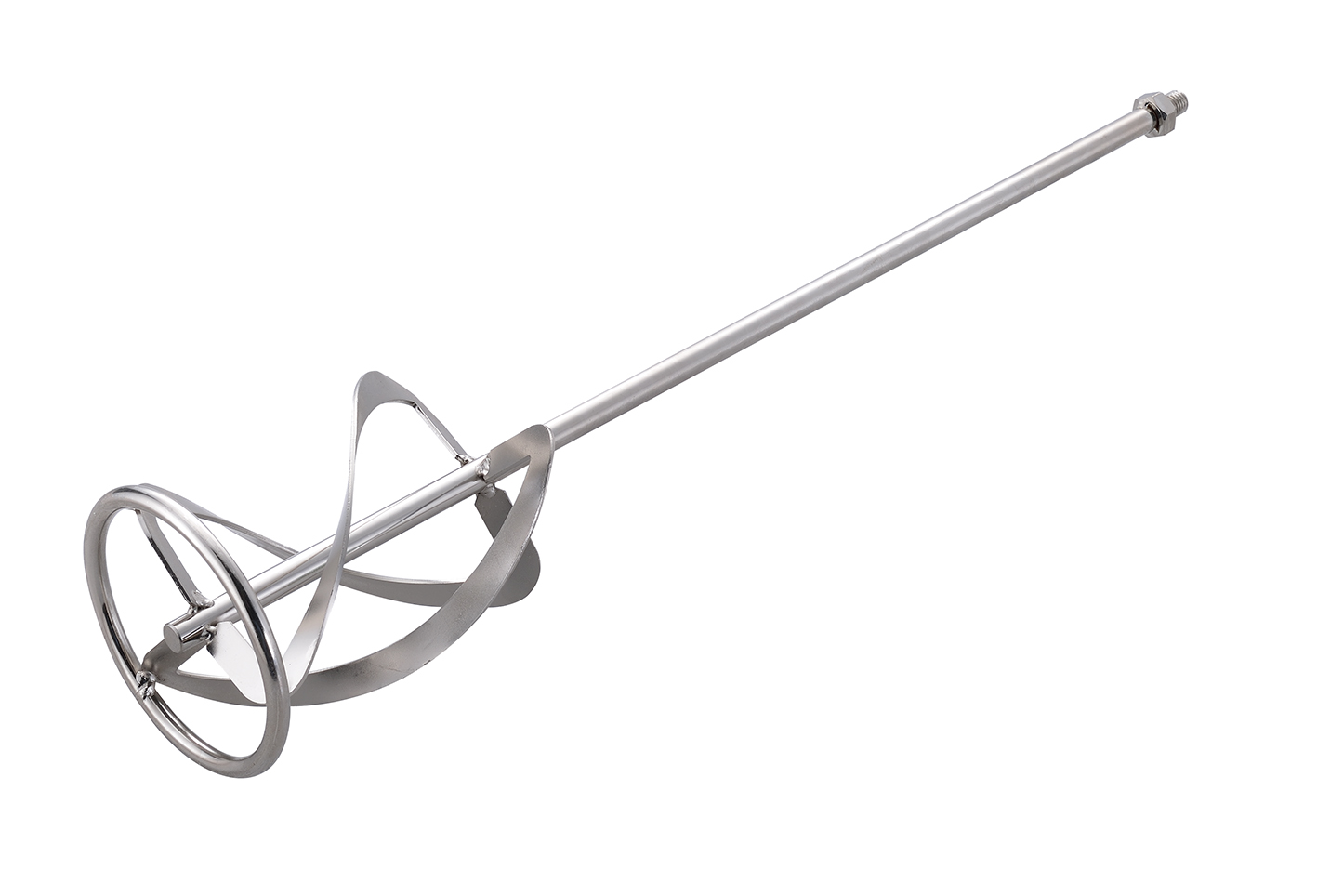
Plaster Mixer — Twin-Helix Mixing Paddle
Product Description
Plaster Mixer — Twin-Helix Mixing Paddle, 12mm Shaft & M14 Thread Series
Art. Nr: 390201, 390202, 390211, 390212
The Plaster Mixer is the highest-capacity of Leading Tools' four mixing heads. It is a twin-helix paddle: two helical blades cross on a single central shaft with a ring (hoop) around the blade tips, so the head shears the batch in two planes at once instead of simply stirring it around the bucket.
Three of the four art numbers are 600mm long and 390202 is 750mm; they differ in blade diameter (120mm, 135mm or 140mm), in length, and in how the paddle connects to the machine (a 12mm shaft for a drill chuck, or an M14 thread for a dedicated mixing machine). Rated batch capacity across the four runs from 5kg to 40kg.
Of Leading Tools' four mixing heads, the Plaster Mixer is the only one that offers M14 at 140mm blade diameter, and the only one rated above 35kg per batch.
Twin-helix blade with a ring (hoop). Two helical blades cross on the shaft, with a ring (hoop) around the blade tips.
Three blade diameters, two shaft lengths. 120mm (390201, 390211), 135mm (390202) and 140mm (390212), at 600mm length except 390202 at 750mm. The 600mm length is what lets the head reach the bottom of a tall builder's bucket while the chuck stays clear of the rim.
Two connection types on the same blade geometry. 12mm shaft models drop straight into an ordinary drill chuck; M14 models thread into a dedicated mixing machine and are made up with two open-end wrenches. Buyers can standardize on one blade profile across a mixed fleet of machines and change only the connection.
Rated by batch weight, not by "capacity class". Each art number carries its own kilogram rating: 5–25kg, 20–30kg, 15–25kg and 25–40kg respectively, so the selection decision is arithmetic rather than judgment.
Rated capacity by connection. At 140mm blade diameter, 390212 (M14) is rated 25–40kgs; at 135mm, 390202 (12mm shaft) is rated 20–30kgs; at 120mm, 390211 (M14) is rated 15–25kgs and 390201 (12mm shaft) 5–25kgs.
You can buy the batch size you actually mix. The four art numbers step the rated capacity 5–25 / 15–25 / 20–30 / 25–40kg, which means a contractor mixing 18kg batches and a crew mixing 35kg batches are not forced onto the same head. Buying one size up "to be safe" is the usual mistake, and it costs you in vortex and splash rather than buying you headroom.
The M14 models carry torque through the thread. Chuck slip under sustained load is the characteristic problem of drill-shank paddles: the chuck jaws wear, grip falls, and the shank starts to spin inside the chuck. A threaded joint has no friction step in the load path.
The 12mm-shaft models let you use machines you already own. A drill-chuck shank runs in a machine most buyers already have, which is why both connections stay in the range rather than the range moving wholesale to M14. For rental-equipment sites and where the dedicated M14 mixing machine is not the default purchase, this is the practical route.
At least 600mm of reach on every model, and 750mm on 390202. That matters for tall containers, where a short paddle forces the operator to tip the container to reach the bottom.
Rated at the top of the mixing-head range. Among Leading Tools' four mixing heads, the Plaster Mixer is the only family that reaches 40kg; the Spiral Mixing Paddle family tops out at 35kg with no M14 option, and the Wire Mixer and Mixing Paddle families stop at 10kg and 15kg respectively.
| Material | Recommended model | Rated capacity |
|---|---|---|
| Gypsum plaster / finish plaster | 390201 / 390211 | 5–25kgs / 15–25kgs |
| Render, scratch coat | 390202 / 390212 | 20–30kgs / 25–40kgs |
| Cement-sand mortar | 390202 / 390212 | 20–30kgs / 25–40kgs |
| Floor screed | 390212 | 25–40kgs |
For grout and filler, see the Wire Mixer (390401 / 390402). For tile adhesive, self-levelling compound, epoxy resin and other special materials, follow the material manufacturer's mixer recommendation.
Not recommended for: abrasive sand-heavy mixes beyond the rated capacity, where blade wear accelerates; and food, pharmaceutical or cosmetic duty, which needs an electropolished food-grade paddle rather than a construction paddle.
| Step | Action | Why |
|---|---|---|
| 1 | Measure the water into the drum first, then add the powder | Adding water to powder leaves dry pockets at the bottom that the paddle then has to break up |
| 2 | Seat the paddle: tighten the chuck fully on 12mm models, or make up the M14 joint with two open-end wrenches on M14 models | A partially seated shank is the starting condition for chuck slip |
| 3 | Place the head in the drum, then start at low speed until the powder is wetted out | Starting at working speed throws dry powder out of the drum and entrains air |
| 4 | Once the powder is taken up, follow the material manufacturer's speed; if the mix splashes or foams, slow down | Excess speed whips air into the mix and costs you strength and finish |
| 5 | Move the head up and down and around the drum on a slow path | Holding the head in one place leaves unmixed material at the wall and under the blade |
| 6 | Mix for the material manufacturer's stated mixing time | Over-mixing heats the batch and entrains air |
| 7 | Let the batch slake if the material manufacturer specifies it, then re-mix briefly | Slaking is a material instruction, not a tool instruction, follow the bag |
| 8 | Wash the head right after the batch | Set material changes the blade profile and the balance of the tool |
Different materials call for different speeds, so follow the bag rather than a single number. The general rule: start low, raise only after wet-out, and reduce speed the moment the mix starts to splash or foam.
Use the 120mm head and keep the speed low throughout. Wet-out first at the lowest speed the machine will hold without stalling, then follow the material manufacturer's mixing time; gypsum finishes lose more to entrained air than they gain from extra mixing time.
Blend the dry constituents before adding water if you are combining cement, sand and lime, so the paddle is distributing an already-uniform powder rather than doing the dry blending under water. Pre-wet the drum walls.
Keep the material moving once mixing starts: heavy sand-loaded mixes segregate if they are allowed to stand mid-batch. If you are on 390202 rather than 390212, this is the duty where chuck grip is most exposed, so check the chuck before each session.
Follow the compound manufacturer's mixing instructions. Self-levelling compounds need a specific viscosity and minimal entrained air, so run the twin-helix head at low speed, mix to the manufacturer's stated consistency rather than by eye, and do not add liquid to "help it flow"; that changes the set, not just the flow.
For any work where the paddle is not vertical and below the machine, the M14 models are the safer choice: a threaded joint cannot back out of the machine under the paddle's own weight, whereas a chuck-held shank depends on clamping force alone.
On 12mm models, confirm the chuck is fully tightened before every start rather than every session. Work in short bursts to control drips and fatigue, and have a second person stabilize the machine for sustained overhead cement work.
Q1. Which model do I order if I only mix one 20kg batch at a time with the drill I already own?
A: 390201, 120mm blade, 12mm shaft, rated 5–25kgs. Check the drill as well as the paddle: it needs a 13mm chuck for the 12mm shaft and enough torque for the batch size.
Q2. What is M14, and is it worth the extra machine cost?
A: M14 is a threaded connection (390211 and 390212) used on professional mixing machines; the thread carries the torque instead of chuck friction, so grip does not fade as the machine wears.
If you mix daily the chuck on a drill-shank paddle (390201 / 390202) is a consumable; if you mix occasionally it is not. The 135mm blade (390202) is rated 20–30kgs on a drill shaft and the 140mm blade (390212) 25–40kgs on M14.
Q3. How should I mix?
A: Put the water in first, then the powder, starting at low speed until the powder is wetted out. Follow the material manufacturer's speed and mixing time: if the mix splashes or foams, slow down; if material clings to the wall and does not circulate, raise the speed slightly. Wash the paddle straight after each batch rather than leaving material to set on it.
Q4. The paddle slows down and spins freely in the chuck, or the head vibrates. What do I check?
A: For slipping, check that the chuck was fully tightened, that the jaws are not worn or rounded, and that the batch is not above the model's rating. For vibration, check the container first, since a blade running close to the drum wall vibrates and mixes badly, then whether the helix is bent; a bent helix should be replaced, not straightened.
Q5. What is the difference between this and the Spiral Mixing Paddle?
A: Rating and connection. The Spiral Mixing Paddle family (390601–390605) spans 60–140mm and 1–35kgs on 8mm, 10mm or 12mm shafts and has no M14 option; the Plaster Mixer spans 120–140mm and 5–40kgs and offers M14 at 120mm and 140mm. If you need M14, or more than 35kg per batch, choose the Plaster Mixer.
| ART. Nr | Dia. | Shaft | Length | Capacity |
|---|---|---|---|---|
| 390201 | 120mm | 12mm | 600mm | 5-25kgs |
| 390202 | 135mm | 12mm | 750mm | 20-30kgs |
| 390211 | 120mm | M14 | 600mm | 15-25kgs |
| 390212 | 140mm | M14 | 600mm | 25-40kgs |
The head is a twin-helix: two helical blades on one shaft, crossing so that material is sheared in two planes and driven along the axis of the shaft rather than only around it. A ring (hoop) surrounds the blade tips. This is a different family from the cage-type Wire Mixer (390401 / 390402), which is used for thinner materials; the twin-helix head is used for thicker materials such as plaster, mortar and render.
12mm shaft (390201 / 390202). The 12mm shaft is a shank that clamps in a standard drill chuck. What governs use is the load path: a drill chuck transmits torque by clamping friction, so grip degrades as the jaws wear, and sustained heavy mixing is what wears them. Practical consequences: the 12mm shaft fits a 13mm (½in) chuck; there is no minimum engagement depth beyond seating the shank fully; and periodic chuck inspection is part of maintenance rather than optional.
M14 thread (390211 / 390212). M14 is the standard professional connection for mixing equipment, made up with two open-end wrenches. The M14 thread connects to the mixing machine, so torque is carried mechanically by the thread rather than by friction, and chuck wear stops being a variable. M14 is the ISO metric designation for a right-hand thread of 14mm nominal diameter with a 2.0mm coarse pitch.
| Factor | 12mm shaft (390201 / 390202) | M14 thread (390211 / 390212) |
|---|---|---|
| Torque path | Friction: chuck jaws clamp the shank | Mechanical: thread engagement carries the load |
| Rated ceiling on the largest blade | 20–30kgs (390202, 135mm) | 25–40kgs (390212, 140mm) |
| Effect of machine wear | Grip falls as chuck jaws wear | No friction step in the load path |
| Slip under sustained load | Possible under sustained heavy load | Not applicable |
| Fitting and removal | Drop in, tighten the chuck | Make up and break with two open-end wrenches |
| Machine required | Any drill with a standard chuck | Dedicated mixing machine with an M14 thread connection |
| Typical buyer | Occasional or mixed-duty work, existing machines | Daily professional mixing, heavy viscous materials |
Do you have, or will you buy, a dedicated mixing machine with an M14 thread connection?
Cross-check against drum volume rather than only against weight, so the blade turns clear of the drum wall. Use a drill or mixing machine with enough torque for the batch size.
Fine gypsum plaster and finish plaster mix well on the 120mm heads; sand-loaded render, scratch coat and cement-sand mortar shear better on the 135mm and 140mm heads because the larger diameter puts more blade edge through the batch per revolution. Soft, creamy materials such as grout and filler: see the Wire Mixer (390401 / 390402). For tile adhesive, self-levelling compound, epoxy resin and other special materials, follow the material manufacturer's mixer recommendation.
| If you have… | And your batch is… | Choose… |
|---|---|---|
| Drill with a standard chuck | 5–25kg plaster | 390201 (120mm) |
| Drill with a standard chuck, high torque | 20–30kg mortar / render | 390202 (135mm) |
| M14 mixing machine | 15–25kg plaster | 390211 (120mm) |
| M14 mixing machine | 25–40kg cement mix | 390212 (140mm) |
| Product | Art. Nr | Dia. | Shaft | Length | Capacity | What it is for |
|---|---|---|---|---|---|---|
| Plaster Mixer | 390201 / 390202 / 390211 / 390212 | 120mm / 135mm / 140mm | 12mm or M14 | 600mm / 750mm | 5–40kgs | Highest rated capacity of the four; the only family offering M14 at 140mm blade diameter |
| Wire Mixer | 390401 / 390402 | 85mm / 105mm | 8mm or M14 | 400mm / 600mm | 5–10kgs | Smallest head (105mm) among the heads that offer M14; both connections carry the same 5–10kgs rating, so the choice is machine-driven, not batch-driven |
| Mixing Paddle | 390501 | 85mm | 8mm | 500mm | 5–15kgs | Single art number, drill shaft only, no M14 |
| Spiral Mixing Paddle | 390601 / 390602 / 390603 / 390604 / 390605 | 60mm / 80mm / 100mm / 120mm / 140mm | 8mm / 10mm / 12mm | 400mm / 600mm / 760mm | 1–35kgs | Widest size ladder and the only family reaching down to 1–5kgs, but no M14 anywhere in the family; 390605 has the longest shaft of the four at 760mm |
Buying 140mm because "bigger mixes faster". A 140mm head in a bucket that is too narrow puts the blade tips near the wall, which produces vibration, accelerated blade wear and poor circulation rather than faster mixing. Size the drum first.
Buying 390202 and driving it with a light drill. 390202 is the 135mm blade on a drill-chuck shank rated to 30kg. That is the most demanding combination in the family for the machine, because the largest blade is being driven through the connection that depends on chuck grip. If the drill does not have enough torque for the batch, this is the model most likely to disappoint.
Assuming the 12mm and M14 models are the same tool with a different end. At the largest blade sizes, 390202 (135mm, 12mm shaft) is rated 20–30kgs and 390212 (140mm, M14) 25–40kgs. Specify the connection on the purchase order, not just the blade size.
Matching speed to habit rather than to material. Follow the material manufacturer's speed; gypsum and skim-type materials need a low speed to avoid whipping air into the mix. Running a gypsum finish at a general-purpose speed is a material fault, not a tool fault.
Complete art-number reference for the Plaster Mixer family.
| ART. Nr | Dia. | Shaft | Length | Capacity |
|---|---|---|---|---|
| 390201 | 120mm | 12mm | 600mm | 5-25kgs |
| 390202 | 135mm | 12mm | 750mm | 20-30kgs |
| 390211 | 120mm | M14 | 600mm | 15-25kgs |
| 390212 | 140mm | M14 | 600mm | 25-40kgs |
Four art numbers. Units are the manufacturer's own (mm, kgs); 600mm is 23.6in, 750mm is 29.5in, and 120mm / 135mm / 140mm are 4.7in / 5.3in / 5.5in at 1in = 25.4mm.
Attribute view of the same four models:
| Attribute | 390201 | 390202 | 390211 | 390212 |
|---|---|---|---|---|
| Blade diameter | 120mm | 135mm | 120mm | 140mm |
| Connection | 12mm shaft | 12mm shaft | M14 thread | M14 thread |
| Length | 600mm | 750mm | 600mm | 600mm |
| Rated capacity | 5-25kgs | 20-30kgs | 15-25kgs | 25-40kgs |
| Blade geometry | Twin-helix with ring (hoop) | Twin-helix with ring (hoop) | Twin-helix with ring (hoop) | Twin-helix with ring (hoop) |
There is no handle on this product family: the drive end is the connection itself (12mm shaft or M14 thread), and the operator's grip is on the machine, not on the tool.
Wash the head right after the batch. Gypsum and cementitious materials set on the blades, and once cured they alter the blade profile and the balance of the tool. Practical routine: run the head in a drum of clean water at low speed to flush loose material, then rinse under running water. Remove dried residue with a plastic scraper or nylon brush after soaking in warm water; do not use a steel brush or abrasive pads, which scratch the surface.
On M14 models, clean the thread specifically. Dried material in the thread is what causes cross-threading on the next make-up, and a cross-threaded M14 joint usually ends the life of the paddle rather than the machine.
Inspect the blade edges and the hoop for wear and damage before each use. Dry the head after cleaning.
12mm shaft models (390201 / 390202). Inspect both the shank and the chuck. The wear path is the chuck jaws rather than the shank: sustained heavy mixing wears the jaws, grip falls, and slip follows. Check for shank deformation and for bright rub marks where the jaws have been working. A chuck that no longer holds this paddle will also no longer hold drill bits reliably, so treat slip as a machine fault to be fixed rather than a paddle fault to be tolerated.
M14 models (390211 / 390212). Inspect the thread for deformation and for packed material. Clean with a brush before make-up. Make up and break the joint with two open-end wrenches rather than by hand or by running the machine against the joint. Replace the paddle if the thread is damaged; a damaged M14 thread can transfer the damage to the machine's thread connection.
Store dry. Hang the paddle vertically or rack it so the blades carry no load, since a bent helix cannot be trued without changing the balance of the head. Do not stack weight on stored paddles. For long storage, a light oil film on the shaft or thread limits surface oxidation.
Wear eye protection: powered mixing of dry powders throws both dust and splash, and the moment of highest exposure is the transition from wet-out to working speed. Match glove selection to the material rather than to the tool; cementitious materials are alkaline and chemically aggressive to skin over a working day. Keep the machine's speed control under positive control before the head enters the drum; starting at working speed with the head already submerged is how drums get thrown.
Service life depends far more on material abrasiveness and cleaning discipline than on calendar age. The factors that shorten it are high sand content, which abrades the blade edges, and material left to set on the blades, which changes the profile. Replace when the helix is visibly bent, when the hoop is deformed, or when the blade profile has worn enough to change how the batch circulates.
Plaster Mixer — Twin-Helix Mixing Paddle, 12mm Shaft & M14 Thread Series
Art. Nr: 390201, 390202, 390211, 390212
The Plaster Mixer is the highest-capacity of Leading Tools' four mixing heads. It is a twin-helix paddle: two helical blades cross on a single central shaft with a ring (hoop) around the blade tips, so the head shears the batch in two planes at once instead of simply stirring it around the bucket.
Three of the four art numbers are 600mm long and 390202 is 750mm; they differ in blade diameter (120mm, 135mm or 140mm), in length, and in how the paddle connects to the machine (a 12mm shaft for a drill chuck, or an M14 thread for a dedicated mixing machine). Rated batch capacity across the four runs from 5kg to 40kg.
Of Leading Tools' four mixing heads, the Plaster Mixer is the only one that offers M14 at 140mm blade diameter, and the only one rated above 35kg per batch.
Twin-helix blade with a ring (hoop). Two helical blades cross on the shaft, with a ring (hoop) around the blade tips.
Three blade diameters, two shaft lengths. 120mm (390201, 390211), 135mm (390202) and 140mm (390212), at 600mm length except 390202 at 750mm. The 600mm length is what lets the head reach the bottom of a tall builder's bucket while the chuck stays clear of the rim.
Two connection types on the same blade geometry. 12mm shaft models drop straight into an ordinary drill chuck; M14 models thread into a dedicated mixing machine and are made up with two open-end wrenches. Buyers can standardize on one blade profile across a mixed fleet of machines and change only the connection.
Rated by batch weight, not by "capacity class". Each art number carries its own kilogram rating: 5–25kg, 20–30kg, 15–25kg and 25–40kg respectively, so the selection decision is arithmetic rather than judgment.
Rated capacity by connection. At 140mm blade diameter, 390212 (M14) is rated 25–40kgs; at 135mm, 390202 (12mm shaft) is rated 20–30kgs; at 120mm, 390211 (M14) is rated 15–25kgs and 390201 (12mm shaft) 5–25kgs.
You can buy the batch size you actually mix. The four art numbers step the rated capacity 5–25 / 15–25 / 20–30 / 25–40kg, which means a contractor mixing 18kg batches and a crew mixing 35kg batches are not forced onto the same head. Buying one size up "to be safe" is the usual mistake, and it costs you in vortex and splash rather than buying you headroom.
The M14 models carry torque through the thread. Chuck slip under sustained load is the characteristic problem of drill-shank paddles: the chuck jaws wear, grip falls, and the shank starts to spin inside the chuck. A threaded joint has no friction step in the load path.
The 12mm-shaft models let you use machines you already own. A drill-chuck shank runs in a machine most buyers already have, which is why both connections stay in the range rather than the range moving wholesale to M14. For rental-equipment sites and where the dedicated M14 mixing machine is not the default purchase, this is the practical route.
At least 600mm of reach on every model, and 750mm on 390202. That matters for tall containers, where a short paddle forces the operator to tip the container to reach the bottom.
Rated at the top of the mixing-head range. Among Leading Tools' four mixing heads, the Plaster Mixer is the only family that reaches 40kg; the Spiral Mixing Paddle family tops out at 35kg with no M14 option, and the Wire Mixer and Mixing Paddle families stop at 10kg and 15kg respectively.
| Material | Recommended model | Rated capacity |
|---|---|---|
| Gypsum plaster / finish plaster | 390201 / 390211 | 5–25kgs / 15–25kgs |
| Render, scratch coat | 390202 / 390212 | 20–30kgs / 25–40kgs |
| Cement-sand mortar | 390202 / 390212 | 20–30kgs / 25–40kgs |
| Floor screed | 390212 | 25–40kgs |
For grout and filler, see the Wire Mixer (390401 / 390402). For tile adhesive, self-levelling compound, epoxy resin and other special materials, follow the material manufacturer's mixer recommendation.
Not recommended for: abrasive sand-heavy mixes beyond the rated capacity, where blade wear accelerates; and food, pharmaceutical or cosmetic duty, which needs an electropolished food-grade paddle rather than a construction paddle.
| Step | Action | Why |
|---|---|---|
| 1 | Measure the water into the drum first, then add the powder | Adding water to powder leaves dry pockets at the bottom that the paddle then has to break up |
| 2 | Seat the paddle: tighten the chuck fully on 12mm models, or make up the M14 joint with two open-end wrenches on M14 models | A partially seated shank is the starting condition for chuck slip |
| 3 | Place the head in the drum, then start at low speed until the powder is wetted out | Starting at working speed throws dry powder out of the drum and entrains air |
| 4 | Once the powder is taken up, follow the material manufacturer's speed; if the mix splashes or foams, slow down | Excess speed whips air into the mix and costs you strength and finish |
| 5 | Move the head up and down and around the drum on a slow path | Holding the head in one place leaves unmixed material at the wall and under the blade |
| 6 | Mix for the material manufacturer's stated mixing time | Over-mixing heats the batch and entrains air |
| 7 | Let the batch slake if the material manufacturer specifies it, then re-mix briefly | Slaking is a material instruction, not a tool instruction, follow the bag |
| 8 | Wash the head right after the batch | Set material changes the blade profile and the balance of the tool |
Different materials call for different speeds, so follow the bag rather than a single number. The general rule: start low, raise only after wet-out, and reduce speed the moment the mix starts to splash or foam.
Use the 120mm head and keep the speed low throughout. Wet-out first at the lowest speed the machine will hold without stalling, then follow the material manufacturer's mixing time; gypsum finishes lose more to entrained air than they gain from extra mixing time.
Blend the dry constituents before adding water if you are combining cement, sand and lime, so the paddle is distributing an already-uniform powder rather than doing the dry blending under water. Pre-wet the drum walls.
Keep the material moving once mixing starts: heavy sand-loaded mixes segregate if they are allowed to stand mid-batch. If you are on 390202 rather than 390212, this is the duty where chuck grip is most exposed, so check the chuck before each session.
Follow the compound manufacturer's mixing instructions. Self-levelling compounds need a specific viscosity and minimal entrained air, so run the twin-helix head at low speed, mix to the manufacturer's stated consistency rather than by eye, and do not add liquid to "help it flow"; that changes the set, not just the flow.
For any work where the paddle is not vertical and below the machine, the M14 models are the safer choice: a threaded joint cannot back out of the machine under the paddle's own weight, whereas a chuck-held shank depends on clamping force alone.
On 12mm models, confirm the chuck is fully tightened before every start rather than every session. Work in short bursts to control drips and fatigue, and have a second person stabilize the machine for sustained overhead cement work.
Q1. Which model do I order if I only mix one 20kg batch at a time with the drill I already own?
A: 390201, 120mm blade, 12mm shaft, rated 5–25kgs. Check the drill as well as the paddle: it needs a 13mm chuck for the 12mm shaft and enough torque for the batch size.
Q2. What is M14, and is it worth the extra machine cost?
A: M14 is a threaded connection (390211 and 390212) used on professional mixing machines; the thread carries the torque instead of chuck friction, so grip does not fade as the machine wears.
If you mix daily the chuck on a drill-shank paddle (390201 / 390202) is a consumable; if you mix occasionally it is not. The 135mm blade (390202) is rated 20–30kgs on a drill shaft and the 140mm blade (390212) 25–40kgs on M14.
Q3. How should I mix?
A: Put the water in first, then the powder, starting at low speed until the powder is wetted out. Follow the material manufacturer's speed and mixing time: if the mix splashes or foams, slow down; if material clings to the wall and does not circulate, raise the speed slightly. Wash the paddle straight after each batch rather than leaving material to set on it.
Q4. The paddle slows down and spins freely in the chuck, or the head vibrates. What do I check?
A: For slipping, check that the chuck was fully tightened, that the jaws are not worn or rounded, and that the batch is not above the model's rating. For vibration, check the container first, since a blade running close to the drum wall vibrates and mixes badly, then whether the helix is bent; a bent helix should be replaced, not straightened.
Q5. What is the difference between this and the Spiral Mixing Paddle?
A: Rating and connection. The Spiral Mixing Paddle family (390601–390605) spans 60–140mm and 1–35kgs on 8mm, 10mm or 12mm shafts and has no M14 option; the Plaster Mixer spans 120–140mm and 5–40kgs and offers M14 at 120mm and 140mm. If you need M14, or more than 35kg per batch, choose the Plaster Mixer.
| ART. Nr | Dia. | Shaft | Length | Capacity |
|---|---|---|---|---|
| 390201 | 120mm | 12mm | 600mm | 5-25kgs |
| 390202 | 135mm | 12mm | 750mm | 20-30kgs |
| 390211 | 120mm | M14 | 600mm | 15-25kgs |
| 390212 | 140mm | M14 | 600mm | 25-40kgs |
The head is a twin-helix: two helical blades on one shaft, crossing so that material is sheared in two planes and driven along the axis of the shaft rather than only around it. A ring (hoop) surrounds the blade tips. This is a different family from the cage-type Wire Mixer (390401 / 390402), which is used for thinner materials; the twin-helix head is used for thicker materials such as plaster, mortar and render.
12mm shaft (390201 / 390202). The 12mm shaft is a shank that clamps in a standard drill chuck. What governs use is the load path: a drill chuck transmits torque by clamping friction, so grip degrades as the jaws wear, and sustained heavy mixing is what wears them. Practical consequences: the 12mm shaft fits a 13mm (½in) chuck; there is no minimum engagement depth beyond seating the shank fully; and periodic chuck inspection is part of maintenance rather than optional.
M14 thread (390211 / 390212). M14 is the standard professional connection for mixing equipment, made up with two open-end wrenches. The M14 thread connects to the mixing machine, so torque is carried mechanically by the thread rather than by friction, and chuck wear stops being a variable. M14 is the ISO metric designation for a right-hand thread of 14mm nominal diameter with a 2.0mm coarse pitch.
| Factor | 12mm shaft (390201 / 390202) | M14 thread (390211 / 390212) |
|---|---|---|
| Torque path | Friction: chuck jaws clamp the shank | Mechanical: thread engagement carries the load |
| Rated ceiling on the largest blade | 20–30kgs (390202, 135mm) | 25–40kgs (390212, 140mm) |
| Effect of machine wear | Grip falls as chuck jaws wear | No friction step in the load path |
| Slip under sustained load | Possible under sustained heavy load | Not applicable |
| Fitting and removal | Drop in, tighten the chuck | Make up and break with two open-end wrenches |
| Machine required | Any drill with a standard chuck | Dedicated mixing machine with an M14 thread connection |
| Typical buyer | Occasional or mixed-duty work, existing machines | Daily professional mixing, heavy viscous materials |
Do you have, or will you buy, a dedicated mixing machine with an M14 thread connection?
Cross-check against drum volume rather than only against weight, so the blade turns clear of the drum wall. Use a drill or mixing machine with enough torque for the batch size.
Fine gypsum plaster and finish plaster mix well on the 120mm heads; sand-loaded render, scratch coat and cement-sand mortar shear better on the 135mm and 140mm heads because the larger diameter puts more blade edge through the batch per revolution. Soft, creamy materials such as grout and filler: see the Wire Mixer (390401 / 390402). For tile adhesive, self-levelling compound, epoxy resin and other special materials, follow the material manufacturer's mixer recommendation.
| If you have… | And your batch is… | Choose… |
|---|---|---|
| Drill with a standard chuck | 5–25kg plaster | 390201 (120mm) |
| Drill with a standard chuck, high torque | 20–30kg mortar / render | 390202 (135mm) |
| M14 mixing machine | 15–25kg plaster | 390211 (120mm) |
| M14 mixing machine | 25–40kg cement mix | 390212 (140mm) |
| Product | Art. Nr | Dia. | Shaft | Length | Capacity | What it is for |
|---|---|---|---|---|---|---|
| Plaster Mixer | 390201 / 390202 / 390211 / 390212 | 120mm / 135mm / 140mm | 12mm or M14 | 600mm / 750mm | 5–40kgs | Highest rated capacity of the four; the only family offering M14 at 140mm blade diameter |
| Wire Mixer | 390401 / 390402 | 85mm / 105mm | 8mm or M14 | 400mm / 600mm | 5–10kgs | Smallest head (105mm) among the heads that offer M14; both connections carry the same 5–10kgs rating, so the choice is machine-driven, not batch-driven |
| Mixing Paddle | 390501 | 85mm | 8mm | 500mm | 5–15kgs | Single art number, drill shaft only, no M14 |
| Spiral Mixing Paddle | 390601 / 390602 / 390603 / 390604 / 390605 | 60mm / 80mm / 100mm / 120mm / 140mm | 8mm / 10mm / 12mm | 400mm / 600mm / 760mm | 1–35kgs | Widest size ladder and the only family reaching down to 1–5kgs, but no M14 anywhere in the family; 390605 has the longest shaft of the four at 760mm |
Buying 140mm because "bigger mixes faster". A 140mm head in a bucket that is too narrow puts the blade tips near the wall, which produces vibration, accelerated blade wear and poor circulation rather than faster mixing. Size the drum first.
Buying 390202 and driving it with a light drill. 390202 is the 135mm blade on a drill-chuck shank rated to 30kg. That is the most demanding combination in the family for the machine, because the largest blade is being driven through the connection that depends on chuck grip. If the drill does not have enough torque for the batch, this is the model most likely to disappoint.
Assuming the 12mm and M14 models are the same tool with a different end. At the largest blade sizes, 390202 (135mm, 12mm shaft) is rated 20–30kgs and 390212 (140mm, M14) 25–40kgs. Specify the connection on the purchase order, not just the blade size.
Matching speed to habit rather than to material. Follow the material manufacturer's speed; gypsum and skim-type materials need a low speed to avoid whipping air into the mix. Running a gypsum finish at a general-purpose speed is a material fault, not a tool fault.
Complete art-number reference for the Plaster Mixer family.
| ART. Nr | Dia. | Shaft | Length | Capacity |
|---|---|---|---|---|
| 390201 | 120mm | 12mm | 600mm | 5-25kgs |
| 390202 | 135mm | 12mm | 750mm | 20-30kgs |
| 390211 | 120mm | M14 | 600mm | 15-25kgs |
| 390212 | 140mm | M14 | 600mm | 25-40kgs |
Four art numbers. Units are the manufacturer's own (mm, kgs); 600mm is 23.6in, 750mm is 29.5in, and 120mm / 135mm / 140mm are 4.7in / 5.3in / 5.5in at 1in = 25.4mm.
Attribute view of the same four models:
| Attribute | 390201 | 390202 | 390211 | 390212 |
|---|---|---|---|---|
| Blade diameter | 120mm | 135mm | 120mm | 140mm |
| Connection | 12mm shaft | 12mm shaft | M14 thread | M14 thread |
| Length | 600mm | 750mm | 600mm | 600mm |
| Rated capacity | 5-25kgs | 20-30kgs | 15-25kgs | 25-40kgs |
| Blade geometry | Twin-helix with ring (hoop) | Twin-helix with ring (hoop) | Twin-helix with ring (hoop) | Twin-helix with ring (hoop) |
There is no handle on this product family: the drive end is the connection itself (12mm shaft or M14 thread), and the operator's grip is on the machine, not on the tool.
Wash the head right after the batch. Gypsum and cementitious materials set on the blades, and once cured they alter the blade profile and the balance of the tool. Practical routine: run the head in a drum of clean water at low speed to flush loose material, then rinse under running water. Remove dried residue with a plastic scraper or nylon brush after soaking in warm water; do not use a steel brush or abrasive pads, which scratch the surface.
On M14 models, clean the thread specifically. Dried material in the thread is what causes cross-threading on the next make-up, and a cross-threaded M14 joint usually ends the life of the paddle rather than the machine.
Inspect the blade edges and the hoop for wear and damage before each use. Dry the head after cleaning.
12mm shaft models (390201 / 390202). Inspect both the shank and the chuck. The wear path is the chuck jaws rather than the shank: sustained heavy mixing wears the jaws, grip falls, and slip follows. Check for shank deformation and for bright rub marks where the jaws have been working. A chuck that no longer holds this paddle will also no longer hold drill bits reliably, so treat slip as a machine fault to be fixed rather than a paddle fault to be tolerated.
M14 models (390211 / 390212). Inspect the thread for deformation and for packed material. Clean with a brush before make-up. Make up and break the joint with two open-end wrenches rather than by hand or by running the machine against the joint. Replace the paddle if the thread is damaged; a damaged M14 thread can transfer the damage to the machine's thread connection.
Store dry. Hang the paddle vertically or rack it so the blades carry no load, since a bent helix cannot be trued without changing the balance of the head. Do not stack weight on stored paddles. For long storage, a light oil film on the shaft or thread limits surface oxidation.
Wear eye protection: powered mixing of dry powders throws both dust and splash, and the moment of highest exposure is the transition from wet-out to working speed. Match glove selection to the material rather than to the tool; cementitious materials are alkaline and chemically aggressive to skin over a working day. Keep the machine's speed control under positive control before the head enters the drum; starting at working speed with the head already submerged is how drums get thrown.
Service life depends far more on material abrasiveness and cleaning discipline than on calendar age. The factors that shorten it are high sand content, which abrades the blade edges, and material left to set on the blades, which changes the profile. Replace when the helix is visibly bent, when the hoop is deformed, or when the blade profile has worn enough to change how the batch circulates.

In compliance with EU personal data protection laws, we are committed to protecting and providing you with control over your personal data. By clicking "Accept All", you allow us to place cookies to enhance your experience on this site, help us analyze site performance and usage, and enable us to deliver relevant marketing content. You can manage your cookie settings below. By clicking "Agree" you agree to the current settings. For more information, please visit the Privacy Statement.
This website uses cookies
In compliance with EU personal data protection laws, we are committed to protecting your personal data and providing you with control over it. By clicking "Agree", you allow us to place cookies to improve your experience on this site, help us analyze site performance and usage, and allow us to deliver relevant marketing content.
By clicking "Only necessary" you allow us to place only necessary cookies. The website cannot function without these cookies and you cannot switch them off on your system. These cookies are typically set only in response to an action you perform (i.e. a service request), such as setting privacy preferences, logging in, or filling in a form. You can set your browser to block or prompt you for these cookies, but this may prevent some site features from working.