
Copyright 2026 © Leading Tools Industrial Co., Ltd.
All Rights Reserved. Website Design by Awakening Design
CATALOG TYPE
Product Categories
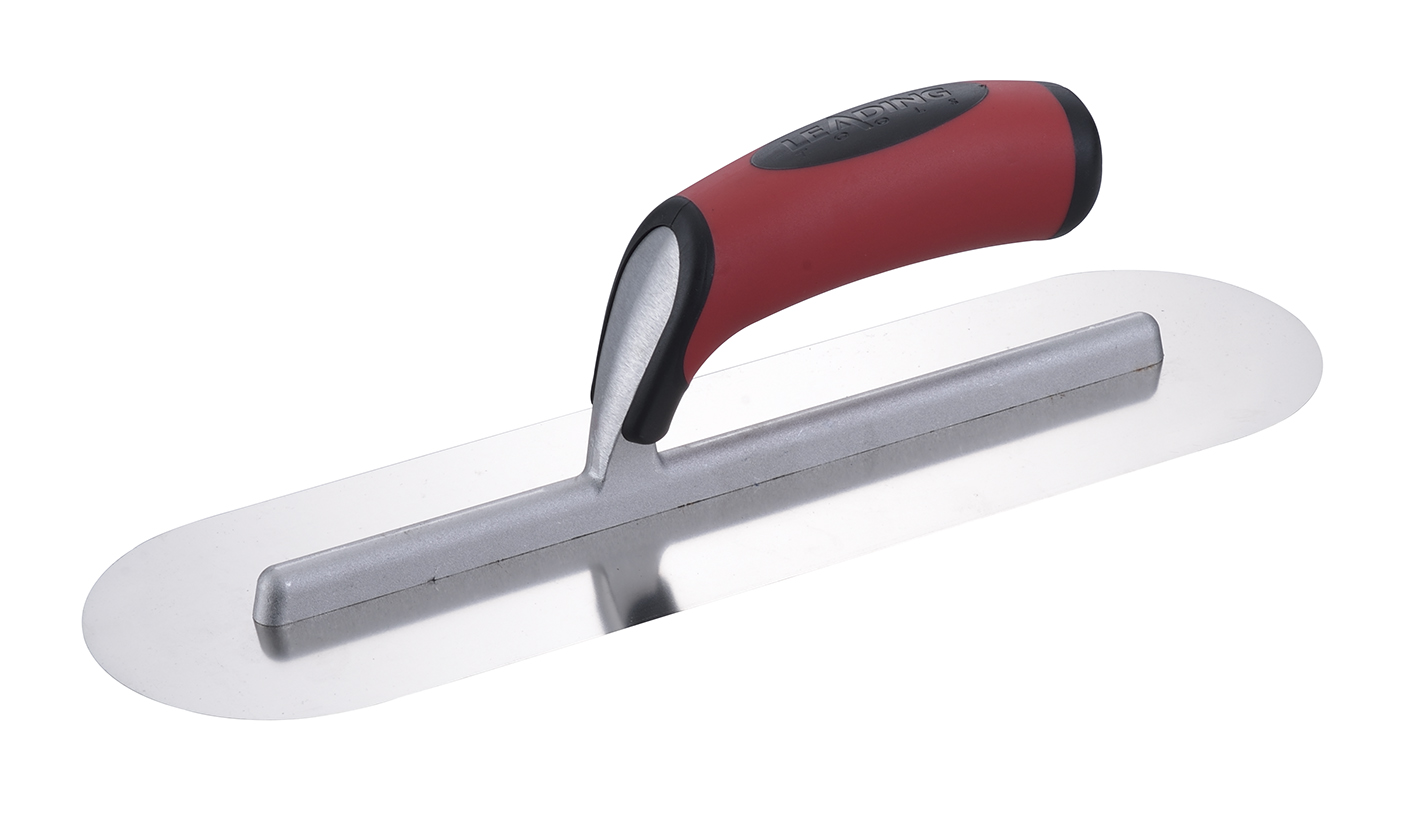
Pool Trowel
Product Description
Pool Trowel: a fully rounded finishing trowel built for the continuously curved interiors of swimming pools, spas, fountains and other water-retaining structures.
| Item | Specification |
|---|---|
| Product name | Pool Trowel |
| Product family | Plaster Trowel range |
| Article numbers | 680821, 681821, 682821, 683821, 684821 |
| Reference size | 680821 — 3" × 10" (76 × 254 mm) |
| Construction | Spot Riveted |
| Material | Stainless steel; for carbon steel, contact sales |
| Quality statement | Quality Consistent |
680821 is the smallest of the five sizes and the detail size of the family; 684821 (5" × 18", 127 × 457 mm) is the largest. All five share one blade geometry, one handle and one mounting method; they differ only in blade width and length, so a contractor can standardize on the family and change size by the job without changing technique.
This shape is also called a marcite trowel (after the cement-and-marble-dust pool plaster it is normally used on) and a fully rounded finishing trowel.
The rounded end is what makes pool work possible, not a styling choice. A pool interior has almost no straight lines: the floor-to-wall cove is a radius, the walls curve in plan, the steps and benches are radiused at every edge, and spillways and swim-outs are curved in two directions at once.
A square-cornered trowel entering that geometry lifts one corner off the surface and drives the other into it. The corner leaves a drag line or a gouge in the coat, and the tool cannot be swept continuously around a curve. The rounded end simply stays in contact.
Spot Riveted mounting. The blade is joined to the mount by spot-riveting; for mount material and joint details, contact us.
Stainless steel for a permanently wet basin. All five article numbers are stainless steel, which suits the corrosion-first buyer. A buyer who needs carbon steel can contact Leading Tools sales. See Selection Guide below.
Five sizes cover detail work and open wall work from one family. The 3" × 10" (680821) handles steps, coves, spillways and patch repairs; the 5" × 18" (684821) covers open wall and floor area. Because the handle, the mounting and the blade geometry are identical across the range, a crew that trains on one size is trained on all five.
| Situation | Recommended size | Why |
|---|---|---|
| Floor-to-wall cove radius | 680821 or 681821 | The rounded end holds contact with both planes through the radius |
| Curved pool walls, open area | 683821 or 684821 | Fewer passes over open area; the rounded ends still prevent drag lines |
| Steps, benches, swim-outs | 680821 | Smallest blade, tightest radii, least risk of scoring a step nose |
| Spillways, weirs, water-feature detail | 680821 | Curved in two directions; needs the shortest blade |
| Patch repair and crack filling | 680821 | Material can be pressed into the opening, struck off and feathered into the surrounding coat |
| Fountains, reflecting pools, koi ponds | Size by area, 680821 for detail | Same curved, water-retaining geometry as a pool |
| Coping and pool deck (non-submerged) | 682821–684821 | Larger area, and corrosion pressure is lower outside the basin |
| Step | Action | Notes |
|---|---|---|
| 1 | Prepare the substrate | The basin shell must be clean and correctly prepared before plastering; substrate preparation controls bond and service life |
| 2 | Mix to a workable but low-water consistency | Excess water weakens the coat and increases shrinkage risk |
| 3 | Apply in two coats | Pool plaster is applied in two coats: apply the first coat, let it take up, then apply the second |
| 4 | Work to the total thickness specified by the finish manufacturer | Follow the manufacturer's thickness for an even coat |
| 5 | Start at the cove, work upward | Keep the rounded end in contact with both the floor and the wall so the radius comes out unbroken |
| 6 | Overlap passes | Overlap each pass into the previous one so no ridge is left standing between passes |
| 7 | Add extra material at radii and corners, then refine | Load the corner first, then work it down with a lighter hand to form the radius |
| 8 | Time the hard trowel pass | Start once the surface has lost its surface water and takes pressure, and follow the plaster manufacturer's timing; a well-timed hard trowelling gives the dense, smooth face, while trowelling a surface that has already hardened too far causes discoloration |
| 9 | Do not add water to the surface | Do not spray or splash water onto the coat while finishing; do not over-trowel; both draw water to the surface, weaken it and promote cracking |
| 10 | Clean the blade before the material sets | Hardened material on the blade will track-mark the next pass |
The two rules in steps 8 and 9 are the ones that separate a good pool finish from a bad one: over-troweling and adding water at the surface are causes of a weak, crack-prone finish, and hard trowelling has a window that must be hit rather than a technique that can be applied at any time.
The cove is the radius where the floor meets the wall, and it is where a square-cornered trowel fails first. Load the blade with a moderate amount of material and start in the cove, drawing upward so the rounded end stays in contact with the floor and the wall at the same time.
Because the end is radiused, the tool tracks around the radius rather than stepping across it. Where the radius needs building out, put extra material in first and then refine it with a lighter hand; this is how to produce a rounded edge. Then continue up the wall in overlapping passes, apply the second coat once the first has taken up, and bring the total to the thickness specified by the finish manufacturer.
Step nosings, benches and swim-outs are the most-touched and most-visible surfaces in a pool, and they are all radiused. Use the 3" × 10" (680821): a shorter blade can stay in contact through a tight radius that a 16" or 18" blade will bridge.
Work in thin, controlled passes with light pressure, and work from the back of the tread toward the nose so material is carried forward rather than pulled off the edge. The rounded end is what prevents the classic defect: a scored or chipped step nose caused by the corner of a square trowel.
Repair work is where the 3" size earns its keep.
The repair sequence is: press the patch material into the crack or spall with the trowel, working out air pockets; strike off the excess with the edge of the blade; texture with a damp sponge if the surrounding surface has texture; then smooth with the trowel and feather the edge of the patch out into the surrounding old plaster so the repair does not read as a hard-edged rectangle. The rounded end of this blade is an advantage in feathering; there is no corner to leave a witness line at the edge of the repair.
Decorative fountains, reflecting pools, koi ponds and waterfall weirs have the same defining characteristic as a swimming pool: curved, water-retaining geometry finished in a dense cementitious coat. The same tool, the same two-coat method and the same finishing discipline apply. The 680821 is usually the working size here because water-feature radii are tighter than pool radii.
Q1. Should I buy the carbon steel or the stainless steel version for pool interiors?
A. Stainless steel is generally recommended for the wet, alkaline pool environment because of its high corrosion resistance and low maintenance; chlorinated water or prolonged soaking can still cause rust spots, so rinse with clean water and dry after use.
The listed article numbers are stainless steel. Some buyers prefer carbon steel; each article number corresponds to one blade material, so contact Leading Tools sales for carbon steel.
Q2. Why are both ends of the blade rounded?
A. So the tool can be swept continuously around a curve without a corner catching or leaving gouges in the coat. Pool interiors are made almost entirely of curves such as the cove, the walls and the step noses, so a square corner has nowhere to sit flat.
Q3. Which size should I order first?
A. 680821 (3" × 10") if the work is steps, coves, spillways and repairs; 683821 (4-1/2" × 16") or 684821 (5" × 18") if the work is open wall and floor area. All five sizes share the same handle and construction, so technique transfers between them.
Q4. Material keeps sticking to the blade and baking on. Is that the tool?
A. This is a known problem in pool plastering. Wash the blade with clean water before the material sets rather than after, and brush out the rounded ends and the mount line where material collects.
Q5. What is the difference between this and the Round Corner Small Trowel?
A. The Round Corner Small Trowel (601808R, 602808R, 603808R) is a compact rectangle with rounded corners, for tight and confined work. The Pool Trowel is a blade with both ends fully rounded, for sweeping along a curve. They complement each other on a pool job, but the Small Trowel is not a substitute on a cove or a curved wall.
Fully Rounded Ends
Material: Stainless Steel (SS)
Material: Carbon Steel (CS)
| Specification | Value |
|---|---|
| Article number | 680821 |
| Blade width | 3" (76 mm) |
| Blade length | 10" (254 mm) |
| Construction | Spot Riveted |
| Material | Stainless Steel |
| Handle | Soft-grip handle (F21) |
| Article Nr | Size | Where it earns its place |
|---|---|---|
| 680821 | 3" × 10" (76 × 254 mm) | Steps, benches, coves, spillways, swim-outs, patch and crack repair: the tightest geometry and the most precise pressure control |
| 681821 | 3-1/2" × 12" (89 × 305 mm) | Spa interiors, small pools, bench and seat areas, second tool for a two-trowel crew |
| 682821 | 4" × 14" (102 × 356 mm) | General residential pool walls: the balance point between coverage and control on a curved wall |
| 683821 | 4-1/2" × 16" (114 × 406 mm) | Large residential and small commercial basins, long continuous wall passes |
| 684821 | 5" × 18" (127 × 457 mm) | Commercial pools and open floor area, maximum coverage per pass |
Practical rule: the tighter the radius, the shorter the blade. A long blade cannot stay in contact through a small-radius cove or a step nose; a short blade on an open wall costs passes.
The five article numbers on this page are stainless steel, and each article number corresponds to one blade material; for carbon steel, contact Leading Tools sales. Which material is right for a pool interior depends on the working environment and the maintenance routine.
| Stainless steel | Carbon steel | |
|---|---|---|
| Best for | Pool interiors in a permanently wet, alkaline environment | Dry or non-submerged work where the blade is wiped dry and oiled after every use |
| Reasoning | High corrosion resistance and low maintenance in the alkaline, wet environment; chlorinated water or prolonged soaking can still cause rust spots, so rinse with clean water and dry after use | Carbon steel blades cost less, but must be wiped dry and given a thin coat of tool oil after use, or they will rust |
How to specify in practice:
| Feature | Pool Trowel (680821–684821) | Small Trowel, Round Corner (601808R / 602808R / 603808R) | Plaster Trowel, Spot Riveted (631821–678821) |
|---|---|---|---|
| Blade shape | Fully rounded both ends | Compact rectangle with rounded corners | Standard rectangle, square corners |
| Blade sizes | 3"×10" to 5"×18" | 3"×7-1/2", 3"×8", 3"×10" | 3"×11" to 4-3/4"×18" |
| Construction | Spot Riveted | Spot Riveted | Spot Riveted |
| Materials | Stainless | Stainless | Stainless |
| Best use | Pool and water-feature interiors, coves, curved walls, steps | Tight areas, small patches, confined corners | General flat plastering and rendering |
For pool interiors the Pool Trowel is the dedicated shape. The Small Trowel is a useful complement in confined areas at step risers and behind fittings. A square-cornered plaster trowel is the wrong tool inside the basin for the reason given under Product Advantages above: the corner scores the coat.
All five article numbers in the range. All are Stainless Steel, Spot Riveted, with the soft-grip handle (F21); for carbon steel, contact sales.
| Article Nr | Width | Length | Metric | Material options | Handle | Best for |
|---|---|---|---|---|---|---|
| 680821 | 3" | 10" | 76 × 254 mm | Stainless Steel | Soft-grip handle (F21) | Steps, benches, coves, spillways, patch and crack repair |
| 681821 | 3-1/2" | 12" | 89 × 305 mm | Stainless Steel | Soft-grip handle (F21) | Spa interiors, small pools, bench areas |
| 682821 | 4" | 14" | 102 × 356 mm | Stainless Steel | Soft-grip handle (F21) | Medium residential pools, continuous wall passes |
| 683821 | 4-1/2" | 16" | 114 × 406 mm | Stainless Steel | Soft-grip handle (F21) | Large residential and small commercial pools |
| 684821 | 5" | 18" | 127 × 457 mm | Stainless Steel | Soft-grip handle (F21) | Large commercial pools, maximum coverage |
Metric values are conversions at 1" = 25.4 mm; nominal sizes are stated in inches.
| Step | Action | Why |
|---|---|---|
| 1 | Wash the blade with clean water before the material sets | Set cementitious material on the blade is abrasive and will track-mark the next job |
| 2 | Brush the face, the blade-to-mount line and both rounded ends with a stiff brush | Material collects at the radii and at the mount line, which are the hardest areas to clean once hard |
| 3 | Dry the tool completely, especially around the mounting points | Trapped water around the mounting points can start corrosion on a carbon steel blade |
| 4 | Wipe a light oil film onto a carbon steel blade | Carbon steel blades need an oil film in a wet working environment |
| 5 | Store dry, off the poolside | Poolside storage is humid and chemically loaded |
| Interval | Task |
|---|---|
| Weekly in use | Check the mount for any movement or looseness |
| Monthly | Deep clean the blade; inspect the rounded ends for deformation or nicks; check that the mount is straight |
| Quarterly | Full inspection; retire any blade with a permanent set or a damaged end |
Cementitious material sticking and hardening onto the blade face, "plaster burn", is a common problem in pool work. The practical control is time: wash the blade before the material sets rather than after.
Pool mixes are deliberately low in water, which loads the blade and the mounting harder than a normal render mix does. Check before each session that the blade has no permanent set and that the mount is tight; a blade that has taken a permanent bow will not produce an even, closed surface. Do not force the tool to the point of deforming the blade or straining the mount.

In compliance with EU personal data protection laws, we are committed to protecting and providing you with control over your personal data. By clicking "Accept All", you allow us to place cookies to enhance your experience on this site, help us analyze site performance and usage, and enable us to deliver relevant marketing content. You can manage your cookie settings below. By clicking "Agree" you agree to the current settings. For more information, please visit the Privacy Statement.
This website uses cookies
In compliance with EU personal data protection laws, we are committed to protecting your personal data and providing you with control over it. By clicking "Agree", you allow us to place cookies to improve your experience on this site, help us analyze site performance and usage, and allow us to deliver relevant marketing content.
By clicking "Only necessary" you allow us to place only necessary cookies. The website cannot function without these cookies and you cannot switch them off on your system. These cookies are typically set only in response to an action you perform (i.e. a service request), such as setting privacy preferences, logging in, or filling in a form. You can set your browser to block or prompt you for these cookies, but this may prevent some site features from working.