
Copyright 2026 © Leading Tools Industrial Co., Ltd.
All Rights Reserved. Website Design by Awakening Design
CATALOG TYPE
Product Categories
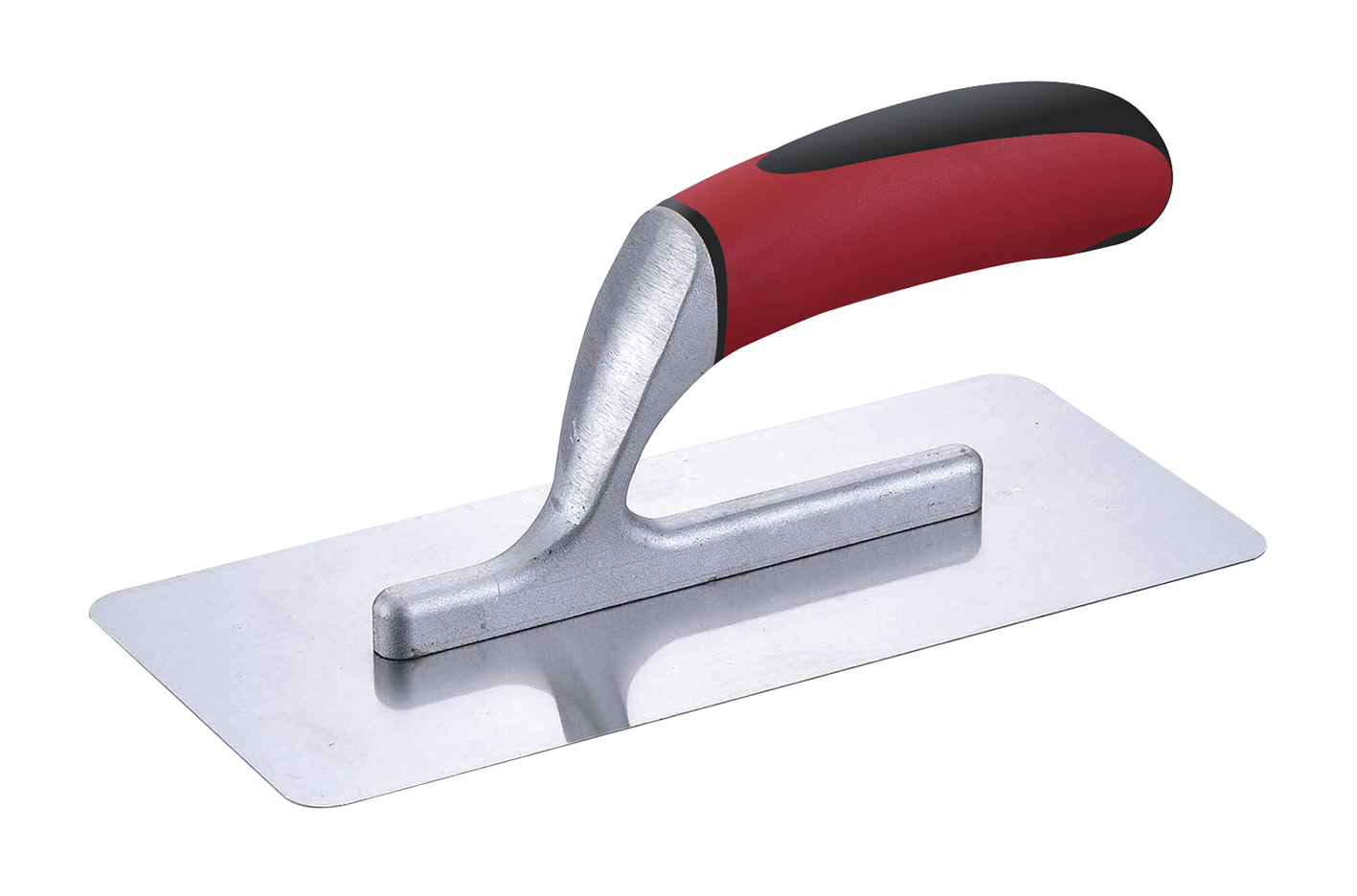
Round Corner Small Trowel
Product Description
Product name: Small Trowel (Round Corner), marketed as the Round Corner Small Trowel.
Range attributes: Spot Riveted · Round Corner · Stainless steel on the listed art numbers (carbon steel: contact sales) · Quality Consistent.
| Art. Nr | Size (W × L) | Metric equivalent |
|---|---|---|
| 601808R | 3" × 7-1/2" | 76 × 191 mm |
| 602808R | 3" × 8" | 76 × 203 mm |
| 603808R | 3" × 10" | 76 × 254 mm |
Positioning. This is a narrow, short-blade plastering and finishing trowel built for the work a full-size 11"–18" plaster trowel physically cannot reach: the band around a door or window reveal, the strip beside a switch box or pipe penetration, a step nosing, a cove between floor and wall, and any curved or radiused face where a square corner would leave a mark.
The Small Trowel range is the Leading Tools rounded-corner version, offered at three blade lengths (601808R, 602808R, 603808R) on one 3" width. All three lengths share the same blade width, the same Spot Riveted mounting and the same soft-grip handle, so a buyer can standardize handling across the range and choose length by radius and by how much surface each pass has to cover.
On a standard square-cornered plaster trowel, the leading corner is a point. When that point meets a surface at an angle, on a radius, at the start of a pass, or when the wrist rotates mid-stroke, contact pressure concentrates at that point and the corner digs, leaving a scored line the plasterer then has to work out. Rounding the corner spreads that contact over an arc, so the corner does not dig in and the pass leaves no corner marks.
A 3" × 7-1/2" blade goes where an 11"–18" plaster trowel cannot: inside a window reveal, along a step riser, into a cove, between two fittings, around a pipe penetration. The short blade also lets the operator feel what the substrate is doing through the tool, which matters on friable or repaired backgrounds where a long blade would simply bridge a soft spot.
The listed art numbers are stainless steel, and each art number corresponds to one blade material; a contractor who needs this shape in carbon steel can contact Leading Tools sales. Carbon steel costs less, but must be wiped dry and given a thin coat of tool oil after use, or it will rust; stainless steel is the blade to use wherever lime, pool plaster or standing water are involved, and it needs only a rinse and wipe-dry.
Rounded and bevelled edges reduce drag as the blade moves, while square ends are better at scraping and lifting material. Lower drag matters most in two situations: on a curved face, where drag is felt more sharply because the contact patch is short, and on thin finishing coats, where drag is what pulls material back off the wall.
Leading Tools already builds the square-cornered equivalent: the Spot Riveted Plaster Trowel range starting at 631821, 3" × 11". The Small Trowel range is not a smaller version of it; it is the tool for the passes the square trowel damages. The Selection Guide below sets out the decision.
| Situation | Use this tool? | Note |
|---|---|---|
| Detail finishing at door and window frames, switch boxes, pipe penetrations | Yes, this is the core job of this trowel | Choose 601808R or 602808R |
| External corners (arris) | No, not for forming a crisp arris | Use a purpose-made external corner trowel for a crisp arris |
| Internal corners | Yes, for finishing the return | For cutting a crisp internal angle, a dedicated internal corner tool is the specialist choice |
| Radiused faces, coves, step nosings | Yes, no corner marks on the pass | Use the shortest length that completes the pass |
| Pool and spa interior finishing | Yes, in stainless steel only | Detail areas; for open pool floors use the Pool Trowel |
| Microcement, Venetian plaster, thin decorative coats | Yes, the rounded corners leave no corner marks in thin coats | Stainless preferred for release and cleanliness |
| Large flat wall areas | No | Use a full-size plaster trowel; 3" is too narrow to be productive |
| Scraping off, chopping out, lifting hardened material | No | A square-ended tool is the right shape for scraping |
| Mixing small batches or loading from a bucket | No | Use a gauging or bucket trowel |
| Step | Action | Why |
|---|---|---|
| 1 | Wet the blade lightly before the first pass and keep it damp during work | A damp blade glides instead of dragging and is less likely to leave a line |
| 2 | Load a modest amount of material onto the blade | The blade is small; over-loading it forces you to work too fast to place the material accurately |
| 3 | Present the blade at a slight angle to the surface rather than flat-on | A slight tilt is the working attitude for trowel finishing; too steep a tilt cuts a line into the surface |
| 4 | At an internal corner, run the blade edge along the line of the corner, then move with even pressure and a constant angle | This keeps the return flat and free of corner marks |
| 5 | Keep the pass moving; do not stop and restart in the middle of a visible face | Stopping mid-pass leaves a butt mark that has to be blended out |
| 6 | Finish the corner with a lightly damp, not soaked, brush drawn along the angle | The damp brush tightens the corner without dragging material out of it |
| 7 | Clean the blade before the material starts to set, especially at the corner radii | Set material in the corner radius is the hardest to remove and changes how the corner behaves |
Overlap rule. Overlap each pass by roughly one third of the blade width. The overlap is what stops a visible seam forming between passes, and on a small blade the passes are short enough that skipping the overlap shows immediately.
This is the core application. Work the band that the large trowel has left short: the reveal of a door or window, the margin around a switch box or socket, the collar around a pipe or duct penetration, the strip behind a radiator bracket.
Take the material off a hawk in small loads, lay it, and level it with the length of the blade rather than the corner. Because the blade is short, use the substrate itself as your reference: run one edge of the blade against the frame or the fitting and let the other edge carry the finish out into the wall. If the finish coat is thin, keep the blade damp: dry-blade drag is what lifts a thin coat back off the wall.
This trowel is not the tool for forming a crisp external corner (arris); use a purpose-made external corner trowel. For internal corners, this trowel will finish and flatten the faces of the return, with pressure and angle held constant along the run, but a purpose-made 90° internal corner tool is what cuts a crisp internal angle in one pass.
On a curve, the pass is short and the contact patch moves continuously, so two things matter more than they do on a flat wall: the blade must stay in contact through the whole arc, and the corner must not be allowed to lead.
Draw the tool in one continuous motion along the curve and end the pass at a natural break: an edge, a joint, an angle: rather than stopping in the middle of a visible face. Choose the length by the radius: the tighter the curve, the shorter the blade that can stay in contact, which is the argument for 601808R over 603808R on tight work.
Column wrapping. On a cylindrical column, divide the surface into four quadrants and lay each quadrant with one continuous top-to-bottom pass. Working this way puts every join on a quadrant line instead of in the middle of a face, where a stop-and-restart mark would be visible from any angle.
Pool interior plaster (marcite / quartz systems) is cement-based and alkaline. On a pool job the Small Trowel is the detail tool: steps and benches, the cove where the floor meets the wall, the radius around fittings, and any tight transition where the larger Pool Trowel cannot follow the curve.
Use stainless steel only: a carbon blade will rust in this environment and the risk of iron staining the finish is not acceptable here. Stainless steel has high corrosion resistance, but chlorinated water and prolonged soaking can still cause rust spots, so rinse with clean water and dry after use.
The rounded corners suit microcement and Venetian plaster because they do not leave corner marks in a coat that is only a millimeter or two thick and cannot be sanded flat afterwards. Keep the blade clean between passes: dried material on the blade transfers straight into the finish, and use stainless steel for lime-based systems so no iron reaches the surface.
Q1. What is the actual difference between the round corner and a normal plaster trowel?
A. Only the corner shape and the blade size. A square corner concentrates pressure, which is good for cutting into material but can mark a finished surface. A rounded corner spreads the contact, which is why round-corner trowels are used for finishes that must show no corner marks.
Q2. Which of the three lengths should a first-time buyer order?
A. 602808R (3" × 8") as the general detail length. Choose 601808R (3" × 7-1/2") if the work is mostly tight curves and confined pockets, and 603808R when passes are long and the curve is generous.
Q3. Carbon steel or stainless steel?
A. Choose stainless for lime, pool and wet areas, thin decorative finishes, and any buyer who will not maintain the tool daily. The listed art numbers are stainless steel. For cement-and-sand work in dry conditions, if you will dry and oil the blade after every wet use, carbon steel is an option; contact Leading Tools sales for it.
Q4. The tool is still catching and scoring the surface. What is wrong?
A. Check three things in order. First, the corner radius: if a corner has been crushed or worn flat, the tool behaves like a square-cornered trowel. Second, a dry blade drags, so keep it lightly damp. Third, too steep an angle cuts a line, so keep the blade flatter and hold the angle constant through the pass.
Q5. Is this the right tool for a whole swimming pool?
A. No, it is the detail tool for the pool. Use it for steps, benches, the floor-to-wall cove and tight curves. For open pool floors and walls, use the larger Leading Tools Pool Trowel (3" × 10" up to 5" × 18").
| Situation | What a square corner does | What the round corner does |
|---|---|---|
| Radiused or curved face | Contacts at a point and concentrates pressure; digs a score line | Spreads contact over an arc; no corner mark |
| Change of direction mid-pass | Catches on setting material; leaves a butt mark to blend out | Sweeps through the direction change |
| Continuous pass around a column or cove | Corner catches at each transition | Continuous pass with no corner witness marks |
| Scraping and lifting material | Better, a square end is the right shape for this | Poorer, this is the trade-off you accept |
The last row is the limit of the design: the same rounding that stops the tool marking a finish also makes it worse at cutting into and lifting material.
| Specification | 601808R | 602808R | 603808R |
|---|---|---|---|
| Blade width | 3" (76 mm) | 3" (76 mm) | 3" (76 mm) |
| Blade length | 7-1/2" (191 mm) | 8" (203 mm) | 10" (254 mm) |
| Corner form | Round | Round | Round |
| Mounting | Spot riveted | Spot riveted | Spot riveted |
| Blade material | SS | SS | SS |
| Handle | Soft-grip handle | Soft-grip handle | Soft-grip handle |
All figures in this table are nominal specifications. Conversion at 1" = 25.4 mm, rounded to the nearest millimeter.
| Art. Nr | Size | Choose it for |
|---|---|---|
| 601808R | 3" × 7-1/2" | The tightest radii, the most confined pockets, step nosings, small niches, work where the hand must be close to the surface |
| 602808R | 3" × 8" | The general-purpose detail length; reveals, bands, patch work, most corner and edge finishing |
| 603808R | 3" × 10" | Longer uninterrupted passes; larger radii; narrow but long bands where fewer joins mean fewer marks |
Rule of thumb. Use the shortest blade that still lets you complete the pass comfortably. A short blade gives more control and covers less area; a longer blade is more productive but concentrates force and is harder to keep in contact on a tight curve.
The listed art numbers are stainless steel. Each art number corresponds to one blade material; for a carbon steel blade, contact Leading Tools sales. The comparison below is for reference.
| Criterion | Carbon Steel (CS) | Stainless Steel (SS) |
|---|---|---|
| Corrosion resistance | Low, will rust if left wet | High; chlorinated water or prolonged soaking can still cause rust spots |
| Maintenance burden | Dry thoroughly and oil after every wet use; a daily habit, not an occasional one | Rinse with clean water and wipe dry |
| Lime plasters | Not recommended, rust staining risk | Correct choice |
| Pool and wet-area work | Not recommended | Correct choice; rinse and wipe dry after use |
Recommendations.
| Factor | Round Corner (601808R range) | Square Corner (e.g. 631821, 3" × 11") |
|---|---|---|
| Radiused and curved faces | Designed for this, no corner marking | Corner will catch and score |
| Flat wall areas | Works, but a wider blade is more productive | The primary geometry for flat work |
| Forming a crisp internal angle or arris | Not its job; use a purpose-made corner tool for a crisp arris | Better, a square end cuts and lifts |
| Continuous pass through a direction change | Smooth | Catches at the corner |
| Scraping and material removal | Not its job | Better |
Decision. If most of the work is curved, radiused, or in confined detail areas, buy the round corner. If most of the work is flat wall in open areas with crisp corners to be formed, buy the square-cornered plaster trowel. Many finishers carry both, because the two tools are not substitutes for one another.
| Tool | Art. Nr | Size | Why it pairs with the Small Trowel |
|---|---|---|---|
| Pool Trowel | 680821 | 3" × 10" | Same 3" width, round-ended pool geometry; the larger sizes in that range (up to 5" × 18") cover open pool surfaces while the Small Trowel handles steps, coves and tight radii |
| Pipe Trowel | 612821 | 3" × 10-1/2" (76 × 267 mm) | Longer reach for pipes and narrow columns where the Small Trowel is too short to bridge |
| Finishing Trowel | 690721 | 100 × 114 × 280 mm, chamfer edge | Final polish pass on larger flat areas after detail work is complete |
| Spot Riveted Plaster Trowel | 631821 | 3" × 11" | The square-cornered counterpart for flat wall areas and crisp corners |
Complete art-number reference for the Small Trowel (Round Corner) range. All listed art numbers are stainless steel; each art number corresponds to one blade material. For carbon steel, contact sales.
| Art. Nr | Blade width | Blade length | Metric | Corner | Mounting | Blade material | Handle |
|---|---|---|---|---|---|---|---|
| 601808R | 3" | 7-1/2" | 76 × 191 mm | Round | Spot riveted | Stainless steel | Soft-grip handle |
| 602808R | 3" | 8" | 76 × 203 mm | Round | Spot riveted | Stainless steel | Soft-grip handle |
| 603808R | 3" | 10" | 76 × 254 mm | Round | Spot riveted | Stainless steel | Soft-grip handle |
Three art numbers in the range; no other size is offered.
| Interval | Task |
|---|---|
| After every session | Clean, dry, oil (CS only); inspect the four corner radii |
| Weekly | Check the handle-to-mount connection for play |
| Monthly | Deep clean; check the working edges for deformation; confirm the mount is tight along its whole length |
| Quarterly | Full inspection; check blade flatness against a straightedge |
Compare all four corners against each other, and against a new tool of the same art number if you have one. A corner that has been flattened, folded or worn back has lost the anti-marking behavior the tool was bought for, and on visible finish work it will start scoring the surface. A tool shop can sometimes restore a radius by filing and sanding, but a corner that has been deformed by impact rather than worn is normally the point to replace the tool rather than to keep it on finish work.
Follow the same routine as the rest of the Leading Tools soft-grip range: keep the grip clean, and check the handle-to-mount connection regularly. Detail and corner work applies more twisting load to the handle than flat wall work does, because the wrist is rotating through most passes. If any movement appears between handle, mount and blade, stop using the tool on finish work until it has been checked.
Store dry. Humidity is what rusts a carbon blade between jobs, and it does the damage while the tool is in the bag, not while it is in your hand. Hang the tool or store it flat with the blade protected: an edge protector or an individual pocket in a tool roll, rather than loose in a box under heavier tools, since a knock on a corner is the one damage this design cannot tolerate.

In compliance with EU personal data protection laws, we are committed to protecting and providing you with control over your personal data. By clicking "Accept All", you allow us to place cookies to enhance your experience on this site, help us analyze site performance and usage, and enable us to deliver relevant marketing content. You can manage your cookie settings below. By clicking "Agree" you agree to the current settings. For more information, please visit the Privacy Statement.
This website uses cookies
In compliance with EU personal data protection laws, we are committed to protecting your personal data and providing you with control over it. By clicking "Agree", you allow us to place cookies to improve your experience on this site, help us analyze site performance and usage, and allow us to deliver relevant marketing content.
By clicking "Only necessary" you allow us to place only necessary cookies. The website cannot function without these cookies and you cannot switch them off on your system. These cookies are typically set only in response to an action you perform (i.e. a service request), such as setting privacy preferences, logging in, or filling in a form. You can set your browser to block or prompt you for these cookies, but this may prevent some site features from working.